Energy Commissioner Pleads Case For Alternative Energy
|
David Cash was the guest speaker at an energy forum at BCC and explained the current state of energy costs and usage as well as what should be expected. |
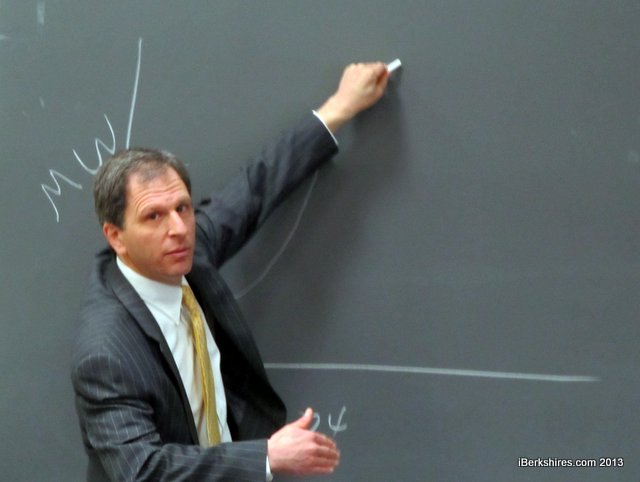
PITTSFIELD, Mass. — There is still plenty of "low-hanging fruit" the government can pursue to improve the its energy portfolio, according to state Department of Public Utilities Commissioner David Cash.
Cash was the guest speaker Thursday at an energy forum at Berkshire Community College, where he advocated for government officials to continue pushing for alternative energy. Massachusetts is "at the end of the pipeline," which inflates cost and is a factor in why businesses opt to open elsewhere, he said.
However, there are plenty of ways to lower those costs such as improving technology, investing in alternative energy and continuing to provide tax breaks to alternative energy companies.
"I am very hopeful that there will be steps in all of these area," Cash said. "I don't think we're even close to having plucked all of the low-hanging fruit."
While some could argue that the government should be staying out of the energy market, Cash believes that the state should be finding ways to bring out the most public good. The government should help companies develop and implement new technology to help keep $22 billion a year in the state.
"Each one of those dollars is a wasted economic opportunity," Cash said, explaining that 80 percent of the money spent on energy goes to Canada and the Middle East.
Investing in alternative energy would be a boost to the state's economy and lure more businesses because of low-energy costs. The state has unusually high because there is a short supply of energy options and usage is "peaky."
Power plants are built to handle peak capacity, which is about 4,000 megawatts more than typical usage and is seldom needed. But having to build the plants bigger adds to the cost. Further, on those peak days, the plants typically use inefficient ways to create the energy, adding to the cost.
"We all pay for power plants to be built," Cash said.
Alternative energy and the development of efficient energy storage would go a long way in helping to reduce the size of plants, he said. Technology such as smart meters, which would measure the grid and adjust usage in a household automatically, can also help eliminate those expensive peaks.
However, the startup cost for a company to integrate and develop new technology is high but the overall benefit long-term is great, he said, and thus the government should find ways to eliminate financial risk the companies would have to take. There is a lot of new technology that hasn't gone into the market yet which could reap benefits, he said.
"It's new technology so it is more expensive," he said.
The state has already taken steps toward energy independence with an array of funding options to help companies. Since 2008, the state has increased solar generation from 3 MW to more than 200 and wind projects have been popping up across the state. Massachusetts has won awards for being the most energy efficient — surpassing California.
Another bigger boon was changing the way utilities charge. Instead of charging for the energy used, the utility companies now charge for the service provided, which entices them to reduce the amount they generate, he said.
Cash also encourages greater diversity in the state's energy portfolio and while some may suggest that alternative energy investments should be made now because natural gas prices have decreased, Cash argues that now is the best time because the prices will certainly be going up soon.
Berkshire Community College and 1Berkshire sponsored the discussion.
Tags: alternative energy, energy costs, energy rates,