Volunteers preserve Harrison House legacyBy Bill Sample 12:00AM / Thursday, September 30, 2004
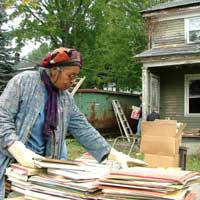
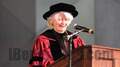
 | | Ruth Edmonds Hill, great granddaughter of the Rev. Samuel Harrison, sorts through contents of the historic Harrison House on Third Street during a clean-up effort in preparation for a scheduled historical architectural evaluation. Hill is the oral history | PITTSFIELD — Work began over the weekend on removing the contents of the house built in 1858 by the Rev. Samuel Harrison, a civil rights activist who became the chaplain of the Massachusetts 54th Infantry. The story of the 54th, a black infantry regiment that was formed in Massachusetts and sent south to fight against the Confederacy in the Civil War, was told in the movie “Glory.”

The clean-up effort was performed by members of the Pittsfield Historical Commission, Ward 3 City Councilor Linda Tyer, volunteers and the current owners of the property, Ruth and Hugh Hill of Boston. Ruth Edmonds Hill, the oral history librarian for Radcliff University in Cambridge, is the great granddaughter of Samuel Harrison.
Hugh Morgan Hill, better known as “Brother Blue,” is a professional storyteller who has performed around the world. He said that the project to preserve the Harrison House was profoundly moving to him.
“This event, these people getting together like this, has so much meaning,” he said. “This house, being saved and turned into a museum, will be here long after we are gone. It will tell the story of a remarkable man, a man who overcame long odds to become a voice for freedom and equality in a country that was being torn apart by slavery and injustice.”
Born into slavery in 1818, Samuel Harrison had first-hand knowledge of the misery and hardship imposed on his race by the incumbent powers that then ruled America. He risked personal injury and great adversity in his quest to obtain an education for himself and to speak out against the practice of slavery. After obtaining his freedom, he became an ordained minister of the Congregational church and ministered to congregations in several New England communities before moving to Pittsfield sometime about 1851.
Prior to the Civil War, Harrison was the pastor of the Second Congregational Church on Fenn Street. In 1852, he purchased a small plot of land on Third Street and by 1858 had managed to save and borrow enough money to construct the small house, which still stands there, for his growing family. When the Civil War broke out, Harrison was one of the voices appealing to the Massachusetts government to allow the formation of a black fighting unit that could take the battle against slavery into action.
Not only was the effort to form a black regiment successful, but also Harrison was tapped to be the chaplain of the unit due to his fervor and to the fact that he had helped recruit many area blacks into the regiment. History reveals that Berkshire County had a higher number of recruits join the 54th than many other areas of the state.
Once scheduled for demolition as an abandoned building in the city’s ongoing neighborhood revitalization efforts, the house was determined to be a significant “historical and archeological asset off the Commonwealth” in a letter to the city by the Massachusetts Historical Commission in October 2002. A group of local historians and city officials quickly organized a committee to preserve and protect the site, which is being reviewed for placement on the National Register of Historic Places.
“We will almost certainly be successful in getting the Harrison property placed on the National Historic Register,” said Tyer. “We are getting a lot of support for this project from the Massachusetts Historical Commission, who clearly recognizes its importance. We also have verbal agreements with the city of Pittsfield for some funding from the community development block grants, and we are forming a 501c3 nonprofit organization to administer fundraising efforts and to oversee the whole process.”
The work being done at the site this weekend was to clear the historical, vertical-plank construction house of debris and abandoned personal belongings, so archeological historian Neal Larson of Woodstock, N.Y., could examine the structure of the house and determine how to proceed with a preservation plan. Larson is preparing the extensive historical documentation needed to complete the application for placement on the National Register. Larson visited the site on Sunday and was given a tour by Ruth Hill, who lived in the house many years ago.
As many as 15 volunteer workers were responsible for clearing the contents of the house on Saturday and Sunday.
“We made great progress,” said Heather Eagan, a Pittsfield Historical Commission member who put on gloves and pitched in all weekend. “There is nothing significant left in the house. We have put everything into storage for the Hills to go through later.”
About noon on Saturday, Mary K. O’Brien, Central Berkshire register of deeds, arrived carrying a load of sandwiches and drinks for the volunteers to lunch on. The food was prepared by members of WHEN [Women Helping Empower Neighborhoods].
“We think this a great and important effort, and we are happy to support this kind of activity. It’s good for this neighborhood, and it’s good for the city of Pittsfield,” O’Brien said.
Many significant items were discovered while the volunteer workers were clearing it room by room on Saturday. One of the most important was the family Bible, dated 1862, which contained a family tree, written in Harrison’s own hand, recording births, deaths and marriages in the family between 1860 and 1900. Harrison moved back to Pittsfield after his duties as chaplain for the 54th Regiment came to an end. He once again became pastor of the Second Congregational Church and lived in Pittsfield until the time of his death in the year 1900. He is buried in Pittsfield Cemetery.
|