Domestic Violence Awareness Blooming
By Susan BushPrint Story | Email Story
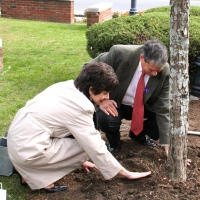
North Adams Mayor John Barrett III and Elizabeth Freeman Center Director Deborah Hemmer-Phillips planted tulip bulbs during an Oct. 20 Domestic Violence Awareness Month ceremony.
North Adams – Purple is more than a crayon color. It’s a color familiar to many domestic violence victims, who often find themselves concealing the purple-tinged bruises dappling their arms, their legs, their backs, or their faces. But if Mother Nature and a smattering of plant bulbs cooperate, purple-hued tulips will bloom at City Hall in the spring as a tribute to domestic violence victims, survivors, and as a reminder that community and personal involvement are necessary to stop domestic abuse. Elizabeth Freeman Center Director Deborah Hemmer-Phillips offered her thoughts about the tulips. “As they bloom and as they blossom, we need to remember the victims and survivors [of domestic violence],” Hemmer Phillips told a gathering of about 45 individuals affiliated with law enforcement and community service agencies and the Berkshire region justice system. “We need to not be bystanders; we need to have a voice.” Domestic Violence Awareness Month The bulbs were presented to city Mayor John Barrett III by Berkshire County District Attorney David Capeless and Hemmer-Phillips during a noontime ceremony held Oct. 20 at City Hall to commemorate October’s designation as Domestic Violence Awareness month. Most of those present at the ceremony wore purple ribbons meant to create awareness of domestic violence and its’ victims. Among those at the gathering were Berkshire Juvenile Court Justice Paul Perachi, state Rep. Denis Guyer D-Dalton and state Rep. Christopher Speranzo D-Pittsfield. The ceremony was sponsored by the Berkshire County District Attorney’s Office and the Freeman center. The Freeman center offers a multitude of services including emergency shelter to victims of domestic violence and sexual abuse. The center is located at 146 First St. in Pittsfield and operates satellite offices in communities including North Adams, Adams, and Great Barrington. Everybody's Problem Domestic violence is an ongoing and misunderstood problem, said Capeless during his remarks. The issue is not a “home problem,” he said. “It reflects and is caused by community problems,” he said, and identified substance abuse as a leading domestic violence factor. Domestic abuse is rooted in a violent struggle for control of one person by another, Capeless said. Children are the most vulnerable victims of domestic abuse and are frequently the subject of batterer threats, he said. Abuse is not always physical. While punching, choking, slapping, kicking, biting, and shoving are tactics of abuse, abusers may also make threats against the victim or those close to the victim, may threaten suicide as a control mechanism, withhold money or take a partner’s paycheck, attempt to humiliate the victim through derogatory remarks, and prevent the victim from visiting friends and family, keep friends and family away from the home, or stop the victim from going to work. Domestic violence impacts all age groups and occurs at all income levels. The Freeman center is a “focal point of intervention and prevention of domestic abuse and violence,” Capeless said. Area police departments and elected leaders such as Barrett have demonstrated a commitment to preventing domestic violence, Capeless said. Violence Against Women Act Barrett said that he was faced with the consequences and impacts of home violence during his years as a teacher. Communities must work together to prevent abuse, he said. “The best way to stop domestic violence is to be proactive, not reactive,” he said. Capeless reminded those in attendance that a federal Violence Against Women Act is presently being revised and reconsidered by the U.S. Congress, and he urged people to voice support for the legislation. The VAWA was passed in 1994 as part of a comprehensive legislation titled the “Violent Crime Control and Law Enforcement Act.” Provisions of the VAWA include grant funds for women’s shelters and a “Safe Streets for Women” initiative. The VAWA was reauthorized by Congress in 2000 and was set to expire on Sept. 30. On Sept. 28, members of the U.S. House of Representatives approved a Department of Justice reauthorization bill that contained several VAWA provisions with a 415-4 vote, and on Oct. 4, the U.S. Senate unanimously approved VAWA S. 1197. Both bills will be discussed and a final bill is expected to be drafted and ultimately called to a final vote. If a final bill is not approved, the act will no longer exist and the accompanying federal funding will evaporate. It Takes A Village Federal and state legislation protecting against domestic violence and funding protection programs is vital, and communities and individuals must join efforts to combat domestic violence, according to Capeless, Hemmer-Phillips, and Barrett. Neighbors should contact police if they believe a domestic violence incident is occurring. Community residents should voice their concerns about domestic abuse and support programs and initiatives designed to aid victims of abuse. The U.S. Department of Justice Violence Against Women office has prepared a Domestic Violence Against Women handbook that advises creating a safety plan for people facing an abusive relationship. While safety plan components may vary due to age, geographic location, available resources, and the presence of children, all plans can be based on certain factors, according to information contained in the handbook. Safety plans should include escape routes such as interior and exterior doors, first-floor windows, basement exits, and stairwells. Escape strategies should be practiced if possible. Plans should also include a self-designated “safe place,” such as a specific motel, shelter, or home of a trusted and supportive friend or relative. “Survival kits” should be packed with enough money for cab fare or vehicle fuel funds, a change of clothing, extra house and vehicle keys, birth certificates, passports if necessary, insurance information, copies of legal documents such as separation agreements or protective orders, valuables such as jewelry, and papers that offer proof of any jointly-owned assets. According to the handbook, a survival kit should be well concealed within the home or given to a trusted friend or relative for safekeeping. Papers of significant value may be kept in a bank safety deposit box. The handbook also recommends that escape plans include establishing an individual savings account. Bank statements should be mailed to the home of a friend or relative who is trustworthy, according to the guide. Individuals in abusive relationships should to try to avoid verbal or physical altercations in areas such as kitchens and garages, which may lack access to the outside and offer access to items that can easily become weapons, the handbook states. Let's Talk Simply wearing a purple ribbon can help battle domestic violence, Capeless said, and added that he hopes people will don the ribbons and launch conversations about domestic violence. Talking about the issue will raise awareness and generate education, Capeless said. He offered a three-word strategy that can help all victims of domestic abuse. “Spread the word,” he said. Information about the Elizabeth Freeman Center may be acquired by calling 413-499-2425 or by e-mail at a efcenter@vgernet.net address. The center operates sexual and domestic abuse hotlines 24 hours a day. The Central Berkshires hotline telephone number is 413-443-0089, the Northern Berkshire hotline number is 413-663-9709, and the Southern Berkshire hotline number is 413-528-2328. Susan Bush may be reached via e-mail at suebush@iberkshires.com or at 802-823-9367.
If you would like to contribute information on this article, contact us at info@iberkshires.com.

Former Harry's Supermarket Under Construction for Restaurant

By Brittany PolitoiBerkshires Staff

PITTSFIELD, Mass. — Construction is underway to transform the former Harry's Supermarket into a restaurant

Late last month, the Conservation Commission greenlit some tree pruning on the property. New windows and a new door can be seen in the front of the building. 

"It's a substantial renovation that's currently underway here," Brent White of White Engineering said, speaking on behalf of the applicant and owner, Huajie Zhu. 

A fire gutted the longtime Wahconah Street supermarket in 2023, and the following year, Zhu purchased the property for $460,000 two years ago to build a restaurant with hibachi in the existing footprint of the more than 100-year-old building. 

White explained that the project has been ongoing for over a year, and the Community Development Board granted the property a waiver to reduce the minimum required number of parking spaces so that additional spaces aren't needed.  

He noted that, looking at the site plan, there is very little room to do so. A mirror will be installed near the sharp turn on Bel Air Avenue to alleviate traffic concerns. 

Pruning will be done on trees in the southeast corner of the existing paved parking lot, as a number of branches are hanging over. The new owners also intend to patch, sealcoat, and re-stripe the parking lot. 

A fire tore through the building less than an hour after the supermarket closed for the day three years ago. An automatic sprinkler system is required for the new use. 

View Full Story

More Stories