| If you would like to contribute information on this article, contact us at info@iberkshires.com. |
Williamstown Board Opts to Negotiate with College on Water St. Lot
By Stephen DravisiBerkshires Staff
WILLIAMSTOWN, Mass. — The Select Board on Monday decided to enter into negotiations with Williams College on the sale of the vacant town-owned lot at 59 Water St.
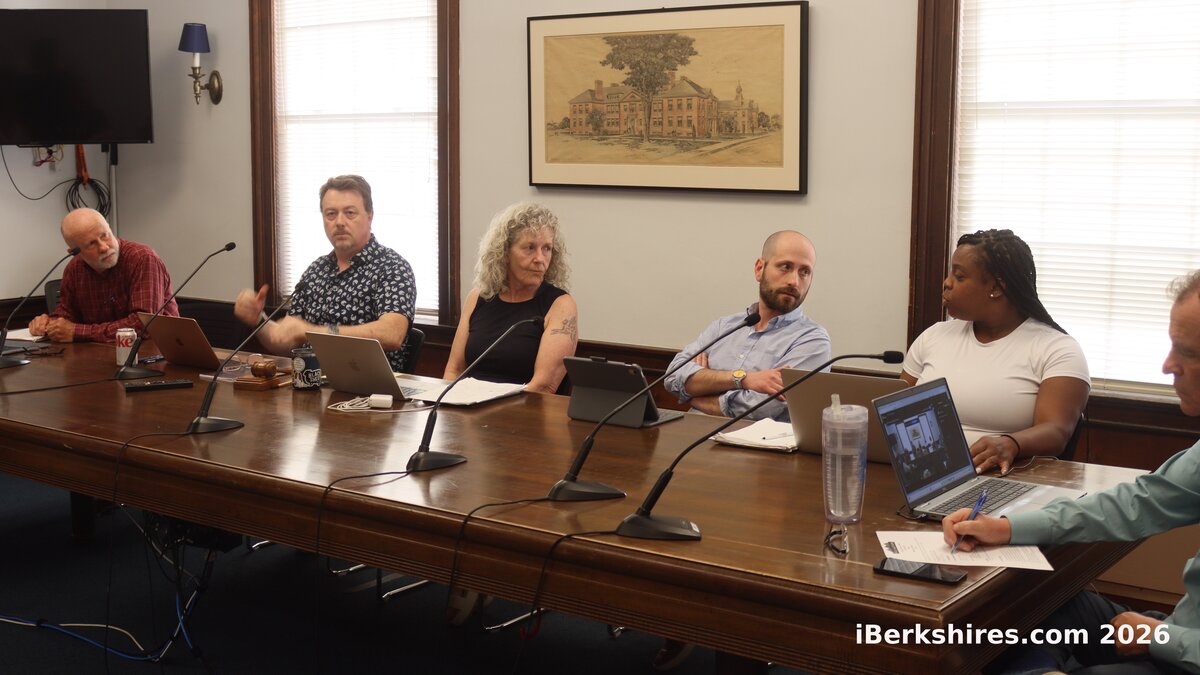
Newly elected board member Nate Budington, far left, participates in his first in-person meeting along with, from left, Matt Neely, Stephanie Boyd, Peter Beck, Shana Dixon and Town Manager Robert Menicocci.
But the board members made it clear that the college's proposal to acquire the lot is a starting point, not a final deal that the elected officials would accept.
"For the sake of continued conversation, I'm in favor of [awarding Williams the site], but if this process wasn't continued with the opportunity for further negotiation, I wouldn't vote to continue this," Peter Beck said. "I think that next step is necessary for us to get to a yes on this."
"I think there's wide agreement on that," Matthew Neely said just before the 5-0 vote to enter talks with the college.
Williams was the sole respondent to a town-issued request for proposals to develop the former town garage site, currently a dirt lot.
The college's stated intent is to build a new Facilities office and create up to 170 parking spaces at 59 Water Street. That use will allow the college to redevelop the current Facilities building site and parking lot as part of a reconception of the school's indoor athletic and recreation facilities.
Under the terms of the RFP, the college's proposal was subjected to review by an ad hoc advisory committee to the town manager, who brought the question to the Select Board. That board will have the final say on any purchase and sales agreement.
More Williamstown Stories
- New Williamstown Board Opts to Negotiate with College on Water St. Lot
- Williamstown Planning Board Narrowing in on Subdivision Bylaw Changes
- Williams Grads Told: Be Kind to 'What Is Strange Within You'
- Lenox Edges Hoosac Valley to Reach State Semi-Final
- Mount Greylock Regional Class of 2026 'Embraced the Unexpected'
- Durant Leads Drury Back to Final Four