State House News Service
BOSTON - It was a committee hearing that could only be described adequately as circuslike.
State lawmakers on Wednesday listened to descriptions of bleeding, screeching elephants mishandled by violent circus employees. Those claims were sharply disputed by Ringling Bros. executives, who insisted that elephants were treated with dignity and shared close bonds with their trainers.
Indeed, the testimony given to the joint Committee on Tourism, Arts and Cultural Development seemed to describe alternate universes of animal care.
The hearing featured a re-enacted beating with a bull hook – a device that animal protection advocates decry as a tool for abuse – incredulous lawmakers who queried Ringling officials about receiving mass e-mails and, from one Western Massachusetts resident, a prayer to God, despite protestations from the committee’s Senate Chairman Brian Joyce, D-Milton, that "We have a separation of church and state."
The matter at hand was a bill that could mean the end of elephant acts in the Bay State. The proposal (S 2002), filed by Sen. Robert Hedlund, R-Weymouth, would ban the use of bull hooks and the chaining of elephants, which Ringling officials say would effectively end all traveling shows in Massachusetts.
Ringling officials contend that when used properly, a bull hook – a long rod with a sharp, curved end – is simply an extension of a trainer’s arm, used to guide an elephant, not to harm it.
"We will not tolerate the misuse of any equipment," said Bruce Read, Ringling Bros. vice president for animal stewardship. "As leaders in elephant care, we believe the bill before you is both unnecessary and unjustified."
Asked by Rep. Brian Wallace, D-Boston, if the passage of the bill would be the end of Ringling Bros. presence in Massachusetts, one circus official said, "Unfortunately, yes."
"Animals are the No. 1 reason that people go to our shows," said Thomas Albert, vice president of government relations for Ringling Bros.
Circus Officials Deny Abuse
The Ringling executive said various zoos and venues, including ones exempted from Hedlund’s bill, opposed the measure, arguing that the bull hook is a humane and essential tool for raising elephants in captivity. They also said they were subject to routine, unannounced inspections by the U.S. Department of Agriculture, which had never uncovered any serious cases of abuse, let alone the widespread, systematic violence that the bill's proponents cited.
On the other hand, animal rights activists warned of elephants mutilated and even killed by aggressive trainers, mercilessly beating them as they writhed and shrieked.
"I quit Ringling in June of 2006 because the animal abuse I witnessed on a daily basis," said Archele Hundley, who cared for Ringling Bros.’ horses from April 2006 until she quit. "It upset me and it will haunt me for the rest of my life."
At one point, Hundley picked up a bull hook and, with permission from Joyce, demonstrated for the committee an incident she claimed to have witnessed in which a trainer speared an elephant's ear canal until it bled profusely.
"[Ringling's animal department] has a culture of it's own, and mainly it's made up of violence and domination," she said.
Hundley, an Oklahoma native setting up a business in West Virginia, disclosed that People for the Ethical Treatment of Animals had arranged and paid for her travel to the commonwealth, although she denied being an active member of any animal rights groups.
Hedlund, the bill's sponsor, opened the hearing by reassuring circusgoers that he did not intend to bar circuses from the state.
"If families understood what went on behind the scenes, there would be a different perspective about how animals are taught to do these kinds of tricks," he said. He also half-jokingly apologized to Wallace, who the News Service reported earlier had received more than 800 e-mails on the elephant issue.
Wallace and Rep. Ellen Story, D-Amherst, both questioned the volume and similarity of e-mails they received in opposition to the bill. Story prodded the Ringling executives until they admitted drafting the language of the e-mails, which they then sent to supporters.
Supporters and opponents also sparred over the practice of chaining elephants, animals that by nature rove long distances each day.
"Chaining severely restricts an elephant's fundamental movements such as walking and lying down," said Tracy Silverman, general counsel for the Washington D.C.-based Animal Welfare Institute. "The reality is that elephants in circuses and traveling shows are shackled [for most of the day]."
Ringling officials said chaining was most often done to ensure that all animals were fed appropriately.
"Tethering ensures that elephants respect each other's physical space," Reed said. "Dominant animals do take food from less dominant animals."
When one woman from Western Massachusetts recited a prayer and then attempted to play a violent image of an elephant being beaten in Texas on her PDA, committee members objected, with Joyce telling her to submit it separately as evidence.
Zoos, Big E Exempt
Versions of the elephant bill have come up in previous sessions. Rep. William "Smitty" Pignatelli, D-Lenox, who has been on the committee for those debates, questioned the wisdom of language in the current version that would exempt certain venues from the bull hook ban. The bill would not apply to "an institution accredited by the American Zoo and Aquarium Association, the Southwick's Zoo, the Forest Park Zoo (in Springfield), and the Big E in West Springfield."
The bill explicitly bans traveling shows from using, or even possessing, "any implement on an elephant that may reasonably result in harm to the elephant including, but not limited to, the damage, scarring or breakage of an elephant's skin." The bill would also ban chaining, except when there is a medical need. Violations would result in a $5,000 fine, a year in prison or both.
If you would like to contribute information on this article, contact us at info@iberkshires.com.
Your Comments
iBerkshires.com welcomes critical, respectful dialogue. Name-calling, personal attacks, libel, slander or foul language is not allowed. All comments are reviewed before posting and will be deleted or edited as necessary.
Bruce Read, Ringling spokesperson, knows first hand that bullhooks are used to inflict pain in elephants. Over the past five years, I have seen and videotaped Ringling elephant handlers routinely use bullhooks in order to cause the elephants fear and pain.
For Ringling to lie about this abuse is just absurd. It's on videotape. Ringling never ceases to amaze me when it comes to their blatant lies.
When people learn of the horrible conditions and treatment of the animals, most decide not to attend circuses with animals.
Female elephants do not naturally stand on their hind legs, spin in circles, skip, dance, wave, etc. These are behaviors they are forced to do -- forced through fear and violence.
I hope the MA legislators see past Ringling's lies and do what is best - be a leader when it comes to saying we don't want this type of violent business in our state.
All people who use elephants know that the bullhook is an aversive or negative stimulus. It is a weapon that is designed to inflict pain. If people who use elephants want to convince the general public and legislators that they don't inflict pain on elephants then they need to get rid of the bullhook and all aversive stimulae, including chains. It is important to remember that Ringling's owner Ken Feld and some of Ringling's elephant "trainers" have publically admitted that they don't consider hitting elephants abuse.
I noticed a bullhook (ankus)for sale on e-Bay this past week under World Famous Circus Bullhook. For anyone who is not familiar with a bullhook, I would imagine the pictures would give a pretty fair discription of this tool used in circuses and zoos. Considering it belonged to Gunther Gebel-Williams, he treated all animals, especially the elephants with dignity, love and respect.
Pat Cuviello has admitted publicly that he doesn't think aversives in dog training are abusive. What's the difference between aversives on elephants and aversives on dogs, Mr. Cuviello?
Late last month, the Conservation Commission greenlit some tree pruning on the property. New windows and a new door can be seen in the front of the building.
"It's a substantial renovation that's currently underway here," Brent White of White Engineering said, speaking on behalf of the applicant and owner, Huajie Zhu.
A fire gutted the longtime Wahconah Street supermarket in 2023, and the following year, Zhu purchased the property for $460,000 two years ago to build a restaurant with hibachi in the existing footprint of the more than 100-year-old building.
White explained that the project has been ongoing for over a year, and the Community Development Board granted the property a waiver to reduce the minimum required number of parking spaces so that additional spaces aren't needed.
He noted that, looking at the site plan, there is very little room to do so. A mirror will be installed near the sharp turn on Bel Air Avenue to alleviate traffic concerns.
Pruning will be done on trees in the southeast corner of the existing paved parking lot, as a number of branches are hanging over. The new owners also intend to patch, sealcoat, and re-stripe the parking lot.
A fire tore through the building less than an hour after the supermarket closed for the day three years ago. An automatic sprinkler system is required for the new use.
Cassidy Flynn scattered five hits in a complete-game effort in the circle as Lenox upset top-seeded Hoosac Valley, 3-2, in the quarter-finals of the Division 5 State Tournament. click for more
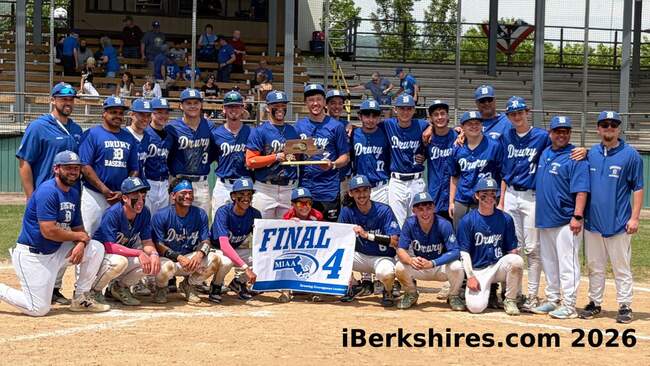
Brayden Durant struck out seven and walked one in a complete-game effort on the mound Saturday to pitch the Drury baseball team to a 6-0 win over Keefe Tech in the quarter-finals of the Division 5 State Tournament at Joe Wolfe Field. click for more
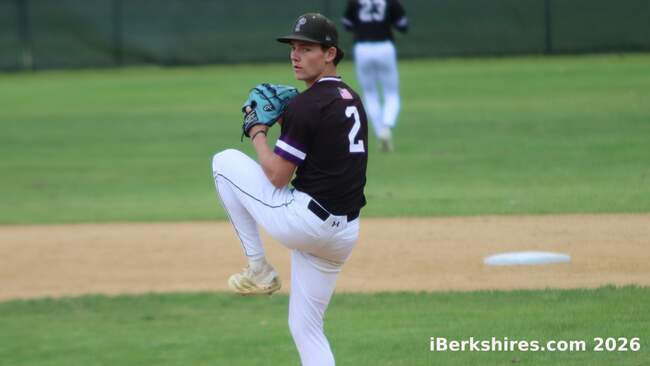
Jason Codey struck out 13, walked two and allowed just an infield single as the Generals earned a 7-1 win over Wahconah to claim their third straight regional title. click for more
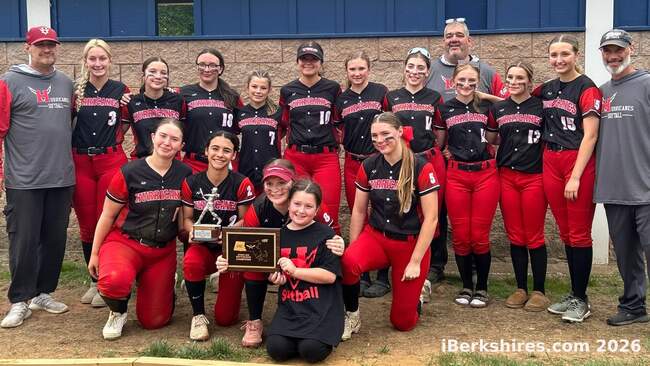
Gracelyn Wright struck out eight, and Genevieve Lagess went 3-for-5 with four runs batted in as the Hurricanes beat Monson, 17-3, to claim their first Western Mass title in four years. click for more
For the boys, Ward Bianchi helped lead the way with a win in the shot put and a second place in the javelin as the Mounties finished 16 points ahead of runner-up Pittsfield (pending the results of the pole vault, which were unavailable at 11 p.m. Friday night). click for more