Williamstown Zoning Board Looks at Weston Field Plan
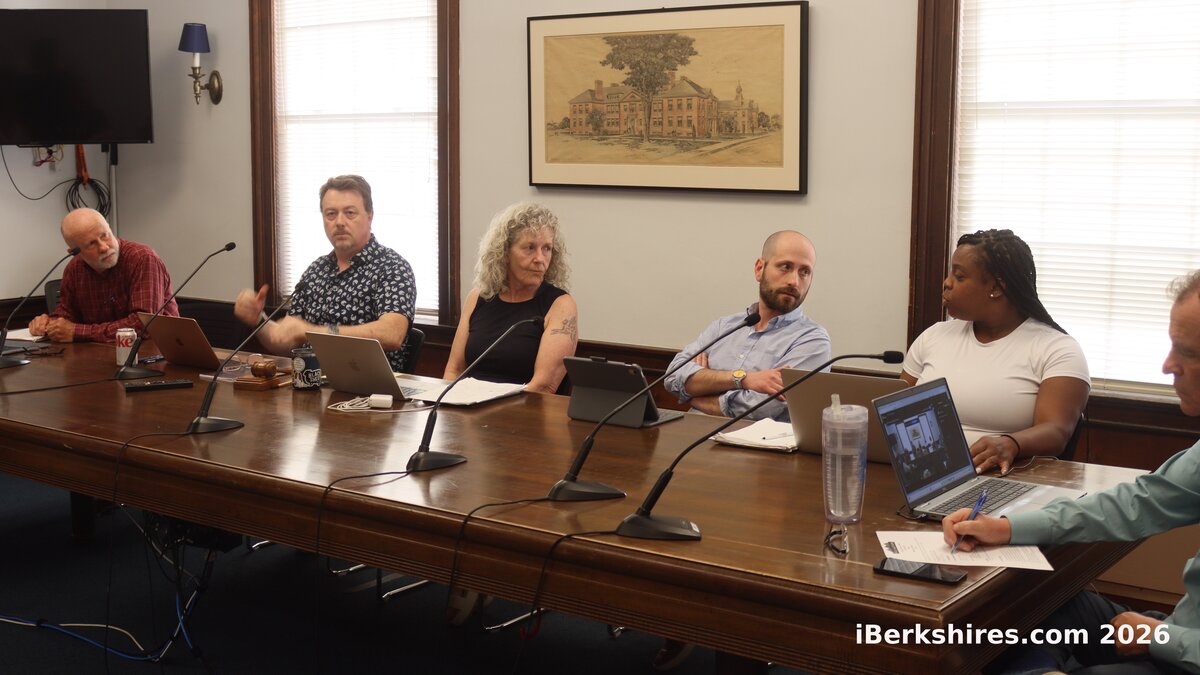
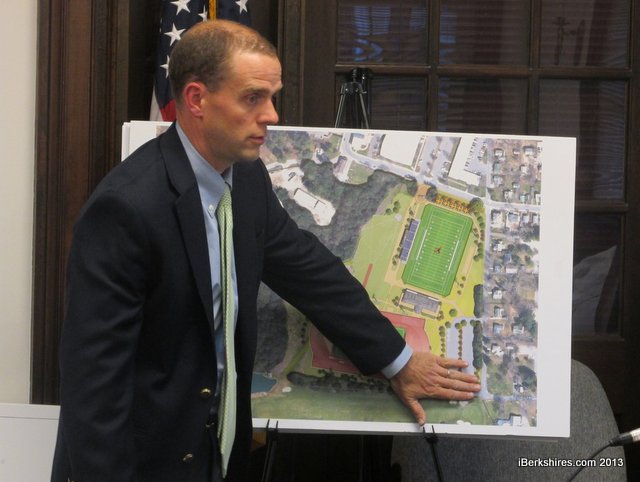 Williams College attorney Jamie Art explains proposed changes to Weston Field at Thursday's meeting of the Zoning Board of Appeals. Williams College attorney Jamie Art explains proposed changes to Weston Field at Thursday's meeting of the Zoning Board of Appeals. |
WILLIAMSTOWN, Mass. — The Zoning Board of Appeals on Thursday took its first look at Williams College's latest plans for Weston Field, and much of the discussion centered on lighting at the athletic complex.
The panel also briefly considered whether the newly configured Weston would have adequate parking in light of the impending loss of parking capacity in the downtown core but received assurances that the college is prepared to deal with large influxes of cars on football Saturdays.
The big issue was lighting.
"The football field will be a turf field, which means they're going to be practicing under lights," ZBA Chairman Andrew Hoar said. "When we put the lights on the existing (field hockey/lacrosse) turf field, I know we went through a whole lot of light studies. I think it was Musco then that came on site, and we tweaked the focus to avoid glare to residents near the field.
"Now, we're basically doubling what we're lighting. ... There is the potential of having all those lights on at the same time and at night.
"It concerns me that that's going to be the most significant impact."
College attorney Jamie Art assured the board that although the new plan calls for lights on two separate fields, the technology used to light athletic fields has improved since the college added Renzie Lamb Field in 2004.
"The lighting is two generations better than what's on the Lamb Field," Art said. "You'll see a little band of light from Spring Street, but it won't be a halo."
A representative from Musco Sports Lighting attended Thursday's meeting and discussed how improved optics help better direct light downward and avoid "spillover." The lighting firm also will attend the ZBA's planned June 13 site visit to Weston Field in advance of its next scheduled meeting on June 20, when it plans to continue the public hearing on the college's proposal.
The lights themselves will be mounted on towers that are 80-feet tall, Art said. That is equal to the poles currently used on Lamb Field and lower than what the ZBA approved for new lighting on the football field when the college was permitted for renovations at Weston five years ago.
Art outlined the history of the project, which was ready to go in 2008 before the college instituted a building moratorium after the global financial crisis hit. In the interim, the school re-evaluated its plans for the complex; five years ago, it was going to reorient the football field to run parallel to Lamb Field and build a grandstand/locker room building between them.
The new design calls for tearing up Lamb Field, moving the track from the football field to a new field hockey field at the south end of Weston, moving football slightly north and building two large structures: a grandstand for football and a "team support building" near the new field hockey/track facility. Lacrosse would be played on the football field, Art said Thursday.
"With the exception of the Gargoyle Gate, nothing stays the same," Hoar said, referring to Weston's ornate entrance off Latham Street.
As for the lighting issue, abutter David Horton of The Knolls told the ZBA that the college has been a good neighbor about limiting the impact of the Lamb Field lighting since it became operational eight years ago.
"I have to say one of the great things the college did is control the lighting by computer and turn it off at 9 o'clock," he said. "They've done a great job. I hope they will continue with the 9 o'clock turnoff of the lights from an economic standpoint and an academic standpoint.
"[Art] did mention that the new lighting is more downcast with less spillover. ... I presume that's going to be helpful to people."
Art said the college plans to continue its policy of a firm 9 p.m. shutoff for the lights at Weston, but he said Williams does plan to ask the town for an "act of God" exception to allow the occasional use of lights beyond the permitted hour.
"There have been a couple of times in the last five, six, seven years when the 9 p.m. shutoff has been a problem from the college's perspective," Art said. "It has to do with if a game starts and there's a rain delay or a team's bus has a flat tire (on the way to the game) or whatever — something beyond the college's control.
"It would make sense to have an 'act of God' clause ... so we don't ahve to send everyone three hours home because of a storm that makes it impossible to finish a game that was scheduled to end before 9 o'clock."
ZBA member Lawrence Wright asked Art how the college plans to deal with the loss of parking downtown if and when the town develops subsidized housing on a currently vacant town-owned lot on Water Street.
Last month when the Planning Board gave its blessing to the new Weston Field plan, Art and Julie Sniezek of engineering firm Guntlow & Associates told the planners that the new Weston will have a light net decrease in the number of parking spaces on college land, owing to a dramatic cut in the size of the tailgating area.
"It's almost 20 spaces more of 'improved,' meaning paved parking," Sniezek told the Planners on April 9. "But when you factor in the tailgating area, we're slightly shy of what's there now."
On Thursday, Wright pursued the issue.
 "For football games, the town garage site (59 Water St.) is jammed, as is the football field," Wright said. "What's going to happen when you lose 200 parking spaces for events? ... I'm worried that the neighborhood is going to be overrun with cars during an event."
Art replied by emphasizing the increase in the parking lot that serves both Taconic Golf Club and Weston Field and suggesting that visitors used to the short walk from 59 Water St. to Weston Field won't mind parking elsewhere.
"There are plenty of parking spaces on campus," he said. "We don't have a problem with too few parking spaces. If you ask me, personally, we have a problem with people's expectations of how far they should have to walk."
In other business on Thursday, the ZBA continued a public hearing on the petition for a special permit to operate a bed and breakfast at 61 Cobbleview Road.
Petitioner A. Carlos Correa agreed to the continuation in light of the fact that the ZBA had only four members available to hear his application. He attended Thursday's meeting and asked panel to specify its concerns about his petition so he can be prepared for the July 18 continuation of the hearing.
ZBA member Leigh Short, acting as chair of the hearing because Hoar recused himself, recommended that Correa talk with either Director of Inspection Services Michael Card or Town Planner Andrew Groff to discuss potential issues in advance of the July 18 meeting.
Tags: Weston Field, Williams College, ZBA,