The Organic movement has only grown in strength these past decades. As consumers and citizens are demanding organic produce because of its health and environmental benefits, they are also increasingly aware that the benefits of an organic landscape are the same as the benefits of an organic diet.
NOFA has responded to this demand by offering the Organic Lawn and Turf Course to educate municipal workers and land care professionals in New Haven, Connecticut on August 15 and Hanover, Massachusetts on August 17.
Links between synthetic chemicals and disease has many Americans rethinking what they choose to put into their bodies and into their environment. According to the Office of Attorney General in NY, “Pesticides can be absorbed through the skin, swallowed or inhaled. Adverse effects associated with common household pesticides include: birth defects, liver, kidney, and central nervous system damage, irritation of the skin, eyes, nose, throat, lungs and digestive systems.
Many pesticides are synthetic and do not easily decompose in nature. A range of pesticides — including some that have been banned from use in the United States for decades — is evident in the blood of most Americans, according to a July report on chemical exposures from the Centers for Disease Control and Prevention.
Due to this increased understanding, consumers are requesting non-toxic playgrounds, town parks and backyards. Many local governments have responded to this demand. States including Connecticut, and many towns and parks throughout the United States are passing laws banning the use of toxic chemicals on public properties.
However, "the demand for organic lawn care overwhelms the supply of landscapers who have the training and confidence to provide it. Many requests for help in maintaining municipal athletic turf organically go unanswered because there is such a shortage of professionals knowledgeable enough to provide this service." This is according to Sarah Little, a Massachusetts Pesticide Activist. “If people knew they could call a reliable organic lawn care service and get prompt, confident, and friendly service, thousands of customers would promptly switch to organic in our state."
Many landscapers don't know how to care for land without chemicals, sometimes due to misconceptions of organic land care. “A very common misconception is that organic land care just eliminates pesticides. Organic land care is really about ecologically sound management of the whole system,†commented Kimberly Stoner, Ph.D., chair of the NOFA Organic Land Care Program. “Experience has shown that organic land care methods work well and can be less expensive in the long run.â€
To help educate landscapers and municipal workers on caring for land organically, the NOFA Organic Land Care Program will offer the NOFA Organic Lawn & Turf Course on August 15, 2006 at the Wilbur Cross High School in New Haven, CT and on August 17th at the South Shore Vocational Technical High School in Hanover, MA. For more information, visit www.organiclandcare.net .
Founded in 2000, the NOFA Organic Land Care Program extends the vision and principles of organic agriculture to the care of the landscapes where most people carry out their daily lives. Currently there are 215 NOFA Accredited Organic Land Care Professionals working to protect their communities in nine different states.
CALENDAR LISTINGS:
The NOFA Organic Lawn & Turf Course will be held Tuesday, August 15th at the Wilbur Cross High School in New Haven, CT and on Thursday, August 17th at the South Shore Vocational Technical High School in Hanover, MA. This one-day intensive course trains landscape professionals to practice organic lawn and turf care (without the use of synthetic pesticides or soil amendments). It is recommended for landscapers, municipal employees and anyone wanting to learn specific methods of organic lawn and turf care. Visit www.organiclandcare.net to register online, or contact Bill Duesing (CT course) at 203-888-5146, bduesing@cs.com or Kathy Litchfield (MA course) at 978-724-0108, kathylitch29@yahoo.com .
The five-day NOFA Course in Organic Land Care will be held on January 9, 10, 11, 16 and 17, 2007 in Leominster, Massachusetts and on January 31, Feb. 1, 2, 5 and 6, 2007 in New Haven, CT. This 5-day intensive course trains and accredits professionals to practice organic land care (caring for land without the use of synthetic pesticides or soil amendments). It is recommended for landscapers, designers, municipal and parks employees, horticulturists, master gardeners and entrepreneurs. Visit www.organiclandcare.net to register online, or contact Kathy Litchfield (MA course) at 978-724-0108, kathylitch29@yahoo.com or Bill Duesing (CT course) at 203-888-5146, bduesing@cs.com .
If you would like to contribute information on this article, contact us at info@iberkshires.com.
Your Comments
iBerkshires.com welcomes critical, respectful dialogue. Name-calling, personal attacks, libel, slander or foul language is not allowed. All comments are reviewed before posting and will be deleted or edited as necessary.
No Comments
Lanesborough Town Meeting to Vote Budget, Bylaws & Vehicle Purchases
By Breanna SteeleiBerkshires Staff
LANESBOROUGH, Mass. — Tuesday's annual town meeting includes a $14 million operating budget, new short-term rentals, accessory dwelling units and sign bylaws, and free cash article appropriations.
Voters will gather at Lanesborough Elementary School on June 9 at 6 p.m. to decide on 20 warrant articles.
The fiscal 2027 budget is up a little over 10 percent. Some of the main increases are the Mount Greylock Regional School District and McCann Technical School: the McCann assessment is up more than 30 percent based on factors including enrollment and the school renovation project, and Mount Greylock's is up 11 percent.
Article 11 is for the town to vote to approve from free cash the sum of $16,298.48 for the McCann Technical School roof and window replacement project so as not to impact the budget. Article 3 is appropriate $7,586,284 for Mount Greylock Regional School assessment.
Another notable increase was in life and health insurance, showing an increase of about 26 percent.
Ambulance Director Jen Weber is planning 24-hour coverage, which means more staff and a hike in her budget. One of the articles asks the town to appropriate $234,100 to operate the Ambulance Enterprise Fund for salaries and expenses.
Many town departments are looking for new vehicles. The Fire Department is looking to replace its outdated 1996 fire engine. There are two articles related to the truck at a total of $813,366. Article 12 would transfer $225,000 from free cash into the Fire Truck Stabilization Fund; Article 13 would transfer $605,000 from the fund and authorize the borrowing of $208,366.08.
The total includes a $100,000 contingency cost to cover any additional costs if a 2026 model-year chassis cannot be secured before new emissions standards go into effect in 2027.
The board at its last meeting moved the $225,000 transfer to come before the borrowing article, changing the stabilization number. If the $225,000 is not voted on, then they will amend the next article's number on the floor, subtracting the $225,000. This shows the borrowing number significantly lower.
Article 17 asks for the transfer of $80,000 from free cash to replace a police cruiser.
Police Chief Rob Derksen's aim is to replace one vehicle every other year, meaning the oldest vehicle gets replaced about every 10 years.
He stressed that if delayed this year, the town may have to double up in a future year to get back on schedule, and that paying later usually costs more. The article will ask for $80,000 from free cash, the vehicles used to be funded by the BHRD.
Lastly, the Highway Department is looking to replace a 2014 International dump truck that will be a total of $330,000 and will take two to three years to receive.
Money will be used from last year's approval of $250,000 from free cash for the replacement of a 2012 highway front-end loader that was underspent $49,261. Town meeting is being asked to approve a transfer of $53,274.85 from free cash and the use of $227,464 from funds from the Sale of Town Real Estate to fund the balance.
Other free cash proposals include $1,200 to purchase software to support tracking and ongoing maintenance schedules of town-owned vehicles; $42,000 for the replacement of the Highway Department's storage shed roof, $200,000 to reduce the tax levy.
Cassidy Flynn scattered five hits in a complete-game effort in the circle as Lenox upset top-seeded Hoosac Valley, 3-2, in the quarter-finals of the Division 5 State Tournament. click for more
Brayden Durant struck out seven and walked one in a complete-game effort on the mound Saturday to pitch the Drury baseball team to a 6-0 win over Keefe Tech in the quarter-finals of the Division 5 State Tournament at Joe Wolfe Field. click for more
Jason Codey struck out 13, walked two and allowed just an infield single as the Generals earned a 7-1 win over Wahconah to claim their third straight regional title. click for more
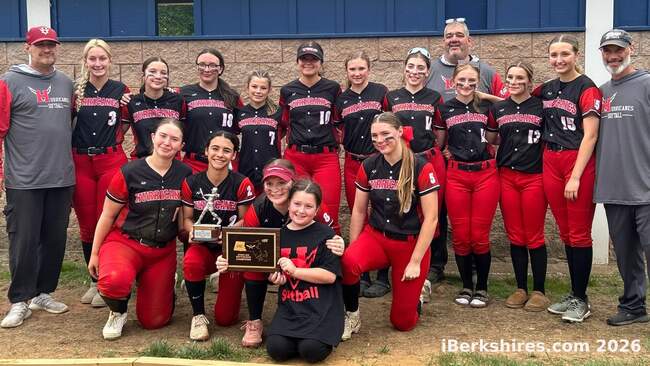
Gracelyn Wright struck out eight, and Genevieve Lagess went 3-for-5 with four runs batted in as the Hurricanes beat Monson, 17-3, to claim their first Western Mass title in four years. click for more
For the boys, Ward Bianchi helped lead the way with a win in the shot put and a second place in the javelin as the Mounties finished 16 points ahead of runner-up Pittsfield (pending the results of the pole vault, which were unavailable at 11 p.m. Friday night). click for more