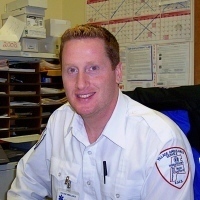
Shawn Godfrey is a certified paramedic and the operations manager for the Village Ambulance Service Inc. in Williamstown.
Bart’s Story
It started as an average day, but unfortunately ended in tragedy. The New Brighton (Minn.) Fire Department was dispatched to a “house fire with flames showing.†The normal anxiety associated with the familiar tone of their fire pager was quickly heightened by the news that followed: the house on fire was owned by a fellow firefighter on the department.
The fire trucks roared out of the station with sirens blaring and lights flashing. They quickly arrived on the scene to find the structure engulfed in flames, black smoke bellowing from the windows and doors. The heat emanating made it almost impossible to get close to the burning edifice.
As the heroic firefighters were battling the flames, they came across Bart, a 13-year-old German shorthaired pointer. He had suffered extensive smoke inhalation and was unresponsive. He was quickly but gently removed from the smoke-filled residence and placed out of harm's way. At the time, the firefighters did not have the knowledge or equipment available to help animals in distress. Despite strong determination and admirable resuscitative attempts, they were unable to revive Bart.
Like many emergency providers, firefighters live beyond their job descriptions. Firefighters have a fierce drive and long history of helping people and saving lives, all lives. Because of this will, the entire fire department was devastated by this tragedy, feeling helpless to assist one of their own.
BART’s Story
Bart the dog died that day, but the Minnesota-based Basic Animal Rescue Training program, aptly named BART, was born to honor his memory and to ensure fewer families will suffer a similar loss.
Through the pioneering efforts of Minnesota native Dr. Janet Olson, a veterinarian, the BART course was designed to provide firefighters, law enforcement, and emergency medical services personnel not only the first responder-type skills necessary to provide basic medical care, basic life support resuscitation and animal rescue techniques, but also the animal-specific equipment necessary to accomplish it.
What Does BART Offer?
The BART program is a two-hour course beginning with a 30-minute orientation and awareness lecture that builds a bridge between the emergency responder and veterinary communities. The majority of the course time is devoted to hands-on training, with the fire/EMS providers rotating through three stations: pet restraint and handling, patient assessment/first aid and pet cardiopulmonary resuscitation.
Station 1 teaches how to appropriately approach, handle and transport dogs and cats, as well as other household pets, safely out of dangerous emergency situations (i.e., house fires) in which other secondary animal-response teams would not be permitted.
In addition, students learn how to safely move or restrain pets so that they do not interfere with efforts to assist or rescue humans.
Station 2 teaches the normal vital-sign parameters for dogs and cats, how to triage (determine how injured or ill) and assess these pets and how to supply on-the-scene medical care, including oxygen administration and bandaging. The local veterinary resources for the community are also reviewed and discussed.
At station 3, CPR on dogs and cats is taught.
Classes are taught by four to six volunteer veterinarians, certified veterinary technicians and veterinary students. The volunteer trainers bring their own dogs and cats to assist in teaching the restraint and vital signs/first aid stations. CPR is demonstrated with a state-of-the-art dog mannequin.
In addition to the training, the departments receive a BART emergency medical kit that contains all the materials and supplies demonstrated in the course, including oxygen face masks, bandages and rescuer protective gear. The kit is designed to support the medical needs of animals until they can be transferred to a veterinary facility for more advanced and intensive care.
The number of kits a department needs is decided by how many emergency vehicles are deployed. The goal is to ensure that a BART kit goes on each call the department responds to, so that after training, the BART equipment is always available to the emergency responders. All kits have been offered to departments free of charge. Small animal kits cost BART approximately $600 each.
Loyalty
Bart’s story shows how firefighters and EMS providers may encounter animals during emergencies. The BART program, along with similar programs across the country, like the United Animal Nations’ Emergency Animal Rescue Service (EARS) program, teaches rescuers how to help these four-legged loved ones, while maintaining their own safety.
Just like family, the public wants their animals to be respected and cared for in emergencies, as was seen following the Gulf Coast hurricanes of 2005. During recounts of the rescue efforts, many emergency personnel spoke of not knowing what to do when faced with injured or endangered animals. Many people chose to stay behind when their pets were not allowed to be evacuated. Sadly, some of those individuals lost their lives as a result of their loyalty.
Federal Involvement
As a result of the many stray animals left behind during the Gulf Coast hurricanes, a U.S. Senate bill titled Pets Evacuation and Transportation Standards Act was introduced on April 5, 2006. This legislation passed both the House and Senate and was signed into law in October 2006. The PETS Act requires local and state disaster plans to include provisions for household pets and service animals. Because of this, many animal rescue programs have added an equine and livestock program to enable the rescue and care of larger animals.
Community Involvement
Many programs, like BART and EARS, also offer training designed for Community Emergency Response Teams (CERT) and other community level responders who do not have the medical training and resources (for example, the ability to provide oxygen support) that the Fire/EMS responders have.
In some areas, fire and EMS departments are now mandating animal rescue training for all of their members, while encouraging them to volunteer for local animal rescue programs as well.
Local Involvement
Presently, there is no fire- or EMS-managed animal rescue program in Berkshire County. However, there are reported cases where animals have been either medically supported or successfully resuscitated by local emergency responders using equipment designed for human beings (i.e., oxygen administration devices, CPR).
As the pet population increases, the need for animal rescue education inherently rises as well. Although the BART program primarily provides animal rescue education and training to Minnesota and its surrounding communities, we can only hope all communities will eventually catch on and institute a program like BART.
No pet owner wants to feel the pain of losing a vital part of the family, especially when there are things that can be done to prevent it. I am sure Bart would be proud.
For more information on how you can help with a local animal rescue program, please contact Shawn Godfrey at shawng0@yahoo.com.
If you would like to contribute information on this article, contact us at info@iberkshires.com.
Your Comments
iBerkshires.com welcomes critical, respectful dialogue. Name-calling, personal attacks, libel, slander or foul language is not allowed. All comments are reviewed before posting and will be deleted or edited as necessary.
Those of us who are pet owners often consider our animals as family members. What a great idea to have specific emergency training to assist animals. Kudos to all our rescue workers who take the steps to learn how to treat our four legged companions in emergency situations. Good job, Shawn. Can we get that kitten?? ;)
how sad.....it always makes me sad to hear about the loss of pets due to fires....they have no clue how to get out or how to crawl under smoke, etc. They depend on us to keep them safe.....
Lanesborough Town Meeting to Vote Budget, Bylaws & Vehicle Purchases
By Breanna SteeleiBerkshires Staff
LANESBOROUGH, Mass. — Tuesday's annual town meeting includes a $14 million operating budget, new short-term rentals, accessory dwelling units and sign bylaws, and free cash article appropriations.
Voters will gather at Lanesborough Elementary School on June 9 at 6 p.m. to decide on 20 warrant articles.
The fiscal 2027 budget is up a little over 10 percent. Some of the main increases are the Mount Greylock Regional School District and McCann Technical School: the McCann assessment is up more than 30 percent based on factors including enrollment and the school renovation project, and Mount Greylock's is up 11 percent.
Article 11 is for the town to vote to approve from free cash the sum of $16,298.48 for the McCann Technical School roof and window replacement project so as not to impact the budget. Article 3 is appropriate $7,586,284 for Mount Greylock Regional School assessment.
Another notable increase was in life and health insurance, showing an increase of about 26 percent.
Ambulance Director Jen Weber is planning 24-hour coverage, which means more staff and a hike in her budget. One of the articles asks the town to appropriate $234,100 to operate the Ambulance Enterprise Fund for salaries and expenses.
Many town departments are looking for new vehicles. The Fire Department is looking to replace its outdated 1996 fire engine. There are two articles related to the truck at a total of $813,366. Article 12 would transfer $225,000 from free cash into the Fire Truck Stabilization Fund; Article 13 would transfer $605,000 from the fund and authorize the borrowing of $208,366.08.
The total includes a $100,000 contingency cost to cover any additional costs if a 2026 model-year chassis cannot be secured before new emissions standards go into effect in 2027.
The board at its last meeting moved the $225,000 transfer to come before the borrowing article, changing the stabilization number. If the $225,000 is not voted on, then they will amend the next article's number on the floor, subtracting the $225,000. This shows the borrowing number significantly lower.
Article 17 asks for the transfer of $80,000 from free cash to replace a police cruiser.
Police Chief Rob Derksen's aim is to replace one vehicle every other year, meaning the oldest vehicle gets replaced about every 10 years.
He stressed that if delayed this year, the town may have to double up in a future year to get back on schedule, and that paying later usually costs more. The article will ask for $80,000 from free cash, the vehicles used to be funded by the BHRD.
Lastly, the Highway Department is looking to replace a 2014 International dump truck that will be a total of $330,000 and will take two to three years to receive.
Money will be used from last year's approval of $250,000 from free cash for the replacement of a 2012 highway front-end loader that was underspent $49,261. Town meeting is being asked to approve a transfer of $53,274.85 from free cash and the use of $227,464 from funds from the Sale of Town Real Estate to fund the balance.
Other free cash proposals include $1,200 to purchase software to support tracking and ongoing maintenance schedules of town-owned vehicles; $42,000 for the replacement of the Highway Department's storage shed roof, $200,000 to reduce the tax levy.
Cassidy Flynn scattered five hits in a complete-game effort in the circle as Lenox upset top-seeded Hoosac Valley, 3-2, in the quarter-finals of the Division 5 State Tournament. click for more
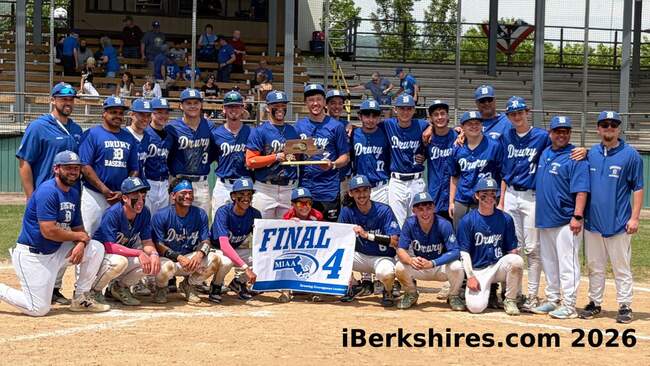
Brayden Durant struck out seven and walked one in a complete-game effort on the mound Saturday to pitch the Drury baseball team to a 6-0 win over Keefe Tech in the quarter-finals of the Division 5 State Tournament at Joe Wolfe Field. click for more
Jason Codey struck out 13, walked two and allowed just an infield single as the Generals earned a 7-1 win over Wahconah to claim their third straight regional title. click for more
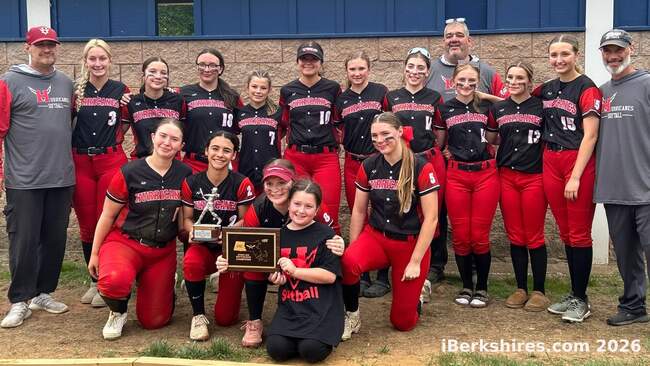
Gracelyn Wright struck out eight, and Genevieve Lagess went 3-for-5 with four runs batted in as the Hurricanes beat Monson, 17-3, to claim their first Western Mass title in four years. click for more
For the boys, Ward Bianchi helped lead the way with a win in the shot put and a second place in the javelin as the Mounties finished 16 points ahead of runner-up Pittsfield (pending the results of the pole vault, which were unavailable at 11 p.m. Friday night). click for more