Williams College Hosts Burma ProtestsBy Jen Thomas 04:00PM / Saturday, October 06, 2007
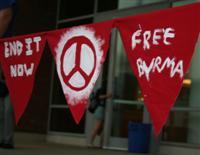
 | | Hand-painted prayer flags line the railings at the Paresky Student Center Friday night. | WILLIAMSTOWN - A small group of impassioned students gathered on the front steps of the Paresky Student Center at Williams College on Friday night, painting prayer flags, holding a candlelight vigil and leading a silent march down bustling Spring Street in support of protestors in Burma.

What they lacked in numbers, they more than made up for in spirit.
"We want to facilitate change," said sophomore Anthony Coleman, 19.
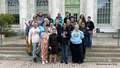
Marching to recognize hundreds of students, monks and protestors massacred in the so-called Burmese "Saffron Revolution," students from Williams' "Students for Social Justice" group led about 50 red-clad attendees through the streets. Red is used in honor of the saffron robes worn by Southeast Asian monks.
The event's organizer, Hnin W. Hnin, who was born in Burma, could not attend the rally but she released a statement opposing the continued violence in Burma.
"We are here to remember the countless monks and peaceful protestors who have been imprisoned, tortured or killed by the military government of Burma. This government does not respect the human rights or civil liberties of Burma's people. It continues to violently suppress the people's call for freedom and democracy while cutting off the media's access to the true extent of its cruelty and crimes," said Hnin.
The Williams College march comes the day before dozens of global protests are planned to urge the United Nations Security Council to address the crisis in Burma. Supported by the supported by the Burma Campaign, Amnesty International, Human Rights Watch, the International Trade Union Confederation, the International Federation for Human Rights (FIDH), Avaaz, the U.S. Campaign for Burma and hundreds of other groups, thousands of protestors intend to stand up for the Burmese who cannot speak for themselves.
"[The government] wishes the world to forget Burma, as much of it has for the last two decades. However, we, Students for Social Justice, and allies hope to make the use of our free voices to stand for those who have fallen. We stand here together in solidarity with Burma's movement for freedom…We want it to be known that when Burma sought out help to take down its oppressive government, we did something," said Hnin.
 Rev. Carrie Bail and students march through the streets in silent protest. | The sudden burst of nonviolent protests in Burma is the largest since the student-led democracy rallies in 1988. At the helm are Buddhist monks who have increased their visibility following a decision by the ruling military regime to hike up fuel costs. The monks have been joined by thousands of ordinary protestors, who are calling for the release of all political prisoners and that the junta engage in talks with opposition leaders, including Nobel laureate Aung San Suu Kyi.
Reports came two weeks ago that several monks had been killed during protests, conjuring up memories of the thousands put down by the junta in 1988. More recent reports indicate that thousands have been arrested and as many as 200 people could have been beaten to death by the military.
Organizers chalked up the low attendance at their own event to the long Columbus Day weekend and a lack of knowledge about the events in Burma.
"On our campus, there's a real lack of activism, a general apathy. This is our small way to try and change that. We want to show other people that we care about more than just ourselves and our 'purple bubble,'" said Coleman.
Rev. Carrie Bail, of the First Congregational Church, headed the line of students and applauded the Students for Social Justice group for taking a stand.
"This needs to be done. The only way for everything to change in Burma is to have world recognition," said Bail.
A scheduled talk by John Win, a Burmese activist who was imprisoned for five years, was cancelled when he failed to appear, but Williams Chaplain Richard E. Spaulding engaged the small contingent with a rousing speech about the importance of student activism.
"In this place that often flows with life and excitement and joy, we set aside a moment to consider what the world looks like from the point of view of people who, like us, are only trying to learn and ask the questions that move most deeply in their hearts and consciousnesses, questions about justice. Our faith and justice can set us free," Spaulding said.
|