A Green Invasion: Alien Species Pushing Out Natives
By Linda CarmanPrint Story | Email Story
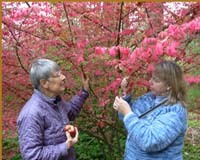
Leslie Reed-Evans and Pamela Weatherbee check a burning bush at Field Farm
Special to iBerkshires WILLIAMSTOWN - The brilliant magenta flowers that glow with almost neon intensity across wetlands may be a gorgeous color, but that beautiful purple loosestrife pushes out less-aggressive native plants, spreads rapidly and takes over the neighborhood. As a guest, it has atrocious manners. It is one of the species known as invasive. The flowering plant was first brought to North America as a garden flower. It spreads rapidly and can negatively effect native plant communities. A "Lose the Loosestrife" workday will be held at Field Farm on Sloan Road in South Williamstown on Sunday, Oct. 14, from 1:30 to 3:30 p.m. Participants should meet in the farm parking area just off the road. Volunteers will be digging up loosestrife to remove it from areas of Field Farm where it has been increasing in the last few years. Volunteers should bring gloves and wear appropriate clothing. Tools will be provided. Field Farm is a property of The Trustees of Reservations, a statewide land conservation trust that preserves, for public use and enjoyment, properties of exceptional scenic, historic and ecological value in Massachusetts. For more information or directions, call Field Farm at 458-3135. Although purple loosestrife may be among the most visible and recognizable, it and its habits are among an ever-increasing list of invasive plants. These flora leave any checks or predators behind in their native habitat and can quickly change the composition of an area’s plant population, and of the creatures that live there. Besides purple loosestrife, or Lythrum salicaria, these invasives include a large cast of characters, some all too familiar: Japanese barberry, whose spikes retaliate against the hand raised against it; bush honeysuckles, which shoulder other plants aside, the disarmingly pretty white-edged Bishop’s goutweed and round scalloped-leaved garlic-mustard. In spring, white-, pink- and purple-flowered Dame's Rocket does a passable imitation of phlox, although the blooming schedule is off by months. And now, in fall, the scarlet beacon of the aptly named burning bush, or winged Euonymus, blazes throughout the landscape. Long favored for its brilliance as an accent in landscaping, its importation into Massachusetts was banned as of July 1, 2006, and its propagation and or sale will be prohibited as of Jan. 1, 2009. Anyone observing its habits along with its bright foliage can see why. Underneath its spreading branches can be found literally hundreds of suckers, little offspring. And because its orangish red fruits are magnets for birds, the seeds are spread into natural areas, threatening habitats in upland forests, river edges and floodplains and elsewhere. Its dense thickets shade and crowd out many other plant species. And multiflora rose, once encouraged by the U.S. Department of Agriculture as a living fence, also forms dense thickets, pushing aside other plants and taking over abandoned pastures. Its seeds, distributed by the birds that eat them, can remain viable in the soil for up to 20 years. Another plant of Asian origin is kudzu, found thankfully in only a few coastal sites in Massachusetts. Encouraged for its erosion-control ability, it has proceeded to nearly engulf the U.S. southeast, growing at up to a foot a day. Its 400-pound tubers growing nearly 9-feet long below ground give it the unchallenged title of the Godzilla of invasives. Earlier this week, Williamstown Rural Lands Foundation Executive Director Leslie Reed-Evans and naturalist Pamela Weatherbee walked along a trail at Field Farm, where the invasives have thrived. Reed-Evans said students at the organization's headquarters at Sheep Hill dug up 32 loosestrife plants earlier this year. Weatherbee, one of the authors of the 1999 guide to invasive plants published by the state's division of Fisheries and Wildlife's Natural Heritage and Endangered Species Program, said invasives thrive because "they don't have that many pests" to keep them in check. If the birds and other creatures that live on the displaced native species lose their habitat and sustenance, the ecology changes. "Invasives form a monoculture, and when there's no diversity in plants, there's no diversity in butterflies and birds," she said. According to the guide, the best way to limit the spread of invasive species is to, in effect, head them off at the pass. "The best method for control is prevention," the guide advises. "Preventing intentional spread through horticulture, and removing or killing invasive plants when they are first spotted, can avoid significant problems later on." And property owners should keep on the lookout for invaders. Gardeners and landscapers are advised to choose non-invasive alternatives to plant. Gerard St. Hilaire, owner of Countryside Landscape, said if a client wants a certain plant for, say, erosion control, "we give them the heads up that it's an invasive species and suggest an alternative." The state's designation of plants such as burning bush as invasive, "really helps us out," St. Hilaire said. "We just didn't stock it." About 75 percent of Countryside's clients use an organic herbicide called Burnout, a mixture of citric acid and oil, he said. Roundup is also used. There's physical removal - digging it up - and "a lot is done with out machinery," he said. To address any plants in a wetland - or the 100-foot buffer zone - requires permission from the town's Conservation Commission. Herbicide application in a wetland requires that the applicator be certified. "What's critical is to get (the plants) before they go to seed. You want to get it before the birds can spread it." Websites provide a fund of information. To consult on herbicides, go to www.mass.gov/agr/pesticides. Information on species is available at http://invasives.eeb.uconn.edu/ipane. Other resources include www.mass.gov/masswildlife or its Natural Heritage and Endangered Species Program at www.nhesp.org; the Nature Conservancy at www.tnc.org; the Massachusetts Nursery and Landscape Association at www.mnla.com, plus local garden clubs and other environmental and agricultural organizations. Since education is central, spread the word, not the seeds. Robert H. Mohlenbrock @ USDA-NRCS PLANTS Database/USDA SCS. 1989. Midwest wetland flora: Field office illustrated guide to plant species. Midwest National Technical Center, Lincoln.
If you would like to contribute information on this article, contact us at info@iberkshires.com.

SteepleCats Shut Out on Road

iBerkshires.com Sports
MONTPELIER, Vt. -- Four Vermont pitchers combined to strike out 11 and allow four hits Tuesday as the Mountaineers beat the North Adams SteepleCats, 11-0, in New England Collegiate Baseball League action.
 
Evan Meier, Bobby Stang, Tonny Woodie and Chris Diaz each had a hit for the SteepleCats, who used five pitchers in the loss.
 
North Adams (0-2) comes home Tuesday to host the Mystic Schooners at 6:30 p.m. at Joe Wolfe Field.
View Full Story

More North Adams Stories