State House News Service
BOSTON - Patrick administration officials said Wednesday that the state would be ready to counter a casino-related increase in gambling addiction with increased funding and regulation.
But gambling experts and former gamblers, brought in by skeptical House leaders, questioned that contention and rebutted some of the figures Patrick officials cited in urging support for Gov. Deval Patrick’s plan to bring three casinos to the Bay State.
"What they're talking about is better than what has been proposed in the past," said Michael Furstenburg, a Cambridge psychotherapist who specializes in gambling addictions, pointing to the 2.5 percent of gross gambling revenues officials said would be set aside for a "Public Health Trust Fund." But, he added, "It's a sop to the problem."
Calling their plan the "most aggressive" in the country, administration officials questioned some of the research now circulating about gambling. They said little of it is conclusive, even as gambling expands nationwide.
"It's a complex set of variables to determine who becomes addicted and who doesn't," said Michael Botticelli, director of the Bureau of Substance Abuse Services at the state Department of Public Health.
By way of comparison, studies over the past few decades have shown that not everyone who is exposed to heroin becomes a heroin addict, according to Health and Human Services Secretary JudyAnn Bigby. Bigby said lifetime prevalence rates for disordered or pathological gambling are at about 1.9 percent of the U.S. adult population.
"It is far too easy to gravitate to the anecdotal and sensational," Botticelli said. "Most Americans are non-problem gamblers."
Some experts said those numbers are higher based on what they're seeing, and represent the far end of the pathological gambling spectrum. The number is closer to 6 percent overall, they say.
"This is very much a hidden disease," said Steven J., a reformed gambling addict who declined to give his last name. "I honestly believe the numbers are lower than they actually are."
He was introduced to Gamblers Anonymous when he was 33 years old, living at home with his mother and owing her $100,000. Now, the Mansfield resident is 45, married and owns a house, with a 401(k) and saving for his daughter's college fund. He volunteers for the Massachusetts Council on Compulsive Gambling, a private non-profit agency.
In their testimony to the special hearing of the Joint Committees on Economic Development and Mental Health and Substance Abuse, Patrick administration officials largely focused on the governor's bill. They and others say that proposal will generate about 20,000 jobs, on top of 30,000 construction jobs, along with revenue that has been lost to other states, like Connecticut, that already have expanded gambling.
Rep. Ruth Balser, D-Newton, a casino critic who co-hosted the informational hearing as House chairman of the Joint Committee on Mental Health and Substance Abuse, noted that there is seemingly a higher rate of suicide linked to gambling.
Patrick administration officials said the state would focus on individuals with mental health and addiction disorders. The gaming authority that would be established under Patrick's plan would also have the ability to regulate marketing in order to ensure it doesn't target minors, and will be able to review public complaints, according to Public Health Commissioner John Auerbach.
Auerbach added that all casino applicants must promise to provide free space for counseling services on-site and intervene when customers exhibit signs of gambling addiction. A central "do-not-call" list will also be set up, and the casinos will have to provide demographic information on their customers, he said.
House Speaker Salvatore DiMasi has already declared that Patrick's bill won't receive a public hearing until sometime next year.
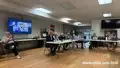
A longtime gambling opponent, Rep. Daniel Bosley, D-North Adams, House chairman of the Joint Committee on Economic Development and Emerging Technologies, joined Balser in hosting the five-hour informational hearing as they and other House members grilled Patrick team.
"I seriously and very sincerely want to take a look at what gambling addiction does, what the figures are," said Bosley after the officials testified. "So far, we haven't heard very much. We heard we don't know how many people are going to become addicted, we don't know what it's going to cost us, but we’re going to do this anyway."
The committees' Senate members were invited but did not attend. A lone senator and gambling opponent, Sen. Susan Tucker, D-Andover, dropped by to hear a particular expert.
Other senators said having the hearing was unfair to the governor since his bill had not been heard yet. "If we really wanted to move ahead and give the governor a fair chance, we'd have the hearing now," said Sen. Michael Morrissey, D-Quincy.
With the Mashpee Wampanoag tribe pushing for a casino, and likely to win the right to build one in the next three to 10 years, Morrissey said, "The sad part is whether you're for or against it, we're going to have to deal with [the problems]."
But Bosley said the informational hearing was needed for lawmakers. "If we're going to hear the actual bill itself, we need to be prepared to ask intelligent questions, and to ask intelligent questions, you need to take a look at gambling addiction, you need to take a look at the economic development figures, you need to take a look at the history of states,†he said.
Balser was critical of Patrick officials, noting that their testimony didn't focus more on the illness aspect of casinos. "They didn't stay to hear a lot of the top researchers in the area," she said. "Nonetheless, some of their testimony revealed how serious a problem this has become."
If you would like to contribute information on this article, contact us at info@iberkshires.com.
Your Comments
iBerkshires.com welcomes critical, respectful dialogue. Name-calling, personal attacks, libel, slander or foul language is not allowed. All comments are reviewed before posting and will be deleted or edited as necessary.
Gamblers Anonymous has a 24/7 Helpline for the people that believe they have a gambling problem.
Late last month, the Conservation Commission greenlit some tree pruning on the property. New windows and a new door can be seen in the front of the building.
"It's a substantial renovation that's currently underway here," Brent White of White Engineering said, speaking on behalf of the applicant and owner, Huajie Zhu.
A fire gutted the longtime Wahconah Street supermarket in 2023, and the following year, Zhu purchased the property for $460,000 two years ago to build a restaurant with hibachi in the existing footprint of the more than 100-year-old building.
White explained that the project has been ongoing for over a year, and the Community Development Board granted the property a waiver to reduce the minimum required number of parking spaces so that additional spaces aren't needed.
He noted that, looking at the site plan, there is very little room to do so. A mirror will be installed near the sharp turn on Bel Air Avenue to alleviate traffic concerns.
Pruning will be done on trees in the southeast corner of the existing paved parking lot, as a number of branches are hanging over. The new owners also intend to patch, sealcoat, and re-stripe the parking lot.
A fire tore through the building less than an hour after the supermarket closed for the day three years ago. An automatic sprinkler system is required for the new use.
Cassidy Flynn scattered five hits in a complete-game effort in the circle as Lenox upset top-seeded Hoosac Valley, 3-2, in the quarter-finals of the Division 5 State Tournament. click for more
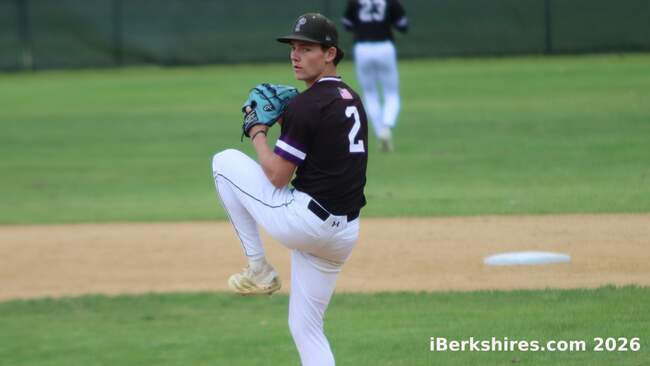
Brayden Durant struck out seven and walked one in a complete-game effort on the mound Saturday to pitch the Drury baseball team to a 6-0 win over Keefe Tech in the quarter-finals of the Division 5 State Tournament at Joe Wolfe Field. click for more
Jason Codey struck out 13, walked two and allowed just an infield single as the Generals earned a 7-1 win over Wahconah to claim their third straight regional title. click for more
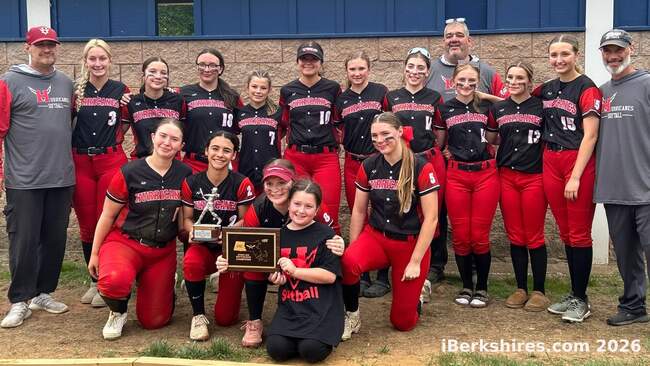
Gracelyn Wright struck out eight, and Genevieve Lagess went 3-for-5 with four runs batted in as the Hurricanes beat Monson, 17-3, to claim their first Western Mass title in four years. click for more
For the boys, Ward Bianchi helped lead the way with a win in the shot put and a second place in the javelin as the Mounties finished 16 points ahead of runner-up Pittsfield (pending the results of the pole vault, which were unavailable at 11 p.m. Friday night). click for more