BOSTON - Two members of the Berkshire delegation joined state leaders on Monday in announcing a legislative proposal to advance biofuels.
State Sen. Benjamin B. Downing and state Rep. Christopher N. Speranzo joined Gov. Deval Patrick, Senate President Therese Murray, Speaker of the House Salvatore DiMasi and U.S. Rep. William D. Delahunt at a State House to promote the proposal as a way to reduce dependence of foreign oil, capture clean-air benefits, and capitalize on clean-fuel research for economic growth and jobs.
The initiative, pursued by the three top leaders of state government, will solidify the commonwealth’s position as a national and global leader in clean energy technology, said the two Pittsfield Democrats.
The legislation, which proposes a gas-tax incentive for cellulosic ethanol, is projected to create 3,000 new jobs in Massachusetts and pump $320 million into the economy as the advanced ethanol is brought to market, according to the Patrick administration. If passed, this bill would be a boon for Pittsfield's Berkshire Biodiesel, which will become the state's largest producer of biofuels, say the lawmakers.
The plant will produce 50 million gallons of soybean-oil-based biodiesel annually. Plant construction is expected to begin in mid- to late-2007, with biodiesel production starting in late 2008.
"Massachusetts has the opportunity to be international leaders in the clean energy economy," said Downing. "I applaud the administration and Leadership for taking the reigns on this critical issue. Promoting development of domestic biofuels not only makes environmental and economic sense, it eases our dependence on foreign oil, which is a national security issue and concerns everyone."
The bill will require all diesel and home-heating fuel sold in the state to contain a minimum level of renewable, biobased alternatives in their blends, with that level rising from 2 percent in 2010 to 5 percent in 2013. These mandates are designed to help build Massachusetts' emerging biofuel refinery and distribution sector. Three refineries are in the planning stages, including Berkshire Biodiesel, which will occupy the former Beloit research and development manufacturing site off Hubbard Avenue in Pittsfield.
Speranzo said, "This legislation will help the commonwealth by reducing our dependency on foreign oil and instead, thanks to Berkshire Biodiesel, invest that money back into out own community. It is an exciting time for Massachusetts and I look forward to working with governor, Senate president, and speaker of the House on this matter."
Lee Harrison, executive vice president of Berkshire Biodiesel, also joined state officials at the State House.
"This is the leadership the country has been waiting for," said Harrison. "The true cost of fuel is not what you are charged at the pump. Once you factor in the cost of war in Iraq, the cost of keeping the sea lanes open, the subsidies to Middle-Eastern countries to retain favor and stabilize the regime, and the cost of pollution and global warming, the true cost of a gallon of gas is much more than the price paid at the pump.
"I am happy to see leadership in the State House institute these kinds of mandates. This is a credit to our political leaders. I am happy to be a Bay-Stater today."
Several other states have biodiesel content standards, but Massachusetts would be the first to establish a biofuel standard for home-heating oil - of particular significance because the Northeast makes much greater use of oil for home heating than other parts of the country.
This legislation also exempts from the state gasoline tax ethanol derived from sources such as forest products, switchgrass and agricultural wastes.
Massachusetts would be the first state in the nation to provide a tax incentive for cellulosic ethanol, an environmentally beneficial next-generation biofuel that state-based companies are now rushing to bring to market. By signaling that cellulosic ethanol will not be taxed, the administration and Legislature are sending a message to emerging refineries and distribution companies that Massachusetts will be a ready-market for clean fuels.
According to the administration, consumers will not experience an increase in energy costs because of production and incorporation of cellulosic ethanol. In fact, consumers may save money. Crude oil is priced at more than $90 a barrel and subject to huge inflation. Moving toward homegrown fuels will reduce market volatility and costs at the pump, say state leaders.
Currently, petroleum containing 2 percent biodiesel is priced at $3.02 per gallon, while straight petroleum diesel costs $3.19 per gallon - a difference of 17 cents per gallon. As the price of crude oil continues to rise, biodiesel fuel is expected to become even more economic.
While Massachusetts cannot single-handedly reverse the effects of climate change, this legislation will slow down our contributions to greenhouse gas emissions and fossil fuel consumption and serve as a model for other states, say lawmakers. The legislation is expected to reduce carbon dioxide emissions by 1.1 million tons annually by 2014.
Other harmful pollutants that contribute to asthma, lung cancer and other respiratory diseases will also be reduced, creating a cleaner, more healthy environment, they say.
The the state leaders also announced they would create a task force to explore other ways to promote advanced biofuels for their environmental and energy benefits as well as the economic benefits of a growing clean-fuels industry based in Massachusetts.
If you would like to contribute information on this article, contact us at info@iberkshires.com.
Your Comments
iBerkshires.com welcomes critical, respectful dialogue. Name-calling, personal attacks, libel, slander or foul language is not allowed. All comments are reviewed before posting and will be deleted or edited as necessary.
"petroleum containing 2 percent biodiesel is priced at $3.02 per gallon, while straight petroleum diesel costs $3.19 per gallon"
By my math, this means that biodiesel is worth -$5.31 per gallon ($3.19*.98 + -$5.31*.02 = $3.02).
I don't think figuring the cost is that straightforward. Biofuel manufacturing includes a lot of variables, not the least of which are government incentives; diesel fuel production isn't much different. And as we all know, fuel prices change daily - next week, diesel may be cheaper.
Our policy is to place a byline on a story we have written; if we've significantly reworked a press release, we may add "staff reports." No byline, it's a press release. However, we do try to make the press releases we receive as reader-friendly as possible.
Late last month, the Conservation Commission greenlit some tree pruning on the property. New windows and a new door can be seen in the front of the building.
"It's a substantial renovation that's currently underway here," Brent White of White Engineering said, speaking on behalf of the applicant and owner, Huajie Zhu.
A fire gutted the longtime Wahconah Street supermarket in 2023, and the following year, Zhu purchased the property for $460,000 two years ago to build a restaurant with hibachi in the existing footprint of the more than 100-year-old building.
White explained that the project has been ongoing for over a year, and the Community Development Board granted the property a waiver to reduce the minimum required number of parking spaces so that additional spaces aren't needed.
He noted that, looking at the site plan, there is very little room to do so. A mirror will be installed near the sharp turn on Bel Air Avenue to alleviate traffic concerns.
Pruning will be done on trees in the southeast corner of the existing paved parking lot, as a number of branches are hanging over. The new owners also intend to patch, sealcoat, and re-stripe the parking lot.
A fire tore through the building less than an hour after the supermarket closed for the day three years ago. An automatic sprinkler system is required for the new use.
Cassidy Flynn scattered five hits in a complete-game effort in the circle as Lenox upset top-seeded Hoosac Valley, 3-2, in the quarter-finals of the Division 5 State Tournament. click for more
Brayden Durant struck out seven and walked one in a complete-game effort on the mound Saturday to pitch the Drury baseball team to a 6-0 win over Keefe Tech in the quarter-finals of the Division 5 State Tournament at Joe Wolfe Field. click for more
Jason Codey struck out 13, walked two and allowed just an infield single as the Generals earned a 7-1 win over Wahconah to claim their third straight regional title. click for more
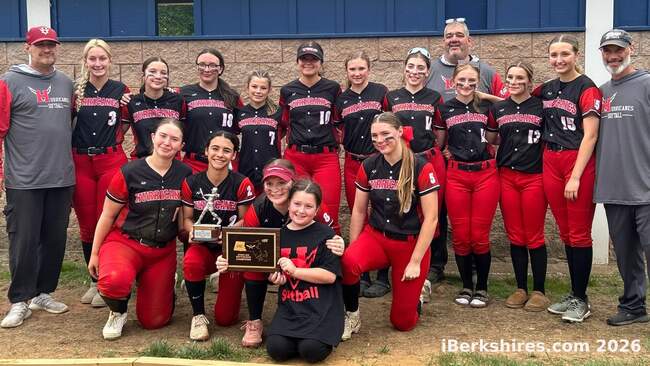
Gracelyn Wright struck out eight, and Genevieve Lagess went 3-for-5 with four runs batted in as the Hurricanes beat Monson, 17-3, to claim their first Western Mass title in four years. click for more
For the boys, Ward Bianchi helped lead the way with a win in the shot put and a second place in the javelin as the Mounties finished 16 points ahead of runner-up Pittsfield (pending the results of the pole vault, which were unavailable at 11 p.m. Friday night). click for more