Over the weekend, I had the pleasure (or displeasure depending who you ask) of seeing Michael Moore's new film, "Sicko." Yes, I said Michael Moore; the most incendiary filmmaker of our time has released another documentary. This time he tackles the U.S. health care system by presenting real-life examples of how the system is corrupt and the different ways it can turn a proverbial blind eye from its people.
Although Moore spends a lot of time exploring health care in smaller European countries without actually comparing how they work or their overall statistics in relation to the U.S., I was deeply affected by "Sicko" and its description of the disastrous state of the outrageously expensive but poorly managed health-care system in the United States.
The documentary walks viewers through several parts (as listed below), each highlighting separate health care issues in the U.S. and how the system is poorly structured and implemented:
● Many Americans are potentially forced to reduce their overall quality of life because they are not adequately covered by health insurance.
The film profiles one man who had to choose between saving either his middle or ring finger on his left hand after they were severed during a table-saw accident. Because of "limited eligibility requirements," his insurance carrier would only pay for one reattachment procedure. He chose the ring finger in order to continue wearing his wedding band.
● Another unfortunate account includes denial of payment for ambulance services because a woman, who was seriously injured in a motor vehicle accident, didn't call her insurance provider from the accident scene for prior authorization for transport. When was she to call? After her momentary lapse of unconsciousness?
● Most, if not all, health-care company medical directors, applicant reviewers and medical boards are employed for the sole purpose of denying membership coverage, and some are even offered incentives, like cash bonuses or extended vacation time, for meeting or exceeding a certain number of claim denials.
Many companies also employ "health-care sleuths." These investigators are handsomely paid to scour through past medical records in order to find a reason for retroactively denying payment for care.
● Hillary Rodham Clinton's crusade for socialized medicine, or "Hillarycare," burned up approximately 15 minutes of the film.
This segment includes a video track from Ronald Reagan's infamous stance on U.S. health care, and President Nixon's clandestine support for Kaiser Permanente and the company's spearheading of the current "for-profit" model.
● Unfortunately, the film weakly examines how the British, French, and Canadian systems work, although it does illustrate how some Americans manage to benefit from these other systems.
One American woman, now living in France, says she feels guilty for the health-care advantages she is afforded while her parents, living in the U.S., are part of a vastly inferior system. Moore, frequently labeled as anti-American by the right, makes a point of presenting Canadians and French who are pro-American and conservative, but strongly believe that socialized medicine is the ideal health-care paradigm.
● Sadly, the film shows how a fragmented system is able to dump patients from the hospitals to the doors of low-income clinics when they no longer have the means to pay for treatment.
One scene portrays a taxi cab dropping off a disoriented elderly woman, barefoot and dressed in only a hospital gown, on the busy city streets. The woman continues to aimlessly wander until a nearby clinic's staff member intervenes.
● The segment that affected me most is how 9/11 EMTs, firefighters and rescuers who, years after being heralded as heroes, are now unable to pay for medical care for illnesses acquired while volunteering at Ground Zero.
A disturbing piece of the film reveals a high-ranking military official bragging that the care given to 9/11 terrorists detained at Guantanamo Bay (Gitmo) is far superior to the health-care citizens receive while living in the U.S. Moore personally takes a group of the volunteers to Gitmo. However, after being turned away, the 9/11 heroes are treated pro bono by Cuban doctors; receiving tests, medications and treatment strategies they were otherwise denied in the U.S. In addition, after hearing of their dilemma, a Cuban fire department honored the volunteers, dispelling the myth that most Cubans (like the French and Canadians) are viscerally anti-American.
● A final part of the film, rich with irony, is when the No. 1 anti-Michael Moore site on the Web is nearly shut down because the webmaster couldn't afford to maintain the site and pay for his wife's ever-growing medical bills for cancer treatment. Moore anonymously sent a $12,000 check to the site founder and, to this day, the site is running stronger than ever.
Judging by the testimonies expressed in the movie, albeit all of them containing a "Moore Slant," there is, in the very least, an iota of proof that the U.S. can provide far better health-care coverage for its people.
Other than exorbitant capital gain for pharmaceutical companies and for lobbying politicians, the one question I was waiting for Moore to answer is: why do we pay more than the other countries profiled? The closest is France, which still only pays about half as much as we do and, bear in mind, their health-care coverage pays for physician house visits, nannies, and other ancillary medical assistance, like eyeglasses and time missed from work.
I am certain film critics, film buffs and filmmakers are able to pick this movie apart much better than I, however, in the very least, I feel it does a wonderful job of bringing our health-care predicament to the forefront.
It makes you think and, more importantly, makes you talk. Isn't that the point of most documentaries? With that in mind, this is a documentary everyone should see.
If you would like to contribute information on this article, contact us at info@iberkshires.com.
Your Comments
iBerkshires.com welcomes critical, respectful dialogue. Name-calling, personal attacks, libel, slander or foul language is not allowed. All comments are reviewed before posting and will be deleted or edited as necessary.
In answer to your question there are multiple reasons we pay twice as much per capita than other countries, while getting significantly worse health outcomes (longevity, infant mortality, and almost all quality indicators except for in the area of cancer care), and not covering 47 million Americans. First and foremost is the staggering waste of overhead and administrative costs imposed by the multitude of private insurance entities that ration our care-HMOs, PPOs, POSs, fee for service, etc. The crushing burden of paperwork they demand with their requirements for documentation, denials of care, refusal to pay claims, underwriting, costs us literally 31% of every health care dollar spent in this country. Instead of that huge percentage of every dollar going to provide care, instead it goes toward denying claims, often with the aim of creating so much bureaucratic hassle for both patients and providers that they give up on getting fair payment. Medicare only uses 2-3% of every dollar for administrative costs, while 97% goes toward valuable health care.
Another reason is simply that US doctors and hospitals are paid much more than those in other countries, and we have a much higher percentage of specialists, and too few primary care providers, because specialty care is much better paid. We need many more primary care doctors to provide the preventive care we need to avoid illness in the first place, whenever possible.
There is much evidence that people who are wealthy and can pay well for care receive too much care, often placing them at risk, and resulting in worse health outcomes. More is not always better when we are talking about invasive medical tests, drugs, and procedures. Meanwhile the poor and middle class, who cannot afford expensive cost sharing with their insurance plans, or are uninsured and cannot afford care, often delay going for the basic preventive care needed to avoid expensive illness, and then end up spending much more when they develop serious conditions.
Medical malpractice is only a very minor cause of extra health care costs. It is only a myth that doctors order many more tests and procedures to CYA. Much excessive testing, imaging studies, etc., are ordered because the fees they made pay for the equipment and staff to maintain it, or represent high fees for the provider or facilities. A great deal of this excess could be reined in with absolutely no added risk for the patient. In many cases it would benefit the patient, because so many tests involve risk of complications.
The best answer to our out of control health care costs is an expanded "Medicare for All" program that covers us all, cradle to grave, like those that exist in every single other civilized country. We could cover everyone for all necessary medical care with the savings from the 31% of every dollar now spent on wasteful bureaucracy with these private health insurance companies. Read HR 676, the Conyers/Kucinich National Health Insurance Bill in Congress, it describes the gold standard in health care proposals.
I've been a first responder for 34 years, and seen more than my share of the awful problems of the uninsured. The pain, irreversible disability, and premature death people are suffering is unspeakable. To me it is a moral imperative that we help our neighbors get the health care they need. But for the Grace of God there go I, it can happen to anyone.
I would like to go to my doctor and not be rushed out the door after a 5 minute consult. For my $15 co-pay I should at least get the full 15 minutes of the doc's time. After all, he will get a king's ransom from the insurance company as a result of his quick assessment of my condition, why shouldn't I get what I deserve from it too?? Then I would like to be able to get the tests done that I really need without having to fight about it with someone who isn't even a doctor...(i.e. the insurance company employee who is denying my test). Just those two aspects of the whole insurance thing are enough to make me sick! Looks like another trip to the doctor.... blah. ;)
Lanesborough Town Meeting to Vote Budget, Bylaws & Vehicle Purchases
By Breanna SteeleiBerkshires Staff
LANESBOROUGH, Mass. — Tuesday's annual town meeting includes a $14 million operating budget, new short-term rentals, accessory dwelling units and sign bylaws, and free cash article appropriations.
Voters will gather at Lanesborough Elementary School on June 9 at 6 p.m. to decide on 20 warrant articles.
The fiscal 2027 budget is up a little over 10 percent. Some of the main increases are the Mount Greylock Regional School District and McCann Technical School: the McCann assessment is up more than 30 percent based on factors including enrollment and the school renovation project, and Mount Greylock's is up 11 percent.
Article 11 is for the town to vote to approve from free cash the sum of $16,298.48 for the McCann Technical School roof and window replacement project so as not to impact the budget. Article 3 is appropriate $7,586,284 for Mount Greylock Regional School assessment.
Another notable increase was in life and health insurance, showing an increase of about 26 percent.
Ambulance Director Jen Weber is planning 24-hour coverage, which means more staff and a hike in her budget. One of the articles asks the town to appropriate $234,100 to operate the Ambulance Enterprise Fund for salaries and expenses.
Many town departments are looking for new vehicles. The Fire Department is looking to replace its outdated 1996 fire engine. There are two articles related to the truck at a total of $813,366. Article 12 would transfer $225,000 from free cash into the Fire Truck Stabilization Fund; Article 13 would transfer $605,000 from the fund and authorize the borrowing of $208,366.08.
The total includes a $100,000 contingency cost to cover any additional costs if a 2026 model-year chassis cannot be secured before new emissions standards go into effect in 2027.
The board at its last meeting moved the $225,000 transfer to come before the borrowing article, changing the stabilization number. If the $225,000 is not voted on, then they will amend the next article's number on the floor, subtracting the $225,000. This shows the borrowing number significantly lower.
Article 17 asks for the transfer of $80,000 from free cash to replace a police cruiser.
Police Chief Rob Derksen's aim is to replace one vehicle every other year, meaning the oldest vehicle gets replaced about every 10 years.
He stressed that if delayed this year, the town may have to double up in a future year to get back on schedule, and that paying later usually costs more. The article will ask for $80,000 from free cash, the vehicles used to be funded by the BHRD.
Lastly, the Highway Department is looking to replace a 2014 International dump truck that will be a total of $330,000 and will take two to three years to receive.
Money will be used from last year's approval of $250,000 from free cash for the replacement of a 2012 highway front-end loader that was underspent $49,261. Town meeting is being asked to approve a transfer of $53,274.85 from free cash and the use of $227,464 from funds from the Sale of Town Real Estate to fund the balance.
Other free cash proposals include $1,200 to purchase software to support tracking and ongoing maintenance schedules of town-owned vehicles; $42,000 for the replacement of the Highway Department's storage shed roof, $200,000 to reduce the tax levy.
Cassidy Flynn scattered five hits in a complete-game effort in the circle as Lenox upset top-seeded Hoosac Valley, 3-2, in the quarter-finals of the Division 5 State Tournament. click for more
Brayden Durant struck out seven and walked one in a complete-game effort on the mound Saturday to pitch the Drury baseball team to a 6-0 win over Keefe Tech in the quarter-finals of the Division 5 State Tournament at Joe Wolfe Field. click for more
Jason Codey struck out 13, walked two and allowed just an infield single as the Generals earned a 7-1 win over Wahconah to claim their third straight regional title. click for more
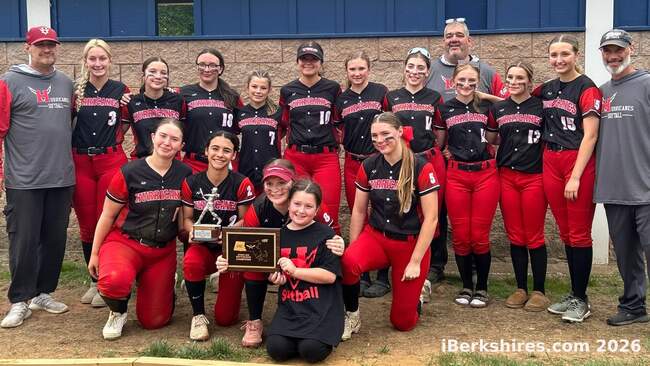
Gracelyn Wright struck out eight, and Genevieve Lagess went 3-for-5 with four runs batted in as the Hurricanes beat Monson, 17-3, to claim their first Western Mass title in four years. click for more
For the boys, Ward Bianchi helped lead the way with a win in the shot put and a second place in the javelin as the Mounties finished 16 points ahead of runner-up Pittsfield (pending the results of the pole vault, which were unavailable at 11 p.m. Friday night). click for more