Biofuels Panel Takes Testimony in Lenox
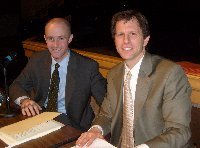 |
| Sen. Benjamin B. Downing and Assistant Secretary of Energy David Cash. |
"We support biofuels and alternatives to oil but want the commonwealth to develop a framework that prioritizes sustainability," said Tina Clark, representing Clean Water Action and the Massachusetts Climate Coalition. But, she added, "[The state] must protect land and protect habitat of wildlife and genuinely reduce emissions."
While sparsely attended compared to last week's 4 1/2-hour hearing in Boston, the Advanced Biofuels Task Force's public session Monday night at Lenox High School included testimony from area environmental, science and industry leaders.
"This is an extremely important endeavor that we're doing," said David Cash, assistant secretary of the Executive Office of Environmental Affairs. Cash, the state's air policy director, and Sen. Benjamin B. Downing, D-Pittsfield, were the only members of the panel in attendance along with aide Steven Clark and several others from the state department. "This is a very complex set of issues and many questions have been raised about biodiesel and bioheat mandates because research is going so quickly."
The task force was jointly created last fall by House Speaker Salvatore Dimasi, Senate President Therese Murray and Gov. Deval Patrick to explore the use of biofuels and provide recommendations for legislation, regulations and programs to develop an advanced biofuels industry in the state. Its establishment coincided with the filing of a bill that included some incentives for biofuel production.
Energy Secretary Ian Bowles is chairman; Cash is his designee to the task force. The task force will hold two more hearings in the eastern part of the state. All the testimony will available online in the coming weeks.
Biofuels are derivatives of plant matter - often in the form of ethanol - that can be mixed with or replace gasoline. Biodiesel mixes ethanol with vegetable oil, animal fat, or recycled cooking grease; it commonly is used as a 20 percent additive with gasoline. Mixed fuels such as B-20 cut down on carbon dioxide emissions. Pure biofuel such as recycled or processed vegetable oil, is referred to B-100.
<L2>It's not only climate change - for this part of the state, biofuels and their production are "huge economic issues," said Cash. Instead of being at the end of the pike when it comes to oil and gas, Massachusetts could become a leader in the development of biofuel, he said, particularly Western Mass.
That can't come at the expense of local habitat, said well-known outdoorsman Gene Chague, president of the Taconic Chapter of Trout Unlimited. The national organization is partnered with a number of state and nonprofit agencies dedicated to restoring brook trout to the region.
"We are deeply concerned with any removal of the tree canopy that keeps our streams cold and clear. We're also worried about emissions from these biofuel facilities and withdrawal of water for use at facilities," said the Lenox resident. "We ask the task force to keep these concerns at the forefront."
J. Dicken Crane, president of the Massachusetts Forestry Association, said his group was supportive of going forward with biofuels, including using biomass - forest residue and wood waste. However, "we need to have confidence that the way the biomass is going to be harvested is going to be ecologically sound."
Officials from the Pioneer Valley Railroad told the panel that rail cannot be overlooked. Unlike oil, biofuels are distributed primarily by rail since delivering the product through the current pipeline system would contaminate it.
Several facilities are being developed to produce B-20, including the $50 million project at the former Beloit-Jones industrial site in Pittsfield. (See Berkshire Biofuels Vice President Lee Harrison's testimony below.)
But the task force should not disregard the use of B-100, said the railway officials and Thomas Leue, owner of Homestead Inc., which has been distributing B-100 for five years.
Made from recycled vegetable oils, Leue said he has sold 5,000 5-gallon containers since opening. The company is a wholesaler, distributing to some 25 stores in Western Massachusetts.
While the fuel freezes during the winter, it offers an alternative for use in the summer months, he said. "Farmers like to use it to cut hay because they don't feel ill at the end of the day."
He expects to future growth into the eastern part of the state. "I'm hoping any incentives could take into consideration that there's a rapidly growing market for B-100."
University of Massachusetts professor Richard Stein said he is working with a group researching the use of biomass and cellulose (woody) products. He estimated that biomass could supply up to one-third of the area's energy needs.
But there may have to be trade-offs as the state moves toward a sustainable biofuels industry, said Clark, and there's concern over how to do that. There may be unforeseen environmental effects and that's an issue the panel is struggling with, he said.
Clark said the groups she represents are behind the effort, but warned "We don't want to put a lot of money and time into a fuel that ultimately turns out to be almost as bad as burning the oil itself."
"We see biofuels not as the silver bullet to all our problems, rather as a key part of a sustainable development policy for Massachusetts," said Downing. "One that doesn't sacrifice the resources that we so value here in the Berkshires."