Fungal Disease Killing Bats in Western Mass.
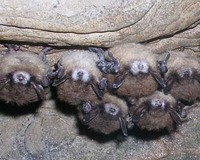 |
| Bats with white nose syndrome. [Al Hicks, N.Y. Department of Environmental Conservation] |
The bats are suffering from white nose syndrome, which makes it appear as if their faces were dipped in powdered sugar. The fungus can be seen growing on up to 10 percent of the affected bats. Up to 97 percent of the bats at some affected sites in New York have died.
After receiving reports last month from Vermont and New York about large numbers of bats dying in caves, biologists from the state Division of Fisheries and Wildlife and the U.S. Fish and Wildlife Service investigated caves and mines in the region where colonies of bats are known to spend the winter.
They found bats flying outside of one of the state's largest mines in Chester when they should have been hibernating, and found dead bats near the entrance that were collected for further study.
Bats with crusting white fungus were first found in New York bat hibernacula, or winter sleeping quarters, last winter. It has spread to many of the largest New York hibernacula and to sites in Vermont and Massachusetts. New sites are still being reported. Of the eight species of bats currently found in Massachusetts, it appears that the bat species most affected by WNS include little brown, eastern pipistrelles and northern long-eared bats as well as the rare, state-listed small-footed bats. These bats hibernate in caves or mines. Big brown bats, which commonly hibernate in buildings, are not yet known to be affected. The red, hoary and silver-haired bats are migratory and apparently not affected.
Bats at affected sites have exhibited unusual behaviors: roosting in the light zone close to cave or mine entrances or on houses; dead bats or remains found outside, and flying during the day in very cold weather (15-20 degrees). Bats have been observed falling to the ground or crash landing and several have been found roosting in woodpiles. Autopsies have found the mammals' fat stores completely depleted, when they would normally last until the bats emerge in spring to feed.
Wildlife managers are concerned about the outbreak because bats congregate by the thousands in caves and mines to hibernate. If WNS is caused by an infectious agent, this behavior increases the potential that the disease will spread among hibernating bats. In addition, hibernating bats disperse in spring and migrate, sometimes hundreds of miles away, to spend the summer.
Last month, the Northeastern Cave Conservancy held an emergency meeting and voted to close all its caves to visitation until at least May 15, to help protect thousands of hibernating bats.
Bats are important predators of mosquitoes and other insects. A study from Boston University estimates that 14 to 15 tons of insects are consumed each summer by the 50,000 big brown bats that live within the bounds of Route 128 alone.
"High bat mortality is a major concern because bats have a low reproductive rate," said Thomas French, MassWildlife assistant director for natural heritage and endangered species. "Most bats raise one pup per year. It will take decades for bat populations to rebound after a large die-off."
It is not clear if white nose syndrome is a cause or a symptom of bat mortality. Nine universities, four or five federal agencies, state wildlife agencies and health departments from three states, and a host of other volunteers, researchers, and cavers are working together to gather data, understand this condition and to diagnose the cause.
Residents who see two or more bats flying before April 1 can contact MassWildlife by at mass.wildlife@state.ma.us or call 508-389-6360. The "Homeowners Guide to Bats" can be picked up at MassWildlife offices or downloaded here.