Mount Greylock Near Final Budget Numbers
WILLIAMSTOWN — The Mount Greylock Regional School Committee conducted the first of three potential public hearings on Tuesday regarding the district's operating budget for fiscal 2009.Discussion centered around a proposed 0.2 full-time equivalent employee increase across the five core middle-school curriculums and $112,000 removed from the Excess and Deficiency Fund to cover the year's expenditures.
Deliberations are continuing Wednesday night and possibly Thursday night, though the third meeting seems unlikely.
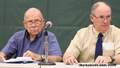
"We're generally fairly happy with the budget, though we do have some questions about the FTEs in the middle," said Christopher Kapiloff, committee chairman. Both meetings will begin at 7 in the high school.
Currently, the budget stands at $9,899,824, a general increase of 5.38 percent from this year.
However, each town will be affected differently: Lanesborough's portion will rise 0.71 percent (roughly $15,135) while Williamstown will contribute 4.8 percent more revenue ($205,861). A preliminary budget with questionable numbers had put Lanesborough's assessment much higher, at $300,000.
According to Superintendent William Travis, these numbers reflect an assessment equation that takes property value, average family income, and enrollment shifts into account. Middle school Principal and Business Manager Ellen Kaiser and other committee members questioned the allocation: "If there ever was a budget that proves we need to look [at the two town's assessments] this is it."
Kapiloff had other objections: "One of my biggest concerns is taking $112,000 from E and D to make a budget ... [this is] putting a Band-Aid over something more permanent."
Committee member David Langston acknowledged the danger of dipping into the rainy-day fund, but disagreed it was a Band-Aid.
"The principal thing we have to do is use the resources we have for the students we have now," he said, adding later "you don't get a do-over in high school."
At least four other committee members added their approval of using the fund. Heather Williams ventured that "if we don't take money out of E and D, we know where it's going to come from instruction in all departments."
One point sure to be discussed at tonight's meeting is a proposed increase in all middle school curriculum (math, science, social studies, English, world languages), equal to one full-time position. This addition would add between $40,000 and $60,000.
Langston wondered whether a slight increase in each town's assessment, followed by another $15,000 taken from E and D could make this happen.
"Middle school is so important and the means are so modest ... it would be worth it."
Kapiloff worried that depleting such a fund would leave the district vulnerable to an unforeseen catastrophe, like a boiler breaking. Langston countered that "public education is a high-risk game."
There were, however, other budget highlights that seem sure to reach the final draft. These include adding a required, fourth year of math to all high school students and a reduction in English class sizes in the ninth grade. The latter will happen in conjunction with the Williams College initiative, facilitating small writing labs of no more than 15 students.
Williams will also help with the growing technology gap at Mount Greylock by donating an uncertain number of 3-year-old computers. Heather Williams said "the technology at Mount Greylock is wholly outdated ... but we probably can't [do better] considering our budget restrictions."
The Williams computers will likely cover two Greylock computer labs.