Kerry Urges Investment in Broadband
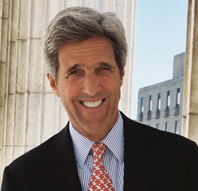 |
"President Bush promised national broadband access by 2007, but today most of Western Massachusetts is still being denied broadband coverage. In Massachusetts only 46 percent of the public has broadband and, amazingly, that's the fourth-best rate in the country," said the senator. "Were just not where we need to be. Eight years into the 21st century, more than half of Americans have either no Internet access at all or are still using dial-up.
"We need a national broadband strategy to encourage economic competitiveness in a global marketplace. By making high-speed Internet more readily available, businesses in Western Massachusetts will be better equipped to compete and grow, and more entrepreneurs will set up shop there because the region has so much to offer in terms of quality of life."
Kerry's statement as prepared for delivery:
I would like to thank Chairman [Daniel] Inouye [D-Hawaii] and Ranking Member [Ted] Stevens [R-Ark.] for holding a hearing on such an important issue. I'd also like to thank Chairman [Kevin] Martin [of the Federal Communications Commission] for taking time to be with us today, and all of our witnesses for agreeing to travel to Washington to focus on an issue that's received a lot of words, a lot of platitudes in politics — it's almost cliched now to say that the Internet is the future — but in recent years too little real focus.
I think by now the story is pretty well known just how much capacity the Internet has to foster innovation, to serve as a forum for unfettered social and political discourse, and to allow for the widespread dissemination of knowledge.
And anyone still wondering whether our national investment in long-term, basic scientific and technological research is worth it, gets their answer every single time they log in to check e-mail and take for granted something that began nearly 40 years ago as a DARPA [Defense Advanced Research Projects Agency] experiment.
But as the Internet has become pervasive in our everyday lives, the debate over the need to ensure some very basic principles around how and when network providers can manage network content has become highly politicized and all too polarized.
During the last go around on this issue in 2006, we were told by the major cable and phone companies that net neutrality was a "solution in search of a problem" — a response to blocking and interference with Internet content which no network operator would ever attempt.
On the heels of this claim, we found out that AT&T censored politically charged words during a live broadcast of a Pearl Jam concert in August 2007. A month later, Verizon rejected a request made by NARAL [National Association for the Repeal of Abortion Laws] to use the network for text-messaging political content. Finally, in October 2007, Comcast admitted to interfering with its subscribers' attempts to share files online using Bit Torrent technology.
It seems that the solution has most certainly found its problem. And even though the companies I've mentioned took steps to address each issue, we cannot expect and should not rely on political pressure and scrutiny from Congress, the FCC, and a vocal and organized group of advocates to regulate this industry. Senator [Byron] Dorgan's bill to add network neutrality principles — a bill which I've cosponsored — is an approach that makes sense.
I also appreciate that the FCC is looking closely at this issue and has held hearings in Cambridge an, last week, in Palo Alto, [Calif.], and I hope that they will see fit to act in a way that will protect open networks.
Now, the cable companies and the phone companies will tell us that because of capacity restraints, there is a need for some level of reasonable network management.
Unfortunately, this claim rings true — but it's a cautionary claim, a canary in the coal mine.
Despite the fact that the Internet was born in this country, America has been in a precipitous free fall when it comes to our global broadband ranking. The Organization for Economic Cooperation and Development has dropped the U.S. from 4th to 15th in its broadband rankings of industrialized nations. The International Telecommunications Union ranks the United States 21st — tied with Estonia — in its Digital Opportunity Index.
The debate over net neutrality and America's global broadband ranking are linked, and I think it's important that we discuss this link. When we talk about reasonable network management, what we're really talking about is the concept of scarcity. We lack the infrastructure to deliver high-speed broadband to every household, and the public's demand for content such as video streaming is exceeding the ability to deliver it.
More than three years ago, the president told us that this country needs a national broadband plan by 2007. Where is the plan? Where is the sense of urgency? Entire swaths of this country, including most of the western part of Massachusetts, have little or no access to broadband service.
We're placing our businesses and our workers at an economic disadvantage every day that we go without figuring out a way to get broadband to every house in America. We need to start talking about large-scale public investment for broadband infrastructure — as Governor [Deval] Patrick has done in Massachusetts and as other states are doing around the country — so that we can create the kinds of incentives that are necessary to make universal broadband possible.
And we need to pass legislation like Chairman Inouye's Broadband Data Improvement Act so we can get the kind of accurate data we need to know exactly what we're up against.
I look forward to hearing from our witnesses on these subjects. The debate over how to proceed on important issues such as net neutrality and our approach to a national broadband policy are too important to leave to another day.
###
For more information, testimony from the "Future of the Internet" hearing can be found here. To learn about broadband access in Western Mass., go to Berkshire Connect.
For more information on net neutrality, try savetheinternet.com.
Below, Sen. Dorgan, a Democrat from North Dakota, discusses his net neutrality bill.