Math, English Programs Get Boost From Olmsteds
 |
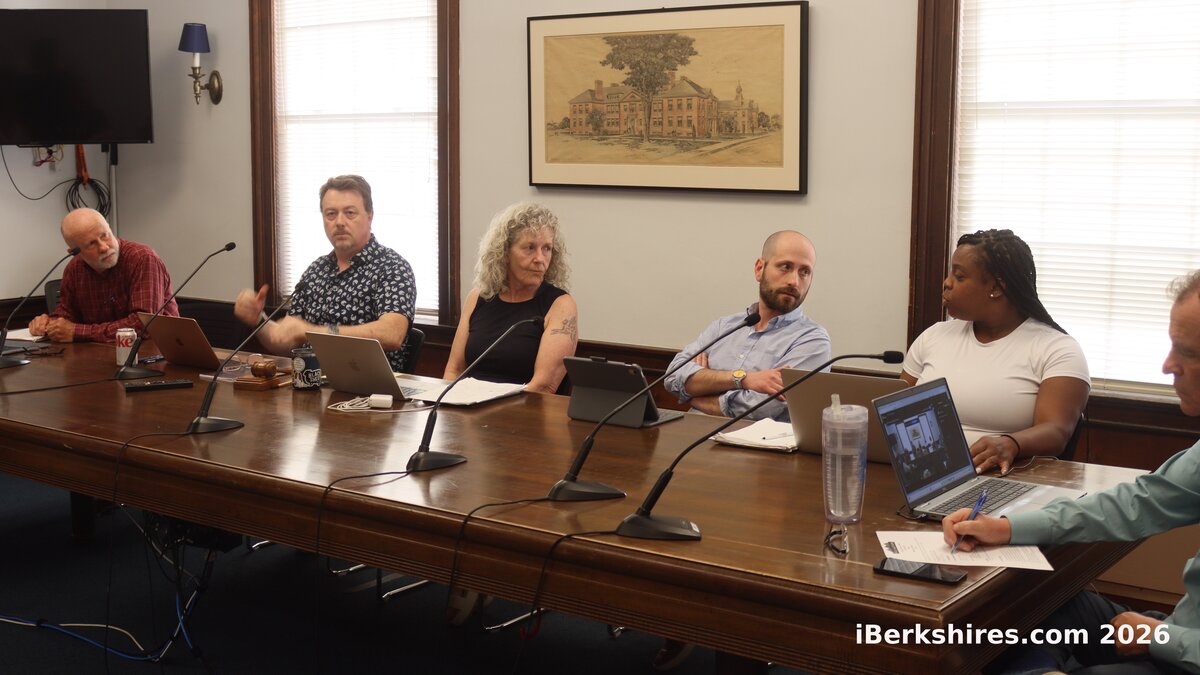
"Kids have a lot of anxiety going to the seventh grade and if there's anything I can do to make a tiny bridge, then I will," said Levy on Tuesday at the awards ceremony for the Williams College Bicentennial Olmsted Awards for Faculty Development.
Last year, Levy received funding from Williams through the Olmsted program for an initiative that sought to bring together students from town with students from Lanesborough and Hancock. Conceived as a way to introduce the children to their future Mount Greylock Regional High School peers, the program is now ending its first year and can boast two successful meetings.
"The students got a chance to know each other so when they get to seventh grade, they won't be just strangers meeting," said Levy during a presentation of the program's progress at the ceremony.
The Olmsted Awards, an endowment from the estates of George Olmsted Jr. and his wife Frances, provides $5,000 each to three local public schools – Williamstown Elementary, Mount Greylock and Charles H. McCann Technical School. Established during the 1993 Williams Bicentennial Celebration, the awards honor Olmsted, a lifelong proponent of superior teaching. Used for a variety of programs at the three locations, the funds are a way for Williams to give back to the community.
"It's important to the college to have strong local schools," said James Kolesar, Williams' director of public affairs.
"For some of us, it's not just academic. We are the frontline beneficiaries of your creativity," said Williams President Morton O. Schapiro, whose own children are in the public school system.
The Olmsted money will fund four other projects, in addition to the regional book club, at Williamstown Elementary, including the continuation of the school's math club, according to Principal Steven Johnson.
Started last year, the math club services 28 advanced math students in Grades 3 through 6 and is a "great way to get really gifted kids together," Johnson said. The Olmsted will also sponsor a schoolwide survey, training for the crisis team and the core reading program for the younger grades.
"We do use the money, let me tell you," Johnson said.
Mount Greylock will use its $5,000 to develop a stronger curriculum in the English and mathematics fields.
"Despite ongoing funding problems at regional schools across the state, Mount Greylock continues to move on in great new directions," said Schapiro.
The high school plans to implement a four-year math requirement, a move school officials think will better prepare students for the rigors of college coursework.
"Math teachers always realized the need for ongoing mathematics but [school math survey results] were the culminating piece that said to the non-mathematicians that we need to move forward with this," said Rose-Marie Pelletier, a math teacher at the school.
Pelletier said a new class will be specifically designed for seniors and will pull together information they've learned in previous years.
Another Olmsted-funded program will see ninth-graders focusing on honing their writing talent and learning to read and write critically.
"How do we give kids more opportunities to write in a way that we can give meaningful feedback?" asked Principal Timothy Payne.
The proposal will see freshmen entered into smaller English classes (no more than 15 students) where the concentration will be on writing fundamentals as well as literature evaluation. Taught by Trudy Ames and Kellie Houle, the smaller classes will give students the opportunity to receive more individualized attention and will allow the teachers to provide substantive feedback.
"We'll give them a strong foundation for writing for all of their high school years. Whatever they discover in this ninth-grade curriculum will have an impact on the rest of their high school career," said English teacher Cindy Bradley.
McCann pre-engineering teachers Scott Botto and Erin Mucci said the Olmsted Awards had helped to support Project Lead the Way at McCann for three years and would now allow students to complete a capstone in their senior years.
"This will be the first year that we implement the fourth year of the pre-engineering program," said Mucci. "It's the final stage and the students will complete a capstone project that will see them take something from idea to project."
Project Lead the Way is a nationwide pre-engineering programming that encourages students to excel in high-tech fields through hands-on experience.
"I can't wait to see what they come up with," said Mucci.
As the funded projects get under way, Schapiro had only one phrase for encouragement.
"Keep up the good work," he said.