Church Bell Peals to Promote Environmental Awareness
 |
Why 350? Because that's the amount of carbon dioxide (in parts per million) that should be in the atmosphere, according climate scientists. It's now at 385 ppm, which is trapping heat and causing climate change, they say.
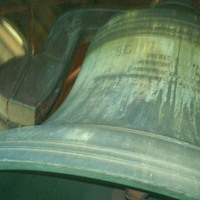
"During the times of the Revolution, the church bells were often rung as alarms," said the Rev. Carrie Bail, pastor, on Tuesday. This time, she said, the bell is being struck as an urgent call to action to prevent a potential worldwide disaster.
Bail has been involved with the Williamstown COOL Committee and other local environmental action groups. The town recently resolved whole-heartedly to reducing its carbon emissions to 10 percent below its 2000 levels by 2010.
Most of the carbon dioxide in the atmosphere is caused by burning fossil fuels — on the residential level that means turning lights on and cooking food. Scientists posit that a result of the increase in temperature is erratic weather such as tornadoes, floods and cyclones.
The United Church Christ sees global warming as a moral issue as much as a natural disaster. Floods and tornadoes often affect the most vulnerable people, said Bail.
The day of the tolling of the bell also holds special significance as it falls in line with the summer solstice.
"The solstice has often been celebrated as the start of a new year by many people," said Bail. "We hope the message we spread with our bell's toll will encourage people to start anew with the season."
Last spring, a graph illustrating the spike in carbon emissions covered the church facade as part of a local Step It Up event. The 60-foot red banner hung from the steeple turned out to be problematic; ringing the bell is expected to less troublesome.
The initial idea came from Andover Newton Theological Seminary and is championed by author and environmentalist Bill McKibben, who often visits Williamstown, and the Rev. Dr. James Antal, minister and president of the Massachusetts Conference of United Church of Christ.
"As Bill always says, 'We can't do it one light bulb at a time anymore.' We need to make whole communities aware of the dangers of global warning and give them the tools and information necessary to make a difference," said Bail.
Antal, in an address given during the 2007 Step It Up Campaign in Boston, said, "We as people of faith recognize that God did not put us on this planet to wreck it, so we will not sell ourselves short."
He has issued a challenge to the 400 UCC congregations in the state, asking that 350 of them ring their bells 350 times by the end of the year. First Congregational Church of Williamstown will by joined by the First Congregational Church of Sheffield, aka the Old Parish Church, which will also be ringing its bells 350 times at noon on Sunday.
"As the largest Protestant denomination in the commonwealth, as each congregation decides to ring its bell 350 times, more and more of our 82,000 members will learn why the number 350 is so important," Antal said in a press release.
For more information, contact Gail M. Burns in the church office at 413-458-4273; for more on information the number 350, visit www.sustainer.org.
Edited on Friday, June 20, 2008, to add information on First Cogregational Church of Sheffield.