Hospital's Scanner Offers Cardiac Closeup
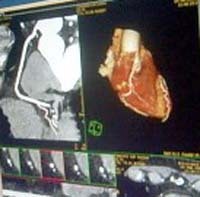 |
"People were kidding me that, given my profession, they wanted to find out if there was a heart," joked the local attorney and chairman of Northern Berkshire Healthcare's board of trustees.
Joking aside, the picture of Pagnotta's heart (yes, there is one) means the machine can now be used to replace, in most instances, cardiac catheterization to determine the presence of heart disease.
The computed tomography, or CT, scanner was installed last November and has processed some 5,000 scans of various parts of the body. Monday was the first time the machine was used to snap X-rays of a beating heart.
The Phillips Medical Systems scanner takes 64 X-ray pictures, or .0625-millimeter slices, along a 360-degree axis in a matter of seconds and at various depths. The cross-sectional slices are rendered into a three-dimensional picture that can be rotated and examined on a computer.
Like cardiac catheterization, the patient is injected with a dye that allows the doctor see parts of the heart. She is also given a drug that slows and steadies the heartbeat so the scanner can take a snapshot of the heart constricting and relaxing.
The patient lies on platform, is moved through the doughnut-shaped machine ... and that's pretty much it.
A catheterization, on the other hand, is an invasive process that requires a hollow tube be inserted through a blood vessel in the groin or arm and up into the aorta of the heart. The patient may be awake through the procedure, but it takes time and requires a recovery period. While considered very safe, there's still risk of infection, pain, blood clots, angina or irregular heartbeat and, in rare cases, stroke.
"From the patient's standpoint, it's a much, much easier examination, it's a safer examination," Dr. Andre Langlois, a radiologist at the hospital, said of the CT scan. But, he added, "It's not an examination at this time that can be done on all patients ... but this will be able to be used for a relatively large portion of the patients."
Someone with acute pain who needs to be treated immediately with a stent and certain other conditions, such as erratic heartbeat, aren't likely candidates; and there is still a slight risk, from radiation or reaction to the contrast dye.
"We want to be able to assess the coronary arteries and maybe replace some other tests that may not be needed because this is probably a more robust technique to find out if somebody has heart disease," said Langlois. "We're really at the beginning of cardiac CT."
"It was easier than going to the dentist and just about any other type of procedure you could have done at the hospital," said Pagnotta, adding "the biggest discomfort was not eating breakfast."
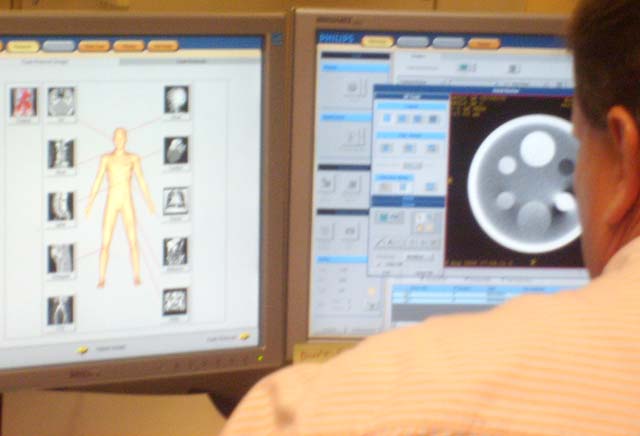 Radiology technician Christopher Wheeler looks over scanning options on his monitor at North Adams Regional Hospital. Radiology technician Christopher Wheeler looks over scanning options on his monitor at North Adams Regional Hospital. |
"This is just sort of a setup, but the setup's got to be perfect," said Wheeler as he peered at an X-ray of Pagnotta's chest on his monitor. Then, in seconds, the screen filled separate slides of semi-circles of white — the contrast dye outlining tissues and structures in Pagnotta's heart.
The huge amount of data takes time to collate; Wheeler estimated about two hours to get a good picture of the heart. As the technicians gain experience, that time will shorten considerably.
The cardiac tests will be done on volunteers at first to allow doctors and technicians time to perfect their expertise in scanning and reading the results before patients go through the process.
"I thought this was a pretty neat opportunity and to be able to help them out," said Pagnotta. "You don't often get high-tech medicine like this for the asking."