Deborah Robinson will present "Failing to Succeed"
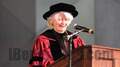
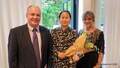
WILLIAMSTOWN, Mass. - Deborah Robinson '78 will present the concluding Gaudino Dialogue, titled "Failing to Succeed," on Wednesday, Dec. 3, at 8 p.m. in Brooks-Rogers Recital Hall. The dialogues are unscripted interviews with successful Williams alumni that address failure, creativity, and triumph. She will be interviewed by Williams College's Gaudino Scholar Edward B. Burger.Robinson, who is executive director of International Possibilities Unlimited (IPU), has traveled to more than 40 countries working on human rights issues. Founded in 1997, IPU works to achieve four organizational goals:
• Building a global network linking people of African descent within the U.S. to social justice struggles throughout the world;
• Increasing understanding, participation, and activism by Black people in international arenas;
• Mobilizing national and international networks to participate in international forums
• Advocating for social justice, conduct research, provide technical assistance and serve as a clearinghouse for information.
IPU organized the International Panel for the National Emergency Gathering of Black Community Advocates for Environmental and Economic Justice in 1999 and helped spread awareness of "environmental racism" and "environmental injustice" by building support for the U.N. World Conference on Racism and Related Discrimination in 2001.
Robinson has also visited and produced educational material on the Dalit Liberation Movement in India, the FLNKS movement in New Caledonia, and the Polisario Liberation Movement of the Western Sahara. She managed the South African Political Prisoner Bracelet Program from 1984 to 1991, building worldwide support for political prisoners in South Africa.
In 2001 she was awarded the Williams College Bicentennial Medal, an honor that recognizes Williams alumni for achievement in their fields.
Robinson received her Ph.D. in social psychology from the University of Michigan and has taught at Howard University. Currently, Robinson speaks and writes on environmental racism and human rights.
The Gaudino Dialogues are supported by The Robert L. Gaudino Memorial Fund (http://www.williams.edu/resources/gaudino/pastscholars.php), whose programs complement the primary objectives of the college's educational mission: promoting active learning, combating fragmentation of knowledge, and assembling an open community of learning characterized by integrity, mutual respect, and rigorous intellectual endeavor.
This fall, Professor of Mathematics Edward B. Burger (http://williams.edu/Mathematics/eburger/), as the college's Gaudino Scholar, offered the first interdisciplinary Gaudino course on the process of creating. In addition, he developed the Gaudino series of dialogues of life stories.
"My hope is that these wonderful alumni will inspire all of us to take more risks and actively try to be more creative in our everyday lives," Burger said.