Local Historians Look Back at St. Raphael's
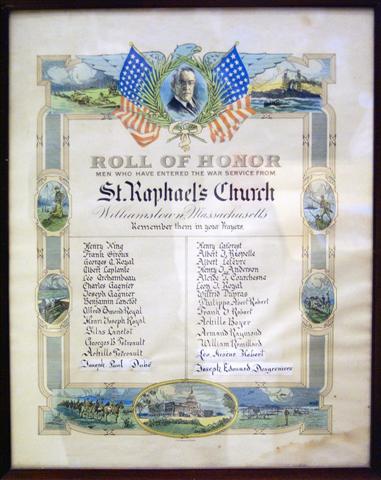 |
 Photos by James Hodgkins Photos by James HodgkinsTop, St. Raphael's World War II honor roll, left, Arthur Lefave presented the history of the 117-year-old church. |
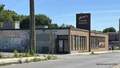
Arthur and Jean Lafave of Williamstown led the way, as speakers in the "History of St. Raphael's Church" program, the third in a series of free monthly programs sponsored by the Williamstown House of Local History. The 117-year-old church on Cole Avenue was shuttered in 2007 and will likely be turned into affordable housing.
A native of the Village Beautiful, Arthur Lafave lived on Arnold Street, within walking distance of St. Raphael's, until he and Jean wed on July 4, 1964. Jean Lafave, a native of New York, moved to Williamstown in 1961. They both are enthusiastic local historians.
Arthur Lefave said most of the French-Canadians who migrated here worked at Williamstown Manufacturing Co., a textile mill last known as Photech, at the north end of Cole Avenue.
"In 1878, the North Adams Transcript ran an article on the Williamstown Manufacturing Co. which described the village as 'the model manufacturing property of the state,'" said Lafave. In the village, there was a country store, a growing library and a "never-failing spring where most of our water still comes from today."
But there was no Catholic church, and the majority of French-Canadians were Catholic. So, they traveled by train and wagon and up the hill to Notre Dame du Sacre Coeur in North Adams, where services were held. "It was a sacrifice of love for their religion to attend services," said Lafave.
In 1870, a separate congregation for the French-Canadian families of Adams, North Adams and Williamstown was established. The first Mass was celebrated in a rented hall two blocks from where St. Raphael's now stands, Lafave said.
St. Raphael's was built on land sold to Bishop O'Reilly in May 1889. Since the first Mass at the new church was celebrated on April 5, 1889, construction evidently began before the property was officially deeded.
The cost was $15,000, financed by contributions and a mortgage. "The hard-working French families also raised enough money to build a rectory at the cost of $5,000," said Lafave.
The only parochial school in Williamstown was operated in the rectory and provided bilingual elementary education in first and second grade. "The school bell is still there today," said Lefave. Tuition was 15 cents a week per student. After completing second grade, the children advanced to the Station School on the corner of Arnold and Elm.
"Because the children's knowledge of English had generally become sufficient to attend classes in the public school, the school was discontinued in 1906," said Lafave.
When Lafave was growing up, the French language had all but disappeared, he said. "I remember the Mass in Latin, the sermon in French and the announcements in both French and English," adding with a smile, "It felt like an international Mass."
Fifty years after St. Raphael's Church was built, a thorough renovation became necessary. To cover the cost, contributions were collected and fundraisers held. More renovations had to be undertaken in the 1960s after Vatican II. (The Vatican Council had issued decrees regarding parishioners' participation in Mass, etc.)
"A new altar was built facing the congregation," said Lafave. The communion rail was removed, kneelers were replaced, carpeting was installed and new modern statues of the Blessed Virgin and Joseph were bought.
When expenses exceeded the contributions, a new source of income had to be found - a small one-day bazaar in the basement. It was so successful it evolved into a two-day festival under numerous tents. Besides providing income for the parish, it also grew to be a very important part of the Williamstown community until discontinued in 2000.
"As far back as 1943, women had organized to promote parish unity and to afford women of the church an opportunity for service," said Jean Lafave, picking up the story. In earlier years, women were not allowed to take part in religious services, as they do now.
.JPG) Parishioners raised $5,000 to build the rectory. |
"In 1989, St. Patrick and St. Raphael parishes became the first parish [in North Berkshire] to be yoked; meaning they remained distinct parishes, but would be served by one pastor," she said.
On New Year's Day 1997, the two parishes were dissolved by a decree from Rome and the Parish of Sts. Patrick and Raphael was formed. Though both church buildings were still in use, many special holiday services were held in one place. Programs as well as finances were combined.
The continued decline in parishioners, bringing in less income to support the abundance of property, factored into the decision to close St. Raphael's, Lefave said.
Fighting back tears, she described the honorary procession led by Rev. Mark Burke (administrator of Sts. Patrick and Raphael) and Deacon Frank Ryan at the final Mass celebrated at St. Raphael's Church on May 27, 2007.
 Jean Lafave with the rest of the story. |
"It was home," Boyer said. Steps have been taken to make St. Patrick's Church "home" to the former parishioners of St. Raphael's. A stained-glass window from St. Raphael's has been installed and another is to be transferred; the valuable icon of the crucified Jesus is now suspended over St. Patrick's altar and banners of both saints cascade from the choir loft.
Gertrude Fields said she would like to see the statues of the Blessed Virgin and Joseph there as well.
Fields began attending services at St. Raphael's when she and her late husband lived in Pownal, Vt. "The church in Vermont was hard to reach," said Fields, who now lives in Proprietor's Field. "And I liked going to St. Raphael's. The people were friendly."
Now the parishioners left are "working hard to join together to keep a positive Catholic presence in the community of Williamstown," said Jean Lafave.