Utility Customers Urged to Weigh in on National Grid Rate Request
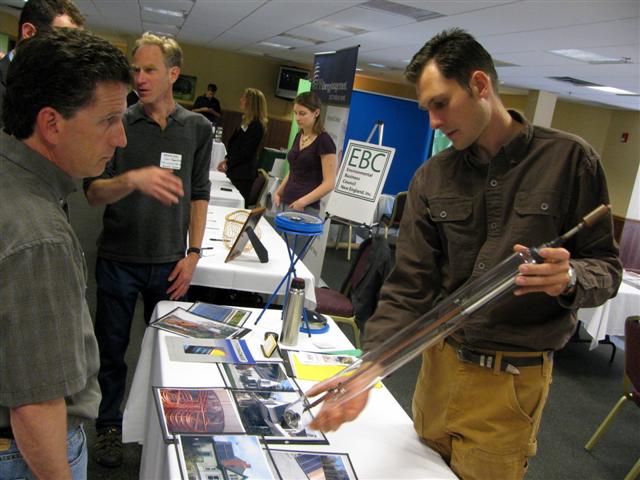 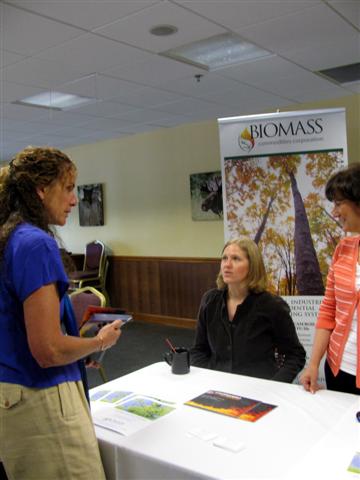 Alec Silitch of Heliocentrix of Williamstown explains how a solar heating tube works at an energy showcase at Jiminy Peak Mountain Resort on Thursday. Right, Biomass Corp., also of Williamstown. Alec Silitch of Heliocentrix of Williamstown explains how a solar heating tube works at an energy showcase at Jiminy Peak Mountain Resort on Thursday. Right, Biomass Corp., also of Williamstown. |
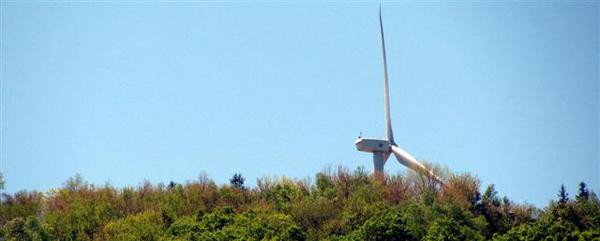
That was the message Thursday at the Berkshire Chamber of Commerce's first Energy Showcase and Summit, held appropriately enough in the shadow of Jiminy Peak Mountain Resort's wind turbine. The event brought chamber members and energy-related businesses, utilities and organizations together to discuss and showcase alternative energies and conservation.
It also highlighted the chamber's focus on the energy issues facing its members, a focus that Kevin Conroy of the attorney general's office applauded.
"There's not a local or regional chamber in Massachusetts that is as active on energy as the Berkshire Chamber," he told participants at the concluding luncheon. "If I could clone this chamber — get 25 to 30 other chambers that are as active on this, that I could get actual ratepayers to care about energy issues, to take the time to focus on energy issues, we'd be in a much better state."
Chamber President Michael Supranowicz turned attention to the energy issue several years ago as costs skyrocketed, affecting the chamber's more than 1,100 businesses that included the region's historic paper mills. A year ago, he and other local business leaders testified before U.S. Sen. John F. Kerry and state Attorney General Martha Coakley on the impact of energy costs in the Berkshires. The chamber has also spearheaded an electricity cooperative to help its members contain costs.
It's the kind of activism that can only help all ratepayers, said Conroy, whose division is the advocate for utility customers, as well as looking at big picture issues like reliability, cost and clean resources.
"The people who get lost in that process are you, the ratepayers," he said. "You're the ones being affected by these decisions. ... It's so complicated that you don't have the ability to participate."
Conroy, chief of the Business and Labor Bureau with a portfolio that covers business, technology and economic development, and energy and telecommunications, said Coakley, a North Adams native, is well aware of the difficulties in Western Mass. The Springfield office has an energy component, including M. Katherine Eade, assistant attorney general in the office of ratepayer advocacy. The bureau doesn't want a repeat of the rate case of two years ago, when local customers had little or no input in Western Massachusetts Electric Co.'s rate hearings.
The office will be pressuring the Department of Public Utilities to hold hearings in Western Mass. for National Grid's rate hike request but there's no guarantee it will be in Berkshire County. Hours and hours of hearings will be held throughout the summer in Boston.
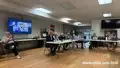
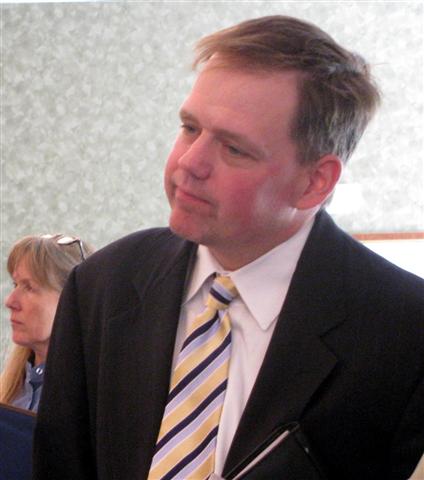
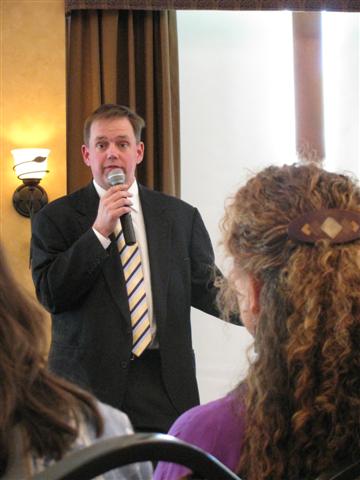 Kevin Conroy of the Attorney General's Office speaks about energy issues. |
"It is unfortunate that National Grid has chosen to propose significant electricity rate increases that could further harm ratepayers who are already struggling to pay their monthly expenses in these tough economic times," said Coakley in a statement. "As the ratepayer advocate, we intend to aggressively challenge National Grid's rate increase before the Department of Public Utilities."
Massachusetts already has among the highest energy rates in the nation. There is a movement to "decouple" profit from demand. As the nation seeks to conserve energy and pursue alternatives, state policymakers are saying it doesn't make sense for utilities to reap profits through higher demand, said Conroy.
National Grid is the state largest electrical provider and will be the first to go through decoupling, through litigation. The state is also looking to increase efficiencies in transmission, which could cost up to $1 billion that will, hopefully, come from stimulus funding.
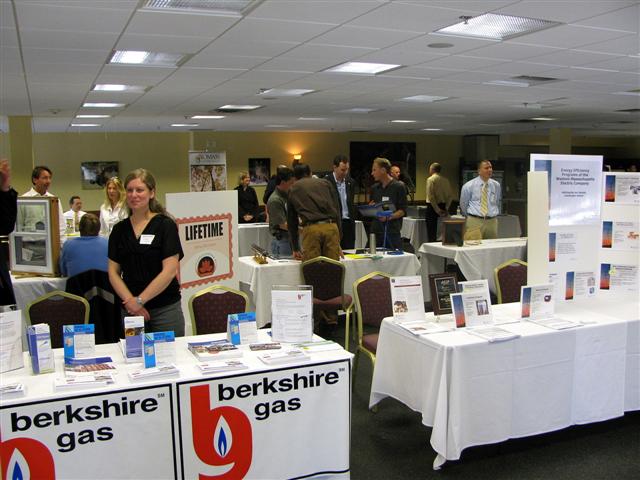
The energy picture isn't great for Massachusetts, but there are alternatives for local businesses and homeowners. It can be as obvious as installing energy-efficient windows and insulation or more forward-thinking, like investing in photovoltaic or solar heating. Those options were among the informational booths at the showcase.
For example, David Burhans of Bennington, Vt., of Burhans Research offered the direct approach of slowing electric motors to make them more energy efficient; Michael Baral of Nus Consulting, a broad range of auditing and management tools for energy use.
There were also several presentations and the chance to see Zephyr, the only wind turbine powering a ski resort, up close.
"This was to get the word out that the cost of energy can be affected by efficiency and conservation," said Supranowicz. Long-term goals are to reduce energy generation costs through both conservation and alternative energy. As demand increases, he said, higher-costing power generators are kicked on, raising prices down the line.
In the meantime, Supranowicz will become a member of an energy liaison group to keep area residents informed on what's happening with state energy policy. Conroy encouraged those present to contact their utilities and their representatives to ensure their concerns were addressed.
"We need more ratepayer involvement."
 |
 |
 |