Patrick Completes Reform Trilogy with Ethics Bill Signing
 Photos by Eugene Ossio/Governor's Office
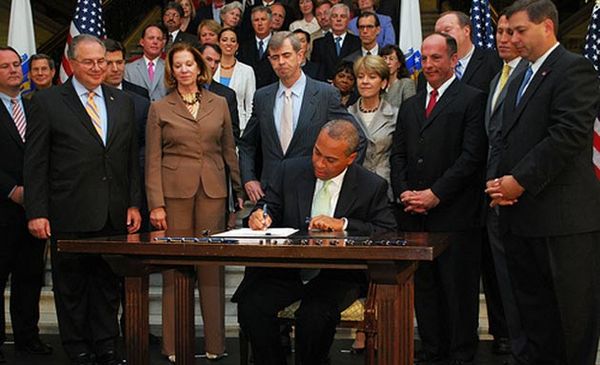
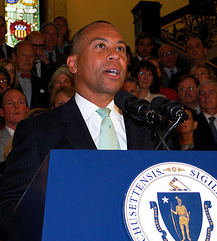
Gov. Deval Patrick speaks on the state's new ethics reform act at its signing in Boston on Wednesday. Top, he's joined by legislative leaders and AG Martha Coakley, among others. |
Joined by House Speaker Robert DeLeo and Senate President Therese Murray, the governor signed into law a lobbying and campaign finance reform legislation that establishes a strong ban on gifts to public officials, increases penalties for civil and criminal violations of ethics laws and expands the investigative and enforcement powers of a number of state authorities.
Coming directly on the heels of landmark changes to the state's pension and transportation systems, administration officials say the law delivers on promises made by the governor to restore public trust in government by bringing real reform to Beacon Hill.
"A series of troubling charges have shaken the confidence of our citizens in state government," said Patrick. "This law demonstrates our firm commitment to governing with integrity, with openness and with the public's interest foremost."
The state's seen a series of scandals that have resulted in the last two House speakers resigning under clouds; former Speaker Salvatore DiMasi was recently indicted on corruption charges. The state's transportation infrastructure is billions in debt, in large part because of the sinkhole known as the Big Dig; loopholes in the pension laws have cost the state hundreds of millions.
Patrick made the reforms a centerpiece in this year's budget debates, going so far as threaten to veto the Legislature's state sales tax increase if the ethics reform bill was watered down. All three bills reached the his desk before the budget was signed into law on Monday.
"This legislation today reflects the essence of what our government stands for: we answer to the people. We have heard and responded to the people’s call for reform," DeLeo said. "With Governor Patrick's signing of this bill as well as strong pension and transportation bills, we have fulfilled the promise of reform I made in January."
Formed in November by the governor, the 13-member bipartisan Task Force on Public Integrity, chaired by the governor's Chief Legal Counsel Bill Clements, examined the current regulatory structure governing ethics, lobbying and public employee conduct. The task force received input from experts and the public.
In January, it issued a report that included recommendations for enhanced investigative and enforcement authority as well as stiffer penalties. The governor filed legislation recommended by the task force in January; lauded strong ethics legislation approved by the House of Representatives in March; and commended the Senate for including a campaign finance reform component in its bill passed in May.
"With the significant reforms in our ethics, lobbying and campaign finance laws, we are sending a clear message that we have heard the public's demands for change, and that violations will come with severe penalties," said Senate President Murray. "We are all proud of this accomplishment, which is part of an aggressive and shared reform agenda that includes landmark changes to our state transportation and pension systems."
The ethics bill includes:
■ A strict gift ban that prohibits public officials from accepting gifts of "substantial value" for or because of their position and bans lobbyists from giving gifts.
■ Increases penalties on bribery from up to $5,000 and to three years imprisonment to $100,000 and 10 years imprisonment, and significantly boosts penalties for violating conflict-of-interest laws, financial disclosure laws and registration-related lobbying rules.
■ Strengthens lobbying laws by expanding the definition of lobbying to include background work, strategizing, research and planning and the revolving door provision to apply to members of the executive branch, and cuts the amount of allowable "incidental" lobbying in half.
■ Expands the enforcement authority of the Ethics Commission, the secretary of state and the attorney general, and enhances campaign finance laws to require greater disclosure, ban arrangements between state political parties and elected officials and hikes penalties for late-filed campaign finance reports.