Recession Doesn't Bring Clark Art Down
 |
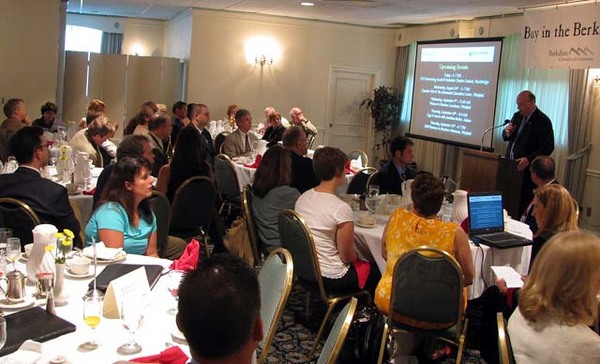
And that's good news for not only Williamstown but the Berkshire County economy, Clark Director Michael Conforti told members of the Berkshire Chamber of Commerce at its monthly Good News Business Salute held at the Williams Inn on Wednesday morning.
"We're having an unusually good season," said Conforti, who believed the current "Dove/O'Keeffe: Circles of Influence" and a tendency toward day trips in this economy may be driving attendance. "Are best season was in 2001 ... with the reality of the staycation ... which is not helping our lodging but certainly people are coming in great numbers to the Berkshires."
Conforti, director since 1994, expected that trend to continue as the museum mounts exhibits on Picasso and Degas next year and completes major additions that will allow more of its vast collection to be exhibited. "We're taking the museum building that people love and expand both above the grade and below grade."
Phase I of the expansion plan was completed in 2008 with the opening of the Stone Hill Center, a hilltop minimal retreat that houses gallery space, classrooms and the Williamstown Art Conservation Center, and offers sweeping views of the Purple Valley from its terrace. The structure was designed by award-winning architect Tadao Ando.
Phase II, also designed by Ando, includes the removal a rear building that had housed the conservation center and the construction of an exhibition, visitors' center and conference center space. Old and new buildings will be connected by a reflecting pool. Conforti said the building is expected to be completed in 2013 but will not likely open until the following year.
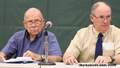
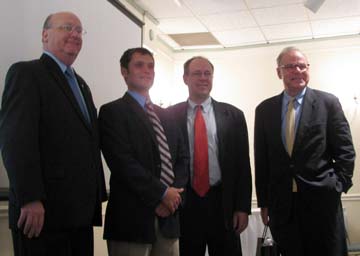 Chamber President Michael Supranowicz, left, David Bond, chamber Chairman David Avery and Michael Conforti. |
"Most importantly, though, we link very strongly with our other cultural institutions," he said, from Massachusetts Museum of Contemporary Art to Tanglewood.
In fact, the Clark is second in draw only to Tanglewood in Berkshire County, and its economic impact on the region is in the millions. According to a study by Williams College in 2004, the Clark brings in 150,000 to 200,000 visitors a year who spend upwards of $20 million and it stimulates another 380 full-time equivalent jobs in the area. It's operating budget is about $14 million and it employs 80 people full time.
While some of the Clark's number are a bit old, Chamber President Michael Supranowicz said the effect of nonprofits on the region's economy shouldn't be underestimated.
"We've been busy doing an economic analysis of the nonprofits ... there are some pretty impressive numbers," he said. The study is being overseen by Williams economics professor Stephen Sheppard.
Supranowicz said members would have to wait for the Oct. 28 meeting for the news. "I think you will be amazed at the impact the nonprofits made. ... But you'll have to wait."
Since the last breakfast in June, the chamber has added 16 new members, he said, and reminded attendees to buy local.
Emcee for the breakfast was David A. Bond, owner of The Range miniature golf course in North Adams. The sponsor was MAC Source Communications, based in Syracuse, N.Y.
Given Good News Salutes were:
■ Massachusetts Museum of Contemporary Art for 10 years of being a catalyst for development in North Berkshire. The museum occupies the sprawling mill complex that once employed thousands of Sprague Electric workers. It now provides space for cutting-edge art and some two dozen companies, including how-to publisher Storey Communications.
■ Northern Berkshire United Way for supporting the community for 75 years. Starting as a local community chest, the agency collected just over $67,000 in 1949; by 2005, its annual donations surpassed $750,000. It provides support to 23 member agencies servicing some 40,000 people with child care, community organizing, education, transportation and family services.
■ Richmond Networx and Richmond Telephone for being integral to the communication systems of South Berkshire businesses. Founded in 1903, it was operated as an independent family business by the Ackleys beginning in 1961. The company was purchased this year by Cornerstone Telephone Co. based in Troy, N.Y., but will continue provide local services, including Internet, voice and data, now with enhanced capability.
■ South Adams Savings Bank for offering community banking for 140 years. Established in 1869 in what was once South Adams (the northern section becoming the city of North Adams a few years later), the bank has grown twice through additions to its current location at 2 Center St. in Adams and has branch locations in Cheshire, Lee and Williamstown. Its assets top $190 million and it provides a wide range of banking services.