Bed Bugs: A Tiny But Growing Annoyance
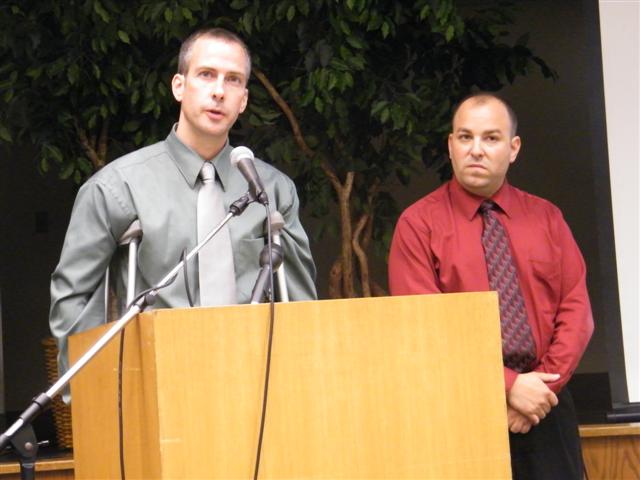 Photo by Jonathan DelSordo
 Justin Hedlund of Steritech, left, and Pittsfield Health Department Director James Wilusz talk bed bugs last week. Justin Hedlund of Steritech, left, and Pittsfield Health Department Director James Wilusz talk bed bugs last week. |
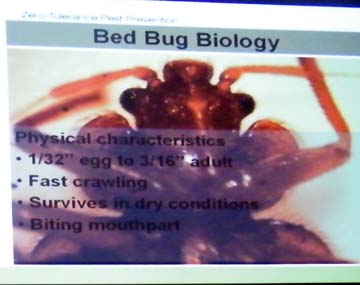
While the bug's lifespan is just over a year, they can lay about 200 egg in that time and spread far beyond their typical locations — homes and hotels — by hitchhiking. In recent years, bed bugs have been spotted in modes of transportation, such as trains, planes, buses, cruise ships. There have also been cases in which bed bugs have been found in movie theaters and businesses, such as rental stores.
The fast-crawling hitchhikers can migrate from beds to just about anything. "The best way to control bed bugs is first realizing the problem, how bad it is, and what treatments can be made in each case," said Justin Houlin Hedlund, an employee of Steritech Co., a pest control service.
Steritech and the Board of Health teamed up last week for a presentation at the Berkshire Athenaeum on the rising problem of bed bugs. About two dozen people attended the educational session.
A study last year by the University of Massachusetts at Amherst and Seoul National University in South Korea found urban bugs are becoming resistant to certain pesticides. New York City's bed bugs are particularly tough, becoming 264 times more resistant to a common insecticide.
Bed bugs tend to stay near their host. When they sense carbon dioxide, they tend to quickly move about. Bed bugs, however, cannot thrive in cooler climates and any temperature below 55 degrees slows down the bugs' metabolism and stops development as a whole.
They tend to be active between the hours of midnight and 4 a.m., said Hedlund.
Forms of treatment start by finding the host. Methods of extreme heating or cooling are proven factors in eliminating these critters. There are also a few practical ways to eliminate these bugs as well.
"Commercial vacuums and simple mattress covers are the easiest way to prevent and eliminate them," said Hedlund.
He stressed that "most people are unaware of these little pests. All it takes is a few minutes to look. So spread the word, not the bugs."