Olver: Health-Insurance Reform Necessary
 Photos by Kathy Keeser
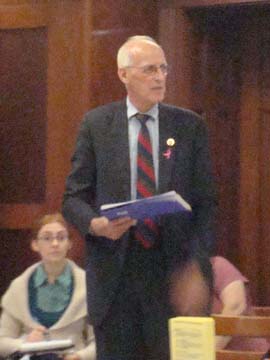
U.S. Rep. John W. Olver discussed health-care reform at a recent NBCC meeting. |
The panel on health care, held Friday, Oct. 9, in the meeting room at First Baptist Church, included state Rep. Daniel E. Bosley, D-North Adams, Northern Berkshire Healthcare President Richard Palmisano, Dr. William Kober and NBCC outreach worker Andrea Peters.
"[The U.S. health-care system] is without any question, bar none, the most costly health-care system in the world," said the Amherst Democrat. "Everyone agrees that it is too costly. This is one of those things that affects everyone in the country."
The 110 attendees to the NBCC's October forum listened attentively to Olver's presentation, the responses from the panel, and the few questions that time allowed to be asked them.
Olver began with explaining why need health-care reform is needed. When compared to other industrialized countries, Americans have lower life expectancy and higher infant mortality, he said, and many people are getting their health care "in crisis" at the emergency room because of the lack of preventative medical care.
"Lives are lost that could have been saved if there was prevention, this is costly in terms of dollars and lives," he said. "It's really a bad situation."
Since the Democratic-controlled Congress set out early in 2009 on the path to reform health-care at the directive of President Obama, many wonder why it is taking so long. Others have vocally expressed concern over cost, access and government control. The attempt to reform has been bogged down in controversy and competing concepts between the House and Senate and the major parties.
"It is very complicated and tough to come up with something that will get the votes to pass the legislature, then be signed by the president," summarized Olver.
In the beginning, he said, all the congressional committees working on health-care reform got together to layout guidelines that they wanted to achieve: for all people to have affordable health care, with emphasis on prevention and primary care, expansion of community health centers and protection and improvement of Medicare and Medicaid.
The final goal was to keep the cost under the $900 billion over a 10-year cap established by the president.
"The other end is that you got to pay for it," Olver pointed out. "By shifting the spending of the money and saving money within the health-care system, the hope is that the total cost will be lowered or at least stop the rise in cost."
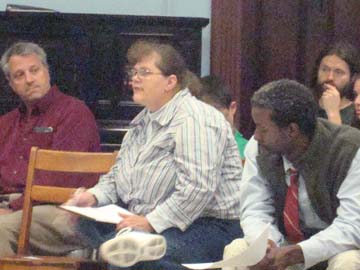 Andrea Peters talks to crowd about people struggling to get access and afford insurance co-pays. |
What might this bill contain and how will it benefit people was the last picture Olver tried to paint for the crowd.
"You see the ads about 'don't allow the government to get between you and your doctor' but at the moment, it is the insurance companies that are getting between you and your doctor. I think that government has pretty soft hands," he said.
Olver had been criticized by a few conservative citizens' groups for failing to hold town meetings during the August recess. In a response to a question about that at the end of the panel, Olver replied that "there wasn't a bill."
"It is much easier if you have a bill to deal with," he said. "Then you can answer the questions."
Olver provided a list of links to helpful Web sites to learn more and encouraged people to contact him with questions about health-reform efforts through HealthReform.OLver@mail.house.gov, requesting that those contacting him include their name and address.
Other members of the panel brought the discussion closer to home: how does the federal plan for health-care reform affect Massachusetts and a rural area like Northern Berkshire?
Various members of the panel said there are not enough doctors in our area, largely because doctors cannot cover the cost of their medical practice here. While more people are insured (Bosley stated that Massachusetts' uninsured rate is down to 2.6 percent because of state insurance reform), sometimes people do not have access to the health care they need.
"If you want to get access, you have to pay medical the cost of care," he said because government programs like Mass Health and Medicaid doesn't.
When the federal plan is put in place, said Bosley, the state's landmark insurance legislation would have to adapt. "I would rather run the deficit up on this than some of things that it has been run up for in the past eight years!"
Kober, a family practioner in North Adams, said health care must be a priority.
"Health is our first wealth. We are not going anywhere as a country unless we can wake up every day with the trust that if we get ill, we can see a physician," said Kober. "Forty-two years ago, Richard Nixon said that we have a health-care crisis ... what have we done since?"