image description
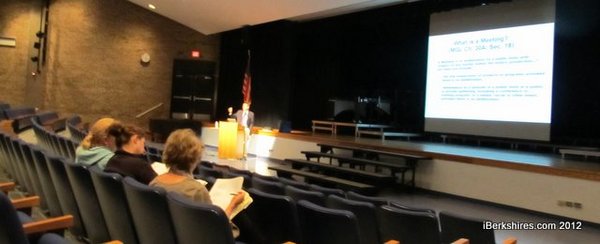
Some 70 or so local officials attended Monday's presentation on open meeting law.

Open Meeting Expert Shares Limits, Principles Of Law

By Tammy DanielsiBerkshires Staff
Print Story | Email Story

Glenn Koocher of the Massachusetts Association of School Committees said boards are struggling with so-called 'outlier' behaviors at governmental meetings.
NORTH ADAMS, Mass. — There's been an often-heated debate raging at City Council meetings lately over whether the public has the right to speak.

The expert's opinion: They don't.

"You do not have to have a public comment period but if you do, you have to treat everybody fairly," according to Glenn Koocher, executive director of the Massachusetts Association of School Committees. "You don't want to turn the meeting over to the audience unless you're having a legitimate interactive form of dicussion about public policy."

Several members of the public have loudly objected to the City Council's newest rules of order that eliminated any public comments during council debate, claiming their 1st Amendment Rights are being violated. Koocher, however, reiterated that the law not only does not provide for public comment, it leaves such comment up to the discretion of the board chairman or president.

Koocher addressed some 70 to 75 local officials from various governmental boards on Monday night at Drury High School. He had been invited to speak by Ellen Sutherland, assistant to the school superintendent; North Berkshire officials and the public were encouraged to attend.

Koocher has frequently done open meeting presentations on behalf of the attorney general's office; on Monday night he was not, which allowed him, he said, a little more levity and editorial remarks. The 90-minute presentation and question period were taped for broadcast on NBCTV.

The attorney general's office has overseen the Open Meeting law implementation since 2010. Prior to that, it had been the responsibility of the district attorneys, which at times led to 14 different interpretations, said Koocher.

Open Meeting Law
The Law
Chapter 30A sections 18-25
Regulations: 940 CMR 29.00
General Principles
Meetings must be open to the public unless the public body enters into a proper executive session
• Meetings must be posted
• Public bodies may enter into executive session for certain purposes
• Public records must be retained
• Alternative complain process where three citizens may file a complaint in Superior Court
• Enforcement by the attorney general's office for state public bodies.
Filing a Complaint
Chapter 30A, section 23

• Must be filed within 30 days of alleged violation to the public body, which has 14 days to respond
• If not resolved, may be filed with AG's office
AG may compel board to comply or attend training, impose fine or other appropriate measure
Attorney General's Website & Resources
He addressed a wide range of issues, from executive sessions to posting agendas to the role of the chairman. The basic tenet of Open Meeting law was the public's right to know what its government is doing.

"The public has the right to know what's going on in public meetings," said Koocher, describing the chairman's role in serving the board and informing the public as being "essentially the broadcast announcer for the meeting."

Chairmen also may find they have to stop speakers from revealing confidential matters and to keep order. "It is the role of the chair to see that the meeting is run efficiently, appropriately and fairly," he said. He or she does have to tell the audience whether they are being recorded.

The rules are pretty clear on boards acting outside the public eye, "serial communications" in which board members may "deliberate" only one or two at time and the use of executive session. But findings on new forms of expression, such as blogs kept by officials, and old forms, such as gestures, are still cloudy.

Several area officials quizzed Koocher on a board's ability to control so-called "outliers" who regularly attend meetings to provide their lengthy opinions — wanted or not.

It's an issue boards are struggling with, he said, not just with the public but with board members who feel they need to speak on everything all the time. He recommended putting limits on speaking times and ensuring the audience knew the rules, including that the board would not comment, and that rules be enforced equally.
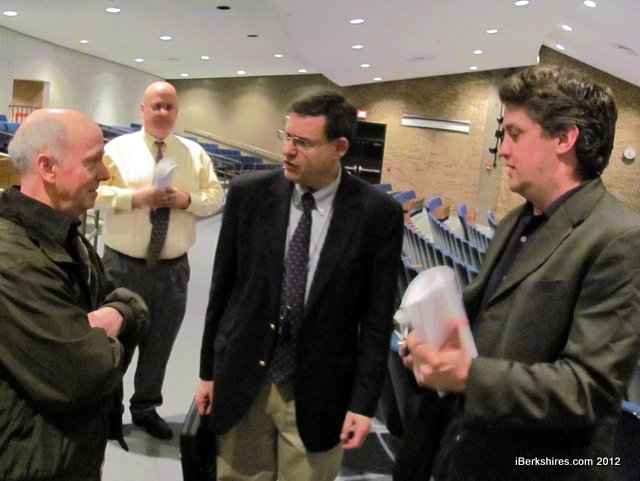

Koocher speaks with School Committee member John Hockridge, left, and Councilor Keith Bona after the session.
Signs may be disruptive depending on what's on them or how they are being presented, and while it's up to the chairman to determine that, he cautioned that "the bill of rights of the state constitution is more powerful than even the federal Constitution."

"I do not think you can permanently ban an American citizen from a public meeting, unless they present a legitimate danger to the safety of the people involved," he responded to a question by Councilor Keith Bona, adding that that was an issue for a judge.

Councilor Alan Marden had raised the issue of banning anyone who was consistently disruptive but the idea was later filed.

"If you can figure out how to deal with the outlier behaviors, we're looking for best strategies," he said. "It's really becoming an issue."

Tags: city council,   open meeting,   

If you would like to contribute information on this article, contact us at info@iberkshires.com.

Lanesborough Town Meeting to Vote Budget, Bylaws & Vehicle Purchases

By Breanna SteeleiBerkshires Staff

LANESBOROUGH, Mass. — Tuesday's annual town meeting includes a $14 million operating budget, new short-term rentals, accessory dwelling units and sign bylaws, and free cash article appropriations.

Voters will gather at Lanesborough Elementary School on June 9 at 6 p.m. to decide on 20 warrant articles.

The fiscal 2027 budget is up a little over 10 percent. Some of the main increases are the Mount Greylock Regional School District and McCann Technical School: the McCann assessment is up more than 30 percent based on factors including enrollment and the school renovation project, and Mount Greylock's is up 11 percent.

Article 11 is for the town to vote to approve from free cash the sum of $16,298.48 for the McCann Technical School roof and window replacement project so as not to impact the budget. Article 3 is  appropriate $7,586,284 for Mount Greylock Regional School assessment.

Another notable increase was in life and health insurance, showing an increase of about 26 percent.

Ambulance Director Jen Weber is planning 24-hour coverage, which means more staff and a hike in her budget. One of the articles asks the town to appropriate $234,100 to operate the Ambulance Enterprise Fund for salaries and expenses.

Many town departments are looking for new vehicles. The Fire Department is looking to replace its outdated 1996 fire engine. There are two articles related to the truck at a total of $813,366. Article 12 would transfer $225,000 from free cash into the Fire Truck Stabilization Fund; Article 13 would transfer $605,000 from the fund and authorize the borrowing of $208,366.08.

The total includes a $100,000 contingency cost to cover any additional costs if a 2026 model-year chassis cannot be secured before new emissions standards go into effect in 2027.

The board at its last meeting moved the $225,000 transfer to come before the borrowing article, changing the stabilization number. If the $225,000 is not voted on, then they will amend the next article's number on the floor, subtracting the $225,000. This shows the borrowing number significantly lower.

Article 17 asks for the transfer of $80,000 from free cash to replace a police cruiser.

Police Chief Rob Derksen's aim is to replace one vehicle every other year, meaning the oldest vehicle gets replaced about every 10 years. 

He stressed that if delayed this year, the town may have to double up in a future year to get back on schedule, and that paying later usually costs more. The article will ask for $80,000 from free cash, the vehicles used to be funded by the BHRD.

Lastly, the Highway Department is looking to replace a 2014 International dump truck that will be a total of $330,000 and will take two to three years to receive.

Money will be used from last year's approval of $250,000 from free cash for the replacement of a 2012 highway front-end loader that was underspent $49,261. Town meeting is being asked to approve  a transfer of $53,274.85 from free cash and the use of $227,464 from funds from the Sale of Town Real Estate to fund the balance.

Other free cash proposals include $1,200 to purchase software to support tracking and ongoing maintenance schedules of town-owned vehicles; $42,000 for the replacement of the Highway Department's storage shed roof, $200,000 to reduce the tax levy.

View Full Story

More Pittsfield Stories