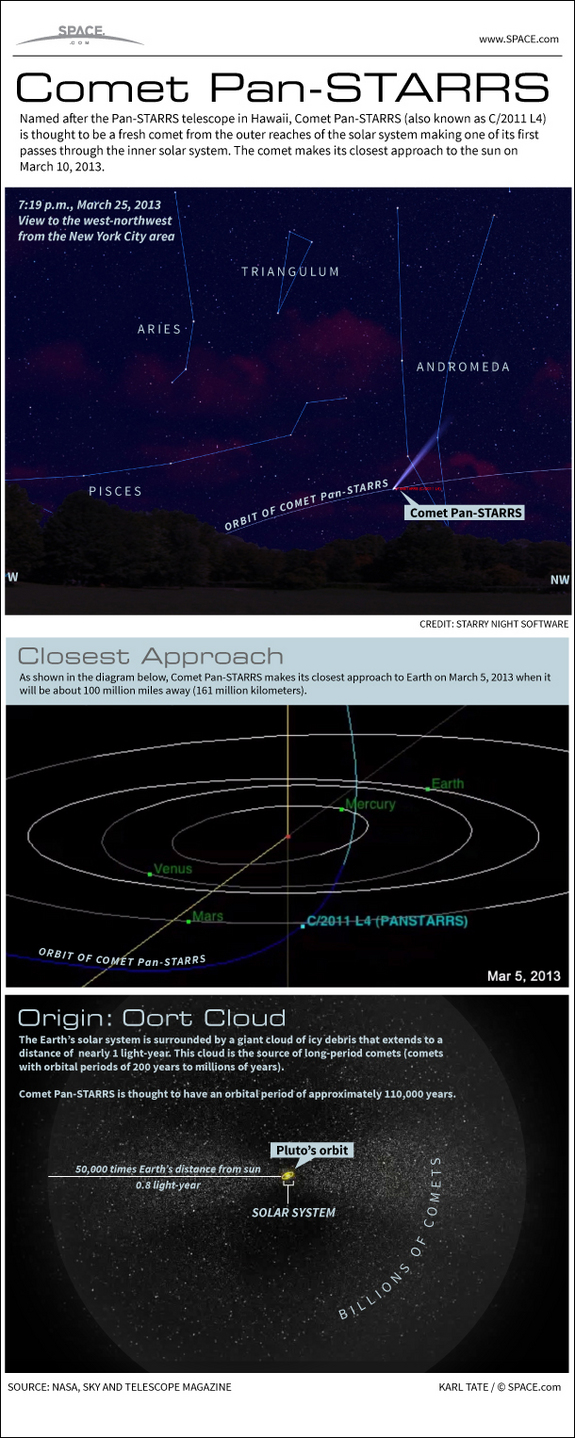
PITTSFIELD, Mass. — For about 15 minutes after twilight the comet Pan-STARRS will be visible on the horizon.
The comet, discovered in 2011, has been close enough to the earth to be seen with a naked eye since the beginning of the month but it was mostly lost in the sun's glare until now. In the next few days, the comet will be on its way back and will be dimly visible, according to NASA.
Pan-STARRS isn't very bright and will be low on the horizon so residents who want to see it will need a "relatively unobstructed view to the southwest at twilight," according to Amy Mainzer, the principal investigator of NASA's NEOWISE mission at the Jet Propulsion Laboratory in Pasadena, Calif.
The National Aeronautics and Space Administration also says there is a tight window for viewing it because the sky will be too bright early in the evenings and the horizon will obstruct views at night. The comet can be seen for only about 15 minutes.
By the end of the month, the comet will be too far away to see.
Pan-STARRS, named for the Panoramic Survey Telescope & Rapid Response System that discovered it, will be the first of two comets visible this year. This fall, NASA predicts the comet ISON will make a pass close enough to viewing. That one could be "spectacular" to see with the naked eye.
Comets are typically only seen without binoculars or telescopes once every five to 10 years.
If you would like to contribute information on this article, contact us at info@iberkshires.com.
Your Comments
iBerkshires.com welcomes critical, respectful dialogue. Name-calling, personal attacks, libel, slander or foul language is not allowed. All comments are reviewed before posting and will be deleted or edited as necessary.
No Comments
Lanesborough Town Meeting to Vote Budget, Bylaws & Vehicle Purchases
By Breanna SteeleiBerkshires Staff
LANESBOROUGH, Mass. — Tuesday's annual town meeting includes a $14 million operating budget, new short-term rentals, accessory dwelling units and sign bylaws, and free cash article appropriations.
Voters will gather at Lanesborough Elementary School on June 9 at 6 p.m. to decide on 20 warrant articles.
The fiscal 2027 budget is up a little over 10 percent. Some of the main increases are the Mount Greylock Regional School District and McCann Technical School: the McCann assessment is up more than 30 percent based on factors including enrollment and the school renovation project, and Mount Greylock's is up 11 percent.
Article 11 is for the town to vote to approve from free cash the sum of $16,298.48 for the McCann Technical School roof and window replacement project so as not to impact the budget. Article 3 is appropriate $7,586,284 for Mount Greylock Regional School assessment.
Another notable increase was in life and health insurance, showing an increase of about 26 percent.
Ambulance Director Jen Weber is planning 24-hour coverage, which means more staff and a hike in her budget. One of the articles asks the town to appropriate $234,100 to operate the Ambulance Enterprise Fund for salaries and expenses.
Many town departments are looking for new vehicles. The Fire Department is looking to replace its outdated 1996 fire engine. There are two articles related to the truck at a total of $813,366. Article 12 would transfer $225,000 from free cash into the Fire Truck Stabilization Fund; Article 13 would transfer $605,000 from the fund and authorize the borrowing of $208,366.08.
The total includes a $100,000 contingency cost to cover any additional costs if a 2026 model-year chassis cannot be secured before new emissions standards go into effect in 2027.
The board at its last meeting moved the $225,000 transfer to come before the borrowing article, changing the stabilization number. If the $225,000 is not voted on, then they will amend the next article's number on the floor, subtracting the $225,000. This shows the borrowing number significantly lower.
Article 17 asks for the transfer of $80,000 from free cash to replace a police cruiser.
Police Chief Rob Derksen's aim is to replace one vehicle every other year, meaning the oldest vehicle gets replaced about every 10 years.
He stressed that if delayed this year, the town may have to double up in a future year to get back on schedule, and that paying later usually costs more. The article will ask for $80,000 from free cash, the vehicles used to be funded by the BHRD.
Lastly, the Highway Department is looking to replace a 2014 International dump truck that will be a total of $330,000 and will take two to three years to receive.
Money will be used from last year's approval of $250,000 from free cash for the replacement of a 2012 highway front-end loader that was underspent $49,261. Town meeting is being asked to approve a transfer of $53,274.85 from free cash and the use of $227,464 from funds from the Sale of Town Real Estate to fund the balance.
Other free cash proposals include $1,200 to purchase software to support tracking and ongoing maintenance schedules of town-owned vehicles; $42,000 for the replacement of the Highway Department's storage shed roof, $200,000 to reduce the tax levy.
As the school year winds down, the sun was shining high as Morris Elementary School and the community celebrated student success with a splash. click for more
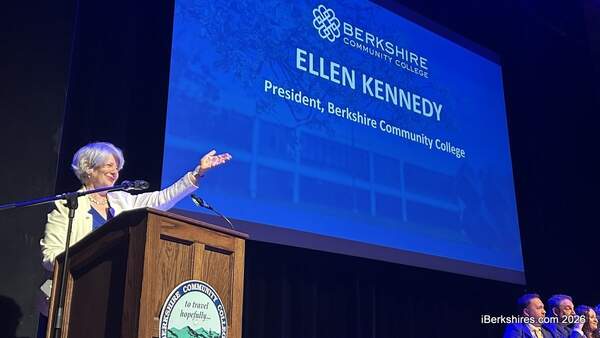
The Berkshire Community College community celebrated outgoing President Ellen Kennedy for the innovation, kindness, and curiosity she has fostered on campus over the last 14 years. click for more
Cassidy Flynn scattered five hits in a complete-game effort in the circle as Lenox upset top-seeded Hoosac Valley, 3-2, in the quarter-finals of the Division 5 State Tournament. click for more
Brayden Durant struck out seven and walked one in a complete-game effort on the mound Saturday to pitch the Drury baseball team to a 6-0 win over Keefe Tech in the quarter-finals of the Division 5 State Tournament at Joe Wolfe Field. click for more
Anthony Salatino Jr. says his memory is getting a little foggy about his time in the Army.
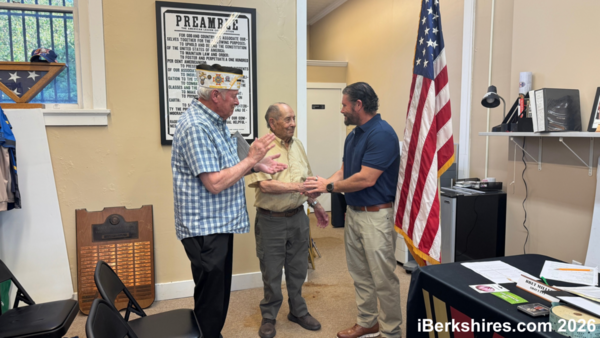
But he remembers how terrible D-Day was, and feeling lucky he wasn't among those in the initial invasion force 82 years ago. click for more