Mount Greylock School Committee Discusses Science and Art Academics
|
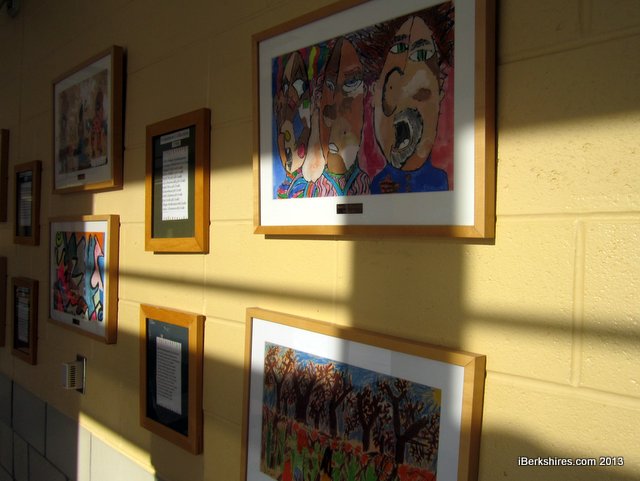
Student artwork framed and hanging in the hallway at Williamstown Elementary School as part of a new initiative in the arts curriculum. |
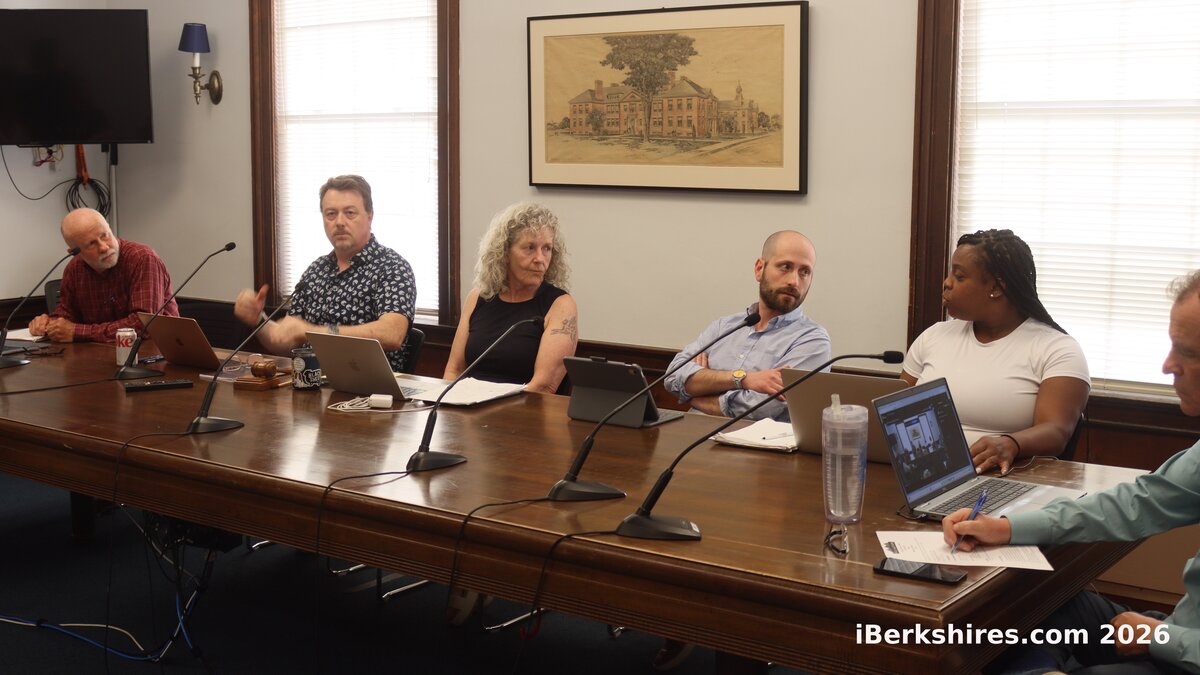
WILLIAMSTOWN, Mass. — Greater collaboration among teachers within Mount Greylock Regional High School and with the faculty at its "feeder" schools was a hot topic at Tuesday's meeting of the school committee.
In recent months, Committee meetings have at times been dominated by discussions about the district's failing infrastructure. But on Tuesday the focus was squarely on curriculum and education.
After its public hearing on the proposed budget, the panel heard a pair of presentations from the district's curriculum, instruction and assessment coordinator, who told committee members about a pair of initiatives - one in the arts and the other in the sciences.
First, Mary MacDonald discussed a recent report from a Rexford, N.Y.,-based consultant who is conducting a three-year assessment of the high school's science program. She then told the board about a recent colloquium that brought together visual and performing arts teachers from Mount Greylock, Lanesborough Elementary and Williamstown Elementary.
The science department at the junior/senior high school received a frank evaluation from Erika Tate of the International Center for Leadership in Education. While praising the school for "embrac(ing) rigorous and relevant expectations for all students," Tate highlighted a number of areas where the school can do better, particularly in light of the Next Generation Science Standards to be released soon by the National Research Council.
"Among the key recommendations ... first of all was to pull together our broad community - faculty, administration and the community itself - to create an action plan for best practices," MacDonald said.
"There was a concern about administration interaction with the faculty. How is administration observing and providing coaching? What is happening with regard to leadership within the faculty itself. ... And how can we take advantage of the rich resources in the community, not just at Williams College but professional resources in the wider community?"
The executive summary of Tate's report lists increased professional development for faculty and coordination without the science department among the key challenges for the program going forward.
"Interviews with faculty and administration revealed few formative observations of classroom instruction and no institutionalized professional collaboration activities," Tate wrote.
MacDonald's presentation elicited some immediate feedback from the committee.
"The report is very well done," Chris Dodig said. "I read it as: We're doing well, but we need to move quickly to do some more. ... Are there any things we can do in the short term? Do we have a chair in the science department?"
"We do have a chair," MacDonald answered, "but the role of the chair traditionally has been someone who can funnel information from the administration. That curriculum leader role doesn't do evaluation or coaching; it's never been part of that job. ... I think that's raised questions for administration."
Naturally, no discussion of Mount Greylock's science program could avoid some discussion of the school building itself.
|
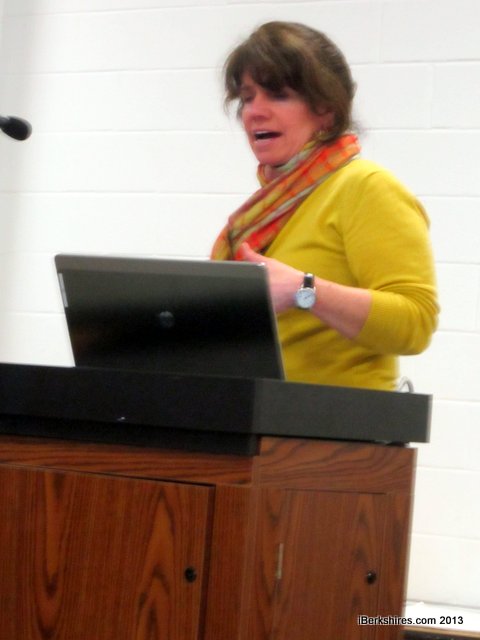
Curriculum, Instruction and Assessment Coordinator Mary MacDonald addressing the Mount Greylock Regional School Committee. |
Improved laboratories were one of the recommendations in Tate's report, but MacDonald and Superintendent Rose Ellis pointed out there are infrastructure improvements that can be made short of either a new or massively renovated building.
"There's a concern about technology, both in instruction and assessment -- the idea of using online technology for students to demonstrate their understanding," MacDonald said.
"The message for us is we need to make technology available in those classrooms," Ellis added. "Saying, 'It's not available,' is not acceptable."
MacDonald said Tate would be returning to the school to provide more feedback and analysis, and that the faculty was embracing her recommendations.
"The teachers are moving forward," she said. "We had a meeting to discuss the full report, and we spent a lot of time really creating an inventory of what's been planned, what's been spurred by some of this. ... Nobody is sitting on the report. The faculty has attended to it, and they're interested in moving forward."
Mount Greylock's arts faculty is moving forward on its own with an outreach to the local elementary schools. Recently, teachers from the visual and performing arts from grades K-12 came together for a half-day of meetings to share ideas and discuss a unified curriculum in the Tri-District.
"To quote (Mount Greylock music teacher) Lyndon Moors, who has been here for 22 years, this is the first time he's been able to have an intense conversation with his arts colleagues in those 22 years," MacDonald said.
She said the faculty plans to schedule visits to one another's schools to observe classes and foresees a two- to three-year process for developing a curriculum across all age levels.
MacDonald, who started in her current position last July, said that the need to build bridges between faculty at the three schools has become apparent to her.
"Once I was established in the three schools, teachers would come up to me and say, 'I'd love to meet with teachers from the other schools,' " MacDonald said. "They would like this to happen on a regular basis. They would like to observe others' classrooms ... and see where they can share resources."
Among the initiatives discussed at the Feb. 15 colloquium: a K-12 art show, a K-12 music festival and a handbook for students and parents highlighting visual and performing arts opportunities at all three schools.
Continuing the theme of curriculum development, the school committee on Tuesday discussed and adopted a new charge for its educational policy subcommittee.
As defined by the committee, the subcommittee, "Reviews educational reports and plans for their policy dimensions, budgetary implications and educational ramifications. Coordinates with the Finance Committee in examining budgetary implications of educational policy, with some additional attention to technology.
"Continues the discussion of the effectiveness of education.
"Works with the administration in crafting a set of policies that meets the norms and expectations of the (New England Association of Schools and Colleges) for an adequate structure of outcomes assessments in anticipation of the upcoming re-accreditation self-study."
School Committee member David Langston, who drafted the charge, said he expected the members of the subcommittee would have to do their homework when curriculum issues come up and help the full committee understand the ramifications.
"Sometimes, I feel like I'm voting blind, and there's' nothing more important than educational policy," Langston said.