North Adams to Vote on Conte Renovation Project

Voters will decide the fate of the Conte School on Tuesday. Polls are open from 7 a.m. to 8 p.m. |
NORTH ADAMS, Mass. — Voters in North Adams will go to the polls on Tuesday to determine the fate of the Conte School project.
The vote will be up or down to authorize total borrowing of $29.7 million, $6.5 million for which the city will be responsible. The split is 80 percent state, 20 percent city. (Grant document is here.)
The state grant cannot be used for any thing other than the Conte renovation.
Should the vote fail, the city is expected to have to resubmit another statement of interest next year. According to the Massachusetts School Building Authority guidelines, "the MSBA cannot indefinitely tie up funds allocated for a project that lacks local support."
There is a possibility to re-address a failed vote within the 120-day deadline, but the city has passed that deadline and had to request an extension to accommodate the ballot vote. It is not clear if the city can — or would want to — reconsider the vote.
Some opponents to the Conte project believe the state will not make the city wait more years to re-enter the program. Officials with the MSBA have declined to speculate whether North Adams would be fast-tracked for a different project.
The renovation of the former middle school was approved last fall by the MSBA after nearly three years of study at a cost of nearly $700,000, including a more extensive review of Sullivan Elementary School after parents there objected to its closure.
However, a citizens petition submitted after the City Council approved the borrowing sent the project to the ballot box. The council last week in a vote of 7-1 approved a resolution backing the Conte project.
Opponents have offered a number of reasons for not pursuing the funding, including concerns over safety and traffic at the East Main Street school, how to pay for the city's $6.5 million share, the building's age and that it does not address the city's poor test scores.
Several have said the city should go back to the drawing board or that Conte could be put to better use as something else. Most arguments have centered on the fact that the project does not solve all the space issues in the city's educational system since it only addresses one school.
Proponents say a school has occupied that spot for more than 150 years, that the safety and traffic concerns can be addressed, that the MSBA did not approve a dual-project to solve all the space issues and that a building program should not be based on test scores.
The administration has put forth a schedule showing the debt for the new school would be approximately $102,500 for the first two years and $370,000 annual after that. It is expected to have no or minimal effect on the budget because of other debt obligations — such as for the Drury and Brayton renovations — being paid off.
The annual debt load is forecast to drop by $1 million in fiscal 2020; however, the city's auditors have warned the administration that its reliance on reserves (stemming from losses in state aid) to pay down a structural deficit could affect its bond rating.
Conte's closure as a middle school in 2009 because of budget cuts put the city's pursuit of a new educational configuration into high gear as Grades 6 and 7 were placed into the three elementary schools and Grade 8 into the high school. Talks about closing the school had begun in 2007 to address the need to restructure the failing middle school model.
|
From 2007 to 2009, the city, citing an accompanying report by the New England School Development Council, submitted statements of interest for Conte, Greylock and Sullivan schools, then for the two elementary schools after Conte's closure.
The NESDC report was used to highlight the school system's needs and possible solutions to the MSBA.
Options considered in the NESDC report included adding classrooms to both schools to reconfigure them into K-8 or to split the schools into a K-4 and 5-8. All the SOIs noted the poor and outdated conditions of the schools.
School officials, in the meantime, had discovered that placement of Grade 8 at Drury High had worked out well and there was a general feeling that the school system should look at a K-7, rather than K-8, configuration.
The School Building Committee hired Margo Jones Architects and Strategic Building Solutions, as owner's project manager, to offer solutions to the problem of educating 620 students, with the idea that Sullivan and Greylock would have to be expanded or rebuilt.
After reviewing the school system's facilities in fall 2010, the architects returned six options that included renovating Conte. The presentation was made at a School Building Committee meeting in February 2011 at which the committee decided to indicate to the MSBA that it wanted to move forward with a K-7 configuration and that it saw the renovation of Conte as a preferred option. Renovating both Conte and Greylock was a close second.
All of the plans were presented at a number of public meetings during the winter and spring of 2011, including one at Sullivan Elementary that had parents up in arms over its likely closure. In May, over concerns expressed by the MSBA over the extent of public input, the city stopped and took another look at Sullivan.
In August 2011, the School Building Committee voted for a two-school project — a renovation of Conte and a new Greylock — but the proposal was rejected by the MSBA. In February 2012, a year after its original vote, the School Building Committee once again determined that Conte was the prime choice.
 Sullivan was considered to have too many structural issues — including foundation issues and a construction style no longer up to modern building codes — and would require more levels and multiple elevators to bring it into compliance with the Americans with Disabilities Act. Moving it to Kemp Park was also considered problematic because of the site issues, including the drop-off behind Kemp, as well as the loss of the neighborhood park.
Greylock, while also suffering from a deteriorating infrastructure, was determined to have fewer immediate problems and could wait a few more years. In addition, fixing Greylock would not address the problems at Sullivan.
Closing Greylock has not been put forward as an option. The committee did discuss making it larger to accommodate 620 students but that proposal never found much traction either at the committee or the public meetings that were held. It has, however, been discussed more recently by opponents to the Conte plan.
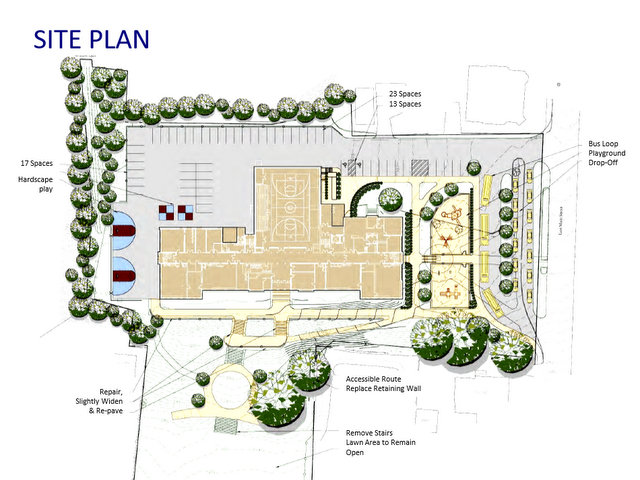
The MSBA gave initial approval to move forward with the Conte project. During the summer of 2012, regular meetings were held to refine all aspects of the plans, including classroom space, playgrounds and parking. The plans were submitted and approved by the state in November 2012.
The plans can be seen here.
Tags: Conte School, election, school building, school project,