Williamstown Conservation Panel Repeats Support of 'Timeout'
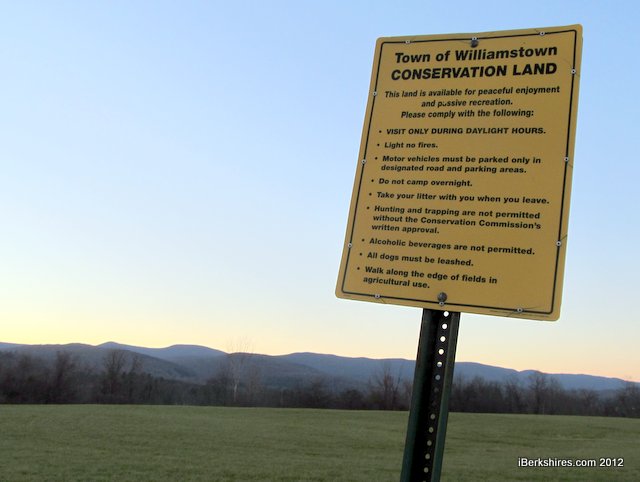 The Conservation Commission is recommending the town meeting table to two articles dealing with conserved land on this year's warrant. The Conservation Commission is recommending the town meeting table to two articles dealing with conserved land on this year's warrant. |
WILLIAMSTOWN, Mass. — The Conservation Commission on Thursday night decided to recommend town take no action on two land-related articles that will be repeated from the April 24 special town meeting at May 21's annual town meeting.
Articles 37 and 38 on the town meeting warrant are identical to a pair of issues first raised at last month's special town meeting. On April 23, the Con Comm joined the Board of Selectmen in recommending that the town take a "timeout" and not consider any of the divisive proposals related to town-owned land currently in conservation.
On Thursday, the Con Comm made a similiar recommendation ... but not without some debate that played out on local television screens over the town's community access television station, WilliNet.
Commissioner Sarah Gardner argued that the Con Comm's recommendation at the special town meeting was unclear to some residents and pushed for a more strongly worded position this time around.
"By taking no action, we don't send a clear message," Gardner said. "It could be interpreted that we agree or disagree."
Gardner was talking about the panel's position on Article 37 on the ATM warrant, which seeks to accept the provisions of the last paragraph of General Law, Chapter 40, Section 15A. If the town were to do so, land transfers of town land for the purpose of building affordable housing could take place by the vote of a simple majority at town meeting; currently, such transfers would require a two-thirds "super majority" of voters.
Resident Robert Hadden supported Gardner's contention from the floor of the meeting.
"I agree that the people of the town would like to see the Conservation Commission take a stand," Hadden said.
Con Comm Chairman Hank Art said the commission's stance last month clearly reflected its contention that the issues on the table at the special town meeting (and to be repeated on May 21) are not ripe for a decision.
"I'm not suggesting that the Conservation Commission doesn't care about having lands protected," Art said. "We care very deeply."
Gardner's motion that the commission recommend to "make no change to the way land is transferred at this time" was defeated by a 4-2 vote of the commission.
Commissioner Thomas Ennis then moved that the commission take the same stance it took in April: that no action be taken on the warrant article. His motion passed by a 5-1 vote with Gardner voting in opposition.
Likewise, the Con Comm voted to support a "timeout" on Article 38 at the annual town meeting, a repeat of Article 2 of the 7:30 special town meeting on April 24. This is the article that seeks to dedicate about 10 acres of the so-called Lowry property off Stratton Road to the aim of developing affordable housing. The Con Comm made an identical "no action" recommendation at its April 23 meeting.
Gardner again voted against the "no action" position.
On April 23, she and Philip McKnight abstained from the "no action" recommendation vote. McKnight again abstained on the same philosophical ground, arguing that town meeting has no authority to take any action on Lowry until after the Con Comm acts.
The Con Comm voted to make no recommendation on Article 36 on the annual town meeting warrant, a citizen's petition to give $365,000 of town money to a yet-to-be-formed residents cooperative at the Spruces Mobile Home Park to allow those residents to keep the park operational.
The author of the article appeared before the Con Comm to defend it. Ken Swiatek of Stratton Road said the article's intent is to preserve the right of the citizens to purchase the park as a cooperative — similar to the recent purchase of North Adams' Wheel Estates park by residents.
Swiatek claims that not only could those 66 homes be preserved, but mobile home sites previously condemned in the wake of Tropical Storm Irene could be used again.
Art challenged that contention.
"Mr. Swiatek, how do you get around the problem of putting homes back in a 100-year floodplain?" Art asked. "They're no longer grandfathered in."
Art said the park predated the commonwealth's Wetlands Protection Act and River Protection Act, and development in land like the park would be much more problematic and costlier today than it was when the park was built and expanded (in the '50s and '70s, respectively).
Spruces resident Linda Chesbro, who has been critical of the town's plan to acquire and dismantle the flood-prone park, asked Art if he was saying it would be impossible to add homes to the park.
"I'm not sure whether it's impossible, but it would be incredibly difficult," Art said.
The annual town meeting is scheduled for 7 p.m. on May 21 at Mount Greylock Regional High School
Tags: affordable housing, conservation commission, conserved land, flooding, Spruces,