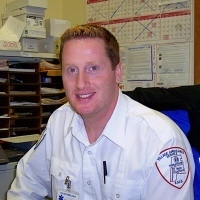
Shawn Godfrey is a certified paramedic and the operations manager for the Village Ambulance Service Inc., Williamstown.
The Spirit: The True Backbone of Us All
In 1995, actor Christopher Reeve fell from a horse and severely damaged his spinal cord, leaving him paralyzed from the neck down. From then until his death in 2004, our beloved Superman became the most recognizable face of spinal cord injury.
But he was not alone. Every year, about 12,000 Americans experience trauma-induced spinal cord injuries that permanently change their everyday activities, their jobs, their relationships, their dreams, their long-term happiness and their lives.
Paramedics and emergency workers are trained to treat people who have sustained traumatic head or neck injuries as if they already have a spinal cord injury or an unstable spinal column, until a thorough neurological screening and diagnosis can be completed. In fact, pre-hospital spinal immobilization is arguably the most emphasized treatment modality found in any emergency medical technician (EMT) text book or training syllabi.
One key step in the initial treatment of a traumatic head or neck injury is immobilizing the spine. Immobilizing the spine can prevent injury to the spine or forestall exacerbation of an injury that is already present. For this reason, emergency personnel receive training in handling such an injury, so as not to further manipulate the person’s neck and back. EMTs carefully apply rigid collars around the injured person's neck and methodically employ techniques to place the injured person on a rigid board, until a complete evaluation can take place.
In the emergency room, a physician may be able to rule out spinal cord injury by carefully inspecting an injured person, testing for sensory function and movement and asking some questions about the accident or mechanism of the injury. But if the injured person complains of neck pain, isn't fully awake or has obvious signs of weakness or neurological injury, further emergency diagnostic tests may be needed.
Significant injury to the spinal cord usually leads to permanent disability or loss of movement (paralysis) and sensation below the site of the injury. Paralysis can involve all four extremities, a condition called quadriplegia, or only the lower body, a condition called paraplegia.
An accident that results in permanent paralysis can be a life-changing event, whether you've lost movement in your legs and lower body or all four limbs. Recovery from such an event takes time, but many people who are paralyzed move on to lead productive and fulfilling lives. The will to live in all of us is amazingly strong and the adaptability used by many affected people to lead their lives is extraordinary.
Many scientists are optimistic that important advances will enable some motor and sensory function in people with spinal cord injuries within the next 10 to 25 years. In the meantime, medications, rehabilitation and counseling allow many people with spinal cord injuries to lead happy, active and independent lives. And make no mistake about it, those living with para/quadraplegia don’t expect or, quite frankly, want sympathy because of their condition. They simply ask we recognize that they are no different from the rest of us.
Jesse’s story is a reminder that the spirit is the backbone of us all.
Jesse’s Story
(Edited for Content)
When I was 18 years old, I was hired for summer work by the local highway department. Among an array of duties, one of the job responsibilities consisted of operating a street sweeper. While driving the sweeper, I had to cross a set of infrequently traveled railroad tracks to dump the contents at a nearby waste station.
After dumping the contents, I needed to cross back over the tracks to continue my route. Unfortunately, due to an abundance of drooping overgrown tree boughs, I could not clearly see to my left. As I inched forward to see beyond the encumbering tree line, a train engine was quickly backing down the tracks.
I remember the engine speedily emerging from the trees and violently crashing into my vehicle. I was ejected from the cab then violently landed on the corner of an old railroad tie lying in a nearby conduit. The impact permanently damaged most of my C-5 (numbered top-to-bottom from C1-C7, atlas [C1] and axis [C2)], are the vertebrae that allow the neck and head so much movement) vertebra.
After summoned by another motorist, the paramedics, realizing the seriousness of the injury, immediately injected a steroid that helped contain the swelling in the spinal area. From the scene, I was airlifted to a nearby trauma hospital and immediately operated on by a team of neurosurgeons and other specialists.
The only injury I sustained was the broken C-5 vertebra. The surgeon had to extract most of the bone and reconnect the remaining segment by fusing bone from my hip and securing it with a plate that attaches to the C-4 to C-6 portion of the spinal column. He explained to me that my spine was “bruised†and that none of the nerves were severed.
Following surgical stabilization, I was eventually sent to a rehabilitation hospital to start my “new†life. While there, I started to regain sensation, albeit limited, in both arms and wrists.
I am now classified as a C-5/C-6 quad. I have the ability to strongly raise both my wrists, palms down, but cannot raise either, palms up. I also regained a small amount of triceps (upper arm muscle) use and can flex the muscle slightly, but it is too limited for effective utilization.
Aside from the ability to feel above the nipple line, I do feel pressure throughout my entire body. I also feel indescribable discomfort in my back, buttocks, and feet. Although difficult to explain, I can also sense when I am touched on these areas.
My feet are especially sensitive to touch, with a “pins and needle†sensation, and I have the ability to feel when both buttocks are getting sore from sitting in one position too long. Fortunately, this reminds me to reposition myself in order to prevent painful pressure sores.
The present condition of my hands is interesting, too. I can feel what could be classified as a “normal†sensation in my thumbs and index fingers, but only a pressure-like sensation in the remaining digits. I also feel pain in my upper arms, shoulders, upper chest and head.
I suffer from periodic spasms in the paralyzed muscles, but it is usually controlled with 50mg of Baclofen (medication used for the treatment of spastic movement, especially in instances of spinal cord injury) a day.
All things considered, I am relatively healthy. My doctor often tells me I am the poster child of what life as a quadraplegic can be, and thanks to the excellent care I receive and the effort and enthusiasm put forth in my rehabilitation, things will only become easier.
Truthfully, I am not looking to walk again, but I wouldn’t mind doing so. Mostly, I would like to have full use of my arms and hands. This would allow me the ability to care for myself and not constantly rely on the help of others on a daily basis.
Just the ability able to transfer myself from the wheelchair to and from the bed; dress; cook; bathe, or throw a baseball again would be wonderful!
One Step at a Time
Today, there's still no way to reverse damage to the spinal cord, but advances in recent years have improved the recovery of patients with spinal cord injuries, cutting in half the amount of time survivors must spend in the hospital. Researchers are working on new treatments, including innovative therapies, prostheses, and medications that may promote nerve cell regeneration or improve the function of the nerves that remain after a spinal cord injury.
If you would like to contribute information on this article, contact us at info@iberkshires.com.
Your Comments
iBerkshires.com welcomes critical, respectful dialogue. Name-calling, personal attacks, libel, slander or foul language is not allowed. All comments are reviewed before posting and will be deleted or edited as necessary.
Loved the column! I can't imagine the work that is need to recover from such a devistating injury.
Yes, people with permanent paralysis are handed a mobility disadvantage, but for those I have met, they remain socially active and instrumental in delivering positive contributions to everyone around them.
Good Story, we sometimes forget that once we drop them off at the hospital our journey usaully ends with them, but their journey will last the rest of their life.
This a story is a great reminder. Sometimes We wonder why we board everyone that has had a fall or car crash. Then we have a pt. that has a cervical fracture that would be parylized if they weren't placed in a crevical collar and on that backboard.
Lanesborough Town Meeting to Vote Budget, Bylaws & Vehicle Purchases
By Breanna SteeleiBerkshires Staff
LANESBOROUGH, Mass. — Tuesday's annual town meeting includes a $14 million operating budget, new short-term rentals, accessory dwelling units and sign bylaws, and free cash article appropriations.
Voters will gather at Lanesborough Elementary School on June 9 at 6 p.m. to decide on 20 warrant articles.
The fiscal 2027 budget is up a little over 10 percent. Some of the main increases are the Mount Greylock Regional School District and McCann Technical School: the McCann assessment is up more than 30 percent based on factors including enrollment and the school renovation project, and Mount Greylock's is up 11 percent.
Article 11 is for the town to vote to approve from free cash the sum of $16,298.48 for the McCann Technical School roof and window replacement project so as not to impact the budget. Article 3 is appropriate $7,586,284 for Mount Greylock Regional School assessment.
Another notable increase was in life and health insurance, showing an increase of about 26 percent.
Ambulance Director Jen Weber is planning 24-hour coverage, which means more staff and a hike in her budget. One of the articles asks the town to appropriate $234,100 to operate the Ambulance Enterprise Fund for salaries and expenses.
Many town departments are looking for new vehicles. The Fire Department is looking to replace its outdated 1996 fire engine. There are two articles related to the truck at a total of $813,366. Article 12 would transfer $225,000 from free cash into the Fire Truck Stabilization Fund; Article 13 would transfer $605,000 from the fund and authorize the borrowing of $208,366.08.
The total includes a $100,000 contingency cost to cover any additional costs if a 2026 model-year chassis cannot be secured before new emissions standards go into effect in 2027.
The board at its last meeting moved the $225,000 transfer to come before the borrowing article, changing the stabilization number. If the $225,000 is not voted on, then they will amend the next article's number on the floor, subtracting the $225,000. This shows the borrowing number significantly lower.
Article 17 asks for the transfer of $80,000 from free cash to replace a police cruiser.
Police Chief Rob Derksen's aim is to replace one vehicle every other year, meaning the oldest vehicle gets replaced about every 10 years.
He stressed that if delayed this year, the town may have to double up in a future year to get back on schedule, and that paying later usually costs more. The article will ask for $80,000 from free cash, the vehicles used to be funded by the BHRD.
Lastly, the Highway Department is looking to replace a 2014 International dump truck that will be a total of $330,000 and will take two to three years to receive.
Money will be used from last year's approval of $250,000 from free cash for the replacement of a 2012 highway front-end loader that was underspent $49,261. Town meeting is being asked to approve a transfer of $53,274.85 from free cash and the use of $227,464 from funds from the Sale of Town Real Estate to fund the balance.
Other free cash proposals include $1,200 to purchase software to support tracking and ongoing maintenance schedules of town-owned vehicles; $42,000 for the replacement of the Highway Department's storage shed roof, $200,000 to reduce the tax levy.
Cassidy Flynn scattered five hits in a complete-game effort in the circle as Lenox upset top-seeded Hoosac Valley, 3-2, in the quarter-finals of the Division 5 State Tournament. click for more
Brayden Durant struck out seven and walked one in a complete-game effort on the mound Saturday to pitch the Drury baseball team to a 6-0 win over Keefe Tech in the quarter-finals of the Division 5 State Tournament at Joe Wolfe Field. click for more
Jason Codey struck out 13, walked two and allowed just an infield single as the Generals earned a 7-1 win over Wahconah to claim their third straight regional title. click for more
Gracelyn Wright struck out eight, and Genevieve Lagess went 3-for-5 with four runs batted in as the Hurricanes beat Monson, 17-3, to claim their first Western Mass title in four years. click for more
For the boys, Ward Bianchi helped lead the way with a win in the shot put and a second place in the javelin as the Mounties finished 16 points ahead of runner-up Pittsfield (pending the results of the pole vault, which were unavailable at 11 p.m. Friday night). click for more