Williams College'S Center For Environmental Studies Recycles A Professor

Print Story | Email Story
When Williams College invited Thomas C. Jorling to return as a Visiting Distinguished Professor of Environmental Studies (http://www.williams.edu/CES/), the retired educator, government administrator and corporate executive knew he would find major changes in the classroom after 20 years away from college teaching. Interviewed this fall at his Kellogg House office on the Williams College campus, Jorling said, "I was more apprehensive now than I was back when I first began teaching in 1972. Part of that is because the expectations of students, faculty, and the institution are very different now with respect to everything that's encompassed in the electronic revolution." He was prepared for big changes involving the arrival of high-tech teaching tools in the classroom when he agreed to teach the Introduction to Environmental Studies lecture course to 49 students, mostly first year students. But he also told the college he would prohibit laptops, Blackberries, and similar devices in the classroom because "when they're in a wireless environment, they're all over the world." He encountered no opposition from students or from the college to his requirement. Jorling, a Cincinnati native who's now 67, served as the director of Environmental Studies at Williams College from 1972 to 1977 after a stint as minority counsel to the U.S. Senate Committee for Public Works. He headed New York State's Department of Environmental Conservation and worked as assistant administrator of the U.S. Environmental Protection Agency (http://www.epa.gov/), returning once before to Williams from 1980 to 1986. He spent 10 years as vice- president for environmental affairs at International Paper, retiring in 2004. Another change, he noted, stems from the students' access to "an unbelievable amount of information, instantly." The major challenge is helping students sort through the deluge of information available electronically. He's concerned about an "attention-span issue" - students are accustomed to a deluge of stimuli from different sources, leading them to require a rapid-fire approach in the classroom. "I think there's a tendency to be too uncritical of the information flood; they tend to believe almost anything they read or gain access to," Jorling observed, although he pointed out that students arrive better-equipped with knowledge about the environment thanks to high- school courses. When climate change comes up in the classroom, Jorling emphasizes that while scientific consensus has emerged on the dimensions of the problem, workable solutions are far more elusive. He cites the development of wind-power technology as a "very important part of the solution," part of a long list of alternative power sources, but opposes the use of nuclear energy to curb greenhouse-gas emissions. "The key to it - and where we're stuck right now - is a social commitment to wean ourselves from fossil fuels," he said, citing a "substantial wing of the Democratic party" that's committed to clean coal technology (http://www.technologyreview.com/Energy/18398/) that requires a "huge new demand for energy, something like 20 percent more to operate cleanly." But he foresees a bipartisan approach emerging on Capitol Hill to tackle the climate-change crisis; he has viewed the environmental movement as hampered by its close identification with the Democratic Party, an impediment to meaningful consensus in Congress. Jorling says his teaching technique has not changed over the years. "Then, as now, I consider the basic objective of teaching as helping students to learn how to think seriously about a problem, not a right answer or wrong answer, but giving them the confidence that they can think through these things deeply and learn how to use the tools they have available." He urges students to consider opposing views, not to demonize those who disagree; an example is a classroom exercise to think through why someone would support going slow on climate change. "If there is a lesson that I've learned," Jorling explained, "it's that most people want to do the right thing, but they have a different history and a different perception of what the right thing is. They're not evil if they disagree with you." Looking ahead, Jorling hopes to teach a seminar that would draw upon his experience in academia, government, and the private sector - "all of them have important roles...and they've all been rewarding."
If you would like to contribute information on this article, contact us at info@iberkshires.com.

Williamstown Board Opts to Negotiate with College on Water St. Lot

By Stephen DravisiBerkshires Staff
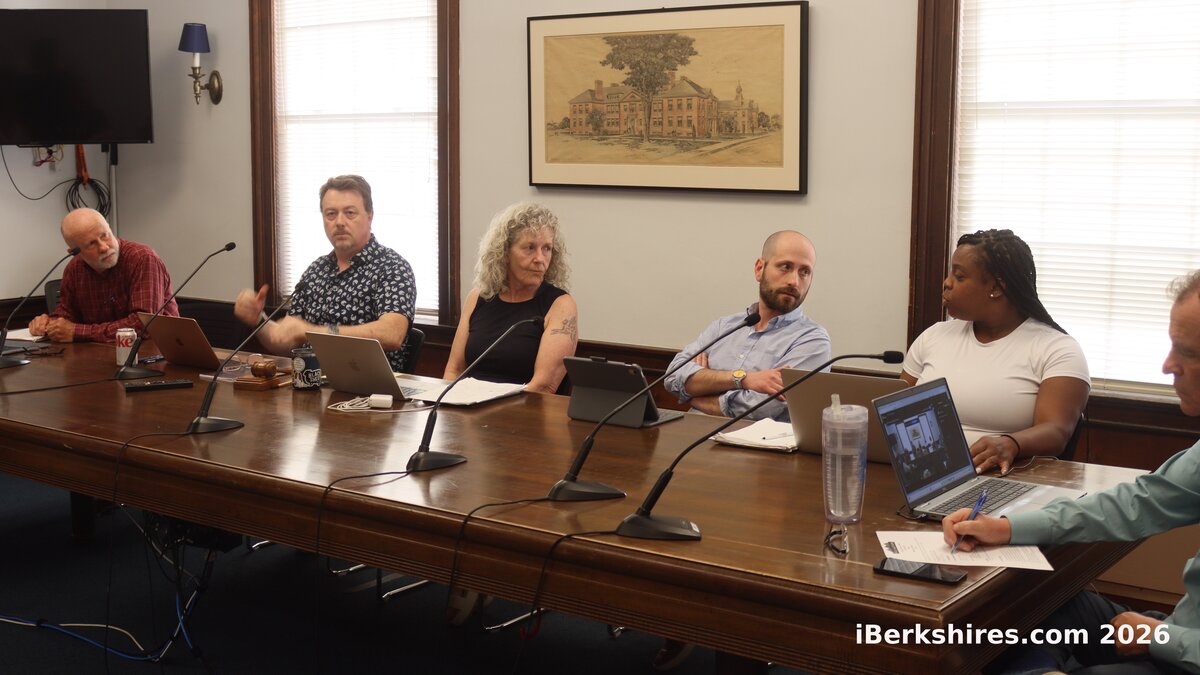
Newly elected board member Nate Budington, far left, participates in his first in-person meeting along with, from left, Matt Neely, Stephanie Boyd, Peter Beck, Shana Dixon and Town Manager Robert Menicocci.
WILLIAMSTOWN, Mass. — The Select Board on Monday decided to enter into negotiations with Williams College on the sale of the vacant town-owned lot at 59 Water St.
 
But the board members made it clear that the college's proposal to acquire the lot is a starting point, not a final deal that the elected officials would accept.
 
"For the sake of continued conversation, I'm in favor of [awarding Williams the site], but if this process wasn't continued with the opportunity for further negotiation, I wouldn't vote to continue this," Peter Beck said. "I think that next step is necessary for us to get to a yes on this."
 
"I think there's wide agreement on that," Matthew Neely said just before the 5-0 vote to enter talks with the college.
 
Williams was the sole respondent to a town-issued request for proposals to develop the former town garage site, currently a dirt lot.
 
The college's stated intent is to build a new Facilities office and create up to 170 parking spaces at 59 Water Street. That use will allow the college to redevelop the current Facilities building site and parking lot as part of a reconception of the school's indoor athletic and recreation facilities.
 
Under the terms of the RFP, the college's proposal was subjected to review by an ad hoc advisory committee to the town manager, who brought the question to the Select Board. That board will have the final say on any purchase and sales agreement.
 
View Full Story

More Williamstown Stories