Officials Quizzed on School Union Proposal

By Tammy DanielsPrint Story | Email Story
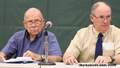
WILLIAMSTOWN - The plan for a joint superintendency union with Lanesborough Elementary School did not get a warm embrace at Tuesday's public hearing, with one teacher wondering why they seemed to be "rushing into a marriage." Nearly two dozen residents, teachers and interested parties pelted the School Committee with questions concerning the proposed union after a presentation by committee Chairman David Backus. Several were concerned about future votes and what it would mean to the autonomy of each school. Others questioned how it might affect services if the top administrators had to be shared with a district a half-hour away. "I'm not convinced all the subtleties have been explored," said resident Rob Savage. The school district has been in talks with Lanesborough since early September. Lanesborough is currently part of School Union 69, which also includes Hancock, New Ashford and Richmond. It would leave Union 69 to create a new union with Williamstown, if both school committees agree. According to state law, both schools would have equal representation on the supervisory board (three members each) and share four administrative positions and their associated costs based on the number of students (Williamstown's share would be 60 percent). It would not affect programs, curriculum or faculty at either of the schools. "We just share their costs and we just share their time," said School Committee Chairman David Backus. The proposal was presented as a win-win situation by providing long-term stability for both schools. Williamstown would save an estimated $110,000 in administrative costs and Lanesborough, which now pays 60 percent of the costs but only has 25 percent of the voting rights in its current union, might also see some relief. It would also provide greater buying power for commodities such as paper, pencils and equipment. Discussions between the local school districts have been off and on over the last 40 years, but the imminent retirement of William Ballen, Union 69's superintendent, put the school union idea on the fast track. Kate Seid, who said she was "wearing many hats" as parent, teacher and teacher's union president, worried about access to the administrators, who would presumably be Williamstown's Superintendent Rose Ellis and Michael Singleton, director of special education. (The other two positions would be executive secretary and business coordinator.) "We have administrators who don't delegate a lot. Some of us feel access is already limited," she said, referring to faculty and parents. How would that management style work if they had to deal with another school, Seid continued, and if it didn't work out, how would school officials know? "Yes, it's a challenge overseeing two school districts," said Ellis, but added that she had worked with the Lanesborough principal before. Her time, and Singleton's, would likely be split three days in Williamstown and two in Lanesborough. School officials said mechanisms could be put in place to provide feedback to them and the administrators. Backus referred several questions to New Ashford School Committee Chairwoman Brenda Frye, who was sitting in the audience. Frye said there has been no downside to being in a union. "It's worked for us." If the superintendent or special ed director has to spend more time at one school than another, they will, she said. Frye added that the union was likely to release Lanesborough at the end of January. A Lanesborough resident wondered if that town would get a share of the largess Williams College provides to the Williamstown school. Backus said Lanesborough would have to talk to the college about it. Grants and other funding the schools received would not be shared, he said. Some wanted to know if the savings would be put toward specific programs but committee members responded that the funds would part of the general budget. The school district is facing declining revenues and population while costs keep rising, warned committee member Judy Fraser. The declining school population is reducing the number of classes for each grade - squeezing the number of slots open for school-choice students, which bring in 15 to 20 percent of the school's revenue. Joining with Lanesborough will take some of that pressure off and provide financial relief. "I think it's going to be terrific fiscally and in other ways," said Fraser. Jennifer Welch of New Ashford, whose children attend Lanesborough School, asked if the union could facilitate social exchanges between the children to help prevent conflicts between the two groups when they begin attending Mount Greylock Regional High School. Ellis said it was up to the schools, since every union is different - some work very closely together, others stay far apart. Audience members urged the School Committee to schedule another public hearing because they felt there were still too many questions. The committee will likely set another public hearing when it meets next month. Lanesborough is holding a public hearing tonight at 7 the school.
If you would like to contribute information on this article, contact us at info@iberkshires.com.

Williamstown Planning Board Narrowing in on Subdivision Bylaw Changes

By Stephen DravisiBerkshires Staff
WILLIAMSTOWN, Mass. — The Planning Board late last month discussed specific features of what it plans to pass as a new subdivision control bylaw this year.
 
The board long has discussed the complex set of regulations as being out of date and cumbersome to both potential developers and the board itself, which has needed to hear requests for waivers of outdated rules for the handful of residential subdivisions that have been proposed in town in recent years.
 
This spring, the town engaged consultants from Northampton's Dodson and Flinker Landscape Architecture and Planning to go through the existing bylaw, compare it to more contemporary regulations in other communities and help craft a revised bylaw.
 
Unlike the zoning bylaw, where amendments require approval of town meeting, the subdivision control bylaw is a creation of the Planning Board, which can make changes on its own after a public hearing process it hopes to complete this year.
 
At a special Planning Board meeting on May 26, Dillon Sussman of Dodson and Flinker and his colleagues walked the board through a dozen different decision points that the board must resolve — either by leaving the bylaw as is or making a change — and offered suggestions based on best practices.
 
All of the issues are technical and ranged from the fundamental, like how the bylaw will define types of subdivisions, to the highly specific, like what turning radii will be required in new streets that are constructed to serve planned developments.
 
One example of a topic that came up in the recent approval of a four-home subdivision off Summer Street is stormwater management.
 
View Full Story

More Williamstown Stories