Initiative Aims to Get At-Risk Kids Ready for School
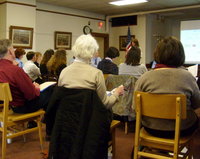 |
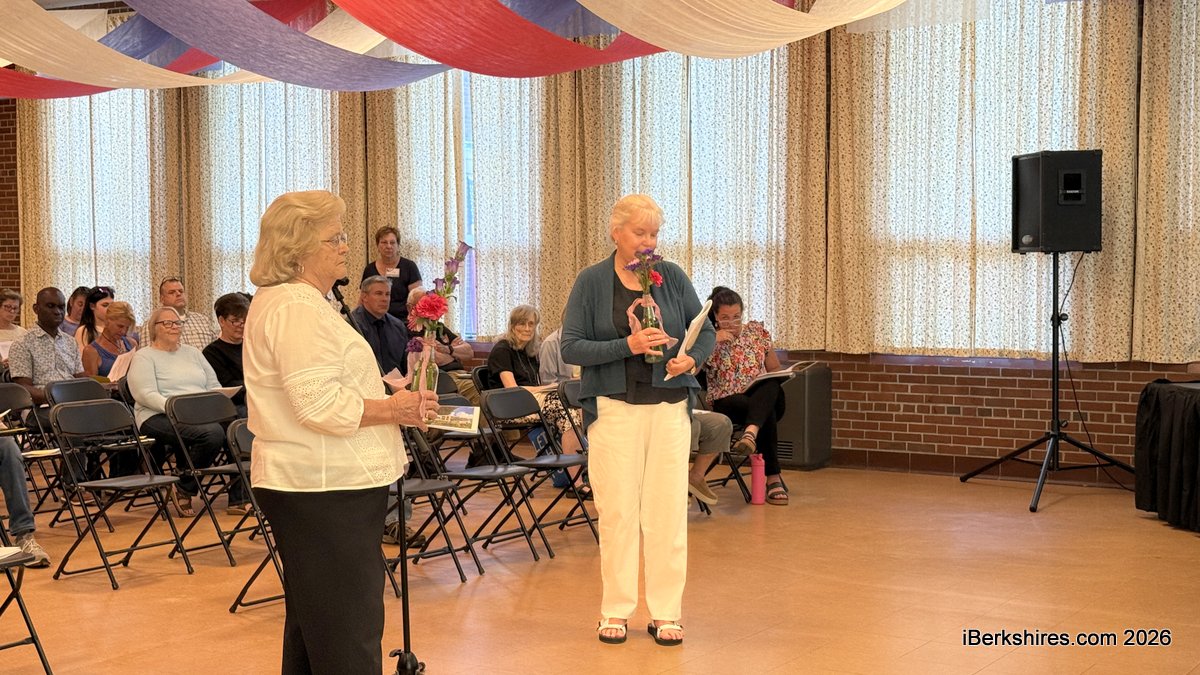
| Consultant Ruth Bowman talks about her findings to the Adams 'Village Council.' |
"It's just staggering," said Dr. Michael Gerrity on Friday. "This isn't just about the kids. It's about the family, the parents and the whole nurturing situation."
This was the first time C.T. Plunkett School had compiled and compared data on the pupils entering its kindergarten, done as part of the Early ChildHood Outcomes program.
The numbers were eye-opening enough that the team compiling the data said next year's parent surveys would be tailored to elicit more information.
"Our parent surveys were already done [for the school year]," said Mary Whitman, a kindergarten teacher at Plunkett. "We are going to redo our parent surveys and we are going to be more specific, but we've never really analyzed the data like this. Now it's much more meaningful for us."
Some 30 educators, social-service representatives and others gathered at the Adams Free Library on Friday morning to discuss the data and brainstorm ways to better prepare the county's children for school.
The ECHO initiative grew out of concern that an estimated 40 percent of local children are considered "not ready to learn."
The Northern Berkshire United Way considered that the No. 1 community priority because unprepared children need substantial services, which strain school budgets and personnel and siphon resources away from other students.
Armed with a half-million dollars, the organization has been working with other agencies and local entities to determine how best to use scarce resources to support the county's youngest citizens. The goal is to engage the broader community, "the village," in developing solutions and expectations.
Plunkett School was chosen to host the pilot program after the Echo Steering Committee decided to focus on one school to launch the initiative. Gerrity is chairman of the committee.
The Plunkett team of Whitman and special-education teacher Jacquelyn Fortier, were joined by several other faculty members.
They found that children determined at-risk were more likely to have health issues, more likely to fall behind their peers academically, and more likely to be retained and need far more help to succeed.
More significantly, these children are also more likely to have unstable home situations and parents who are substance-abusers.
Some 61 families and 107 children within the town are working with the Department of Social Services; countywide, DSS has more than 300 children in some type of foster care.
There also seems to be growing transient populations, driven by the lack of affordable housing and other issues.
"If you can't afford the housing that you're in, you're not going to stay there that long," said Brad Gordon of the Berkshire Regional Housing Authority. "You need housing that offers stability so then they can work on other issues that they have."
Consultant Ruth Bowman outlined a number of issues the Adams Village Team should address: a lack of awareness among parents regarding child development and early learning experiences; stigma associated with accessing social services; prevalence of substance abuse and domestic violence; transience, unemployment and poverty; and uneven access to mental health services for children.
The assembly later broke up into brainstorming sessions; another meeting to discuss those outcomes has been scheduled for March 14. An action is expected to be unveiled in April for implementation at the beginning of the school year.
"We need a community-based systemic response; the larger surrounding community commitment is missing - I think that's the piece that will make it or break it," said Gerrity. "The extent that we can engage the entire community in owning and solving this problem."