Local Man Embraces Green Construction
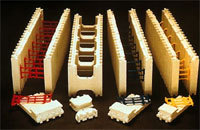 |
| Insulated Cement Forms [Photos courtesy of Portland Cement Association] |
CLARKSBURG – David Thayer calls it the next great thing in green building technology, but not everyone is ready to embrace it.
"Some people have got it ingrained in them that there's only one thing out there," said the north Berkshire contractor.
Thayer builds houses using Insulated Concrete Forms, an energy-saving material that some say are they key to building homes that not only live up to eco-friendly standards but also provide increased safety from weather disasters or fires. Though ICF technology has existed for more than 30 years, relatively few contractors use the material (Thayer is the only one he knows of in the county using it to create full houses), sticking instead to the wood-framed house convention.
An ICF system uses hollow blocks made of plastic or rigid foam used to form walls – traditionally for foundations. The large panels are connected by plastic or cement ties and lock together. Later, the cavities are filled with concrete, creating insulation that is both strong and durable.
"They're like Legos. You stack them up to the configuration of your house and fill them up with concrete," said Thayer, who said he's been using ICFs for 10 years but has only recently started constructing complete houses with it. "You don't have to do any additional work, you don't have to insulate. It's drier and it's not susceptible to humidity from the outside so much."
Thayer also said the blocks can withstand a 2x4 pieces of lumber shot at 100 mph or more.
"It just makes sense to me to do things better," Thayer said. "Lots of people are afraid of using it because it's only been around for 30 yeas but it saves energy and cuts costs. If that's nothing to cheer about it, I don't know what is."
<L2>Though building houses with ICF blocks is still relatively rare, the practice has gained popularity over the last decade, mostly because of its reputation for energy-efficiency and safety. According to Thayer, ICF insulated walls have a higher R-value (the measure of resistance of heat flow), even up to R-50, where most wood-framed walls have values between R-15 to R-20.
"That means the more insulation, the better. It cuts the cost of heating and cooling and gives you a better performance," Thayer said.
Also among the advantages are long-term durability with minimal upkeep, allergen and toxin reduction, fast construction and low maintenance.
Still, many have yet to embrace this simple concept, citing heightened construction costs.
"Sure, there's more on the total cost of the house; it's 2 to 5 percent more but you save more in the long run. A homeowner will make that money back in energy savings," said Thayer, who has recently completed houses in Windsor and Chester, in Hampden County, and wants to help in future construction at the former Green Mountain Race Track in Pownal, Vt.
Some environmentalists claim that working with ICFs should not be considered "green," calling the blocks rich in carbon and hydrocarbon materials. One writer, architect and developer Lloyd Alter of Toronto, said that energy-efficiency should not be the standard for environmental friendliness.
"ICFs are energy efficient for the occupant, solid and strong, and useful for foundations. However I think we are past the point where anything that saves a little money on heating is called green, the issues are bigger than that now. In such a world, polystyrene and concrete sandwiches are not green," said Alter in a 2007 blog on Treehugger.com.
In response to that sort of criticism, ICF manufacturers like Emega Polymers, Inc. (based in Ohio) have created the blocks out of soybean oil, making homes built from the product both energy-efficient and sustainable.
For Thayer, the future of construction means turning to new technologies that will help consumers reduce their impact on the environment, while helping to keep their own costs low.
"Just watch. ICFs will become more popular as heating costs increase. We have to be open to new things," said Thayer.
David Thayer can be reached at 664-8688.