State Launches Initiative to Reduce Bus Pollution
 |
The program will install pollution controls on diesel-powered school buses serving public schools across the state by 2010. MassCleanDiesel is the nation's first fully funded statewide program to reduce air pollution from all school buses.
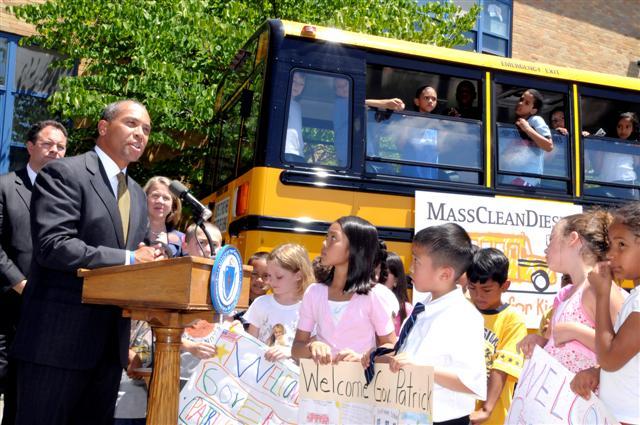
"The buses that take our children to school should not foul the air breathed by those same children, and this program will help put that situation to an end," said Patrick, at an event held at the Julia F. Callahan School. "I applaud the city of Lynn and its school-bus operator, North Reading Transportation Co., for stepping forward as the first to volunteer for this new program, and I call on all school districts in the commonwealth and their bus companies to take part."
Administered by the state Department of Environmental Protection, some 5,500 school buses will be able to be retrofitted – virtually all the large diesel-powered school buses serving public schools that weigh more than 10,000 pounds and carry more than 10 students at a time.
The retrofitted buses will release less air pollution, resulting in healthier air for everyone, but especially students and drivers, say state officials. Approximately 750,000 schoolchildren ride school buses each day.
Pollution controls will be installed using $16.5 million in state and federal funding provided by the Massachusetts Executive Office of Transportation and Public Works under an agreement associated with the Central Artery/Tunnel Project, the Big Dig.
Efforts to reduce school-bus emissions have gained traction over the past few years, with a number of towns, including Williamstown, spearheading anti-idling regulations at schools. The state now limits bus and car idling at schools to no more than 5 minutes.
Patrick also directed Secretary of Energy and Environmental Affairs Ian Bowles and MassDEP Commissioner Laurie Burt to report back to him by Labor Day with a comprehensive program for reducing diesel pollution from other sources, with priority given to protecting vulnerable populations and reducing heavy concentrations of pollution.
High Rate of Asthma
School buses are a safe and energy-efficient way for children to get to school. But school buses, like all diesel-powered vehicles, pollute the air with harmful gases and particles. Diesel pollution contributes to asthma attacks, respiratory problems, and other diseases. A 2006 Department of Public Health survey of 662,994 students in 1,780 Massachusetts schools found that 1 in 10 schoolchildren in kindergarten through eighth grade have asthma.
"The launch of MassCleanDiesel affirms the commonwealth's commitment to providing clean air to all residents in the state, and especially our children, whose developing lungs are particularly susceptible to the harmful effects of diesel exhaust," said Bowles."It is also the first step toward a comprehensive approach to combating diesel pollution."
The MassCleanDiesel initiative is the result of a 2006 agreement between EOT and MassDEP where $22.5 million in state and federal funds was made available to retrofit thousands of school and regional transit buses across the state.
The North Reading Transportation Co. serves school systems in Chelmsford, Dracut, Lawrence, Lowell, Lynn, North Andover, Wakefield and Wilmington, carrying 22,000 students to school each day. Also expressing interest in joining the MassCleanDiesel program are the school systems in Andover, Beverly, Cohasset, Egremont, Gill, Greenfield, Lincoln and Monson, as well as the Manchester-Essex Regional School District and the Southeastern Regional School District.
Retroffitting Diesel Buses
Diesel retrofits will decrease the levels of exterior and in-cabin particulate matter, carbon monoxide and hydrocarbon emissions, and produce less tailpipe exhaust and pollutants that form smog, without compromising vehicle performance. To receive free retrofits, school bus owners must enroll in the program, obtain estimates from retrofit vendors, and work with the vendors to coordinate equipment installations. MassDEP will reimburse the retrofit vendor directly, provided that installations meet all terms of the program.
"The Patrick Administration is to be commended for taking a huge step forward for public health," said Sam Krasnow, policy advocate for Environment Northeast and member of the steering committee of the Diesel Pollution Solution Coalition, a statewide consortium of public health and environmental advocates. "By addressing school buses, the commonwealth is on its way toward cleaner air for kids and their communities."
For more information, visit MassCleanDiesel or call the Help Line at 617-292-5809.