Vermont Farmer Finds Fuel in Flowers
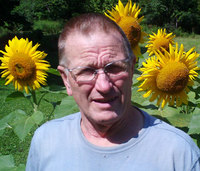 |
| Keith Armstrong is hoping to grow his own diesel fuel. |
POWNAL, Vt. — One local farmer is confronting the energy crisis with a new weapon: flowers.
Keith Armstrong, whose Armstrong farm on Route 7 straddles Pownal and Bennington, is taking action against rising oil prices by planting sunflowers, which he plans to convert into biofuel.
"The main reason I decided to plant sunflowers is to see if the process is economically feasible," said Armstrong on a sunny Wednesday morning. "Five dollars a gallon for diesel fuel is just too much."
His field of fuel stretches along Route 7. It's attracted attention from curious customers, who stop at his farmstand. They want to know what he’s doing with all those sunflowers.
What he’s doing is experimenting with a sustainable resource that he hopes will be as easy on the wallet as it is on the eyes.
Biodiesel is essentially vegetable oil with a glycerin molecule replaced by an alcohol molecule, usually methanol or ethanol. To make it requires little more than some heat and a catalyst, like lye.
Armstrong planted a special type of sunflower known as the Teton, which seeds produce a large amount of oil, and expects his seven-acre crop to produce 525 to 700 gallons of fuel oil once harvested.
"I plan to use the extracted biodiesel as fuel for my 1973 International Tractor, which I'm told doesn't require any conversions to accept the biofuel, and to sell what’s leftover," said Armstrong.
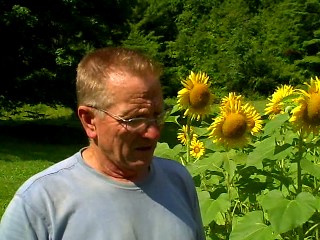 Photos by Justin Saldo Photos by Justin SaldoArmstrong has planted seven acres of sunflowers for biofuel.
|
"As long as there is a demand for oil in this area I'll try it, but that's not the only reason," said Armstrong. "I feel that people should do environmentally conscious things, not just because they have to or intend to profit, but because they can."
Armstrong is following in the footsteps of local trendsetters John Williamson of Shaftsbury and his brother Don Armstrong.
"What I'm so proud of in this country of ours is that when adversities present themselves there are always innovators like my brother and Johnny that rise to meet the challenge," he said.
Don Armstrong makes biodiesel with waste oil from local restaurants and was the first to encourage his brother to explore the option of biofuels through fellow farmer Williamson.
Williamson, with the support of the University of Vermont's Center for Sustainable Agriculture, was the first to start growing plots of oil-producing seed crops including three varieties of canola, two mustards, flax, soybeans and sunflowers.
Armstrong is growing his crop of sunflowers in cooperation with Williamson and plans to use his equipment, which Williamson purchased with a cost-sharing grant from UVM, to produce the biodiesel.
Williamson has more than $19,000 in equipment for processing biofuels including a screw-auger press that separates oil from seeds and a stainless-steel reactor in which the chemical reaction takes place.
He’s running straight biofuel, or B100, not the mix of petroleum diesel and biodiesel ( a 80/20 mix known as B20) most often available.
Armstrong has high hopes for alternative energy solutions and believes that through cooperation, America can solve its fuel crisis.