Reville: Berkshire Compact a Model for State Education Efforts
 Photos by Noah Hoffenberg
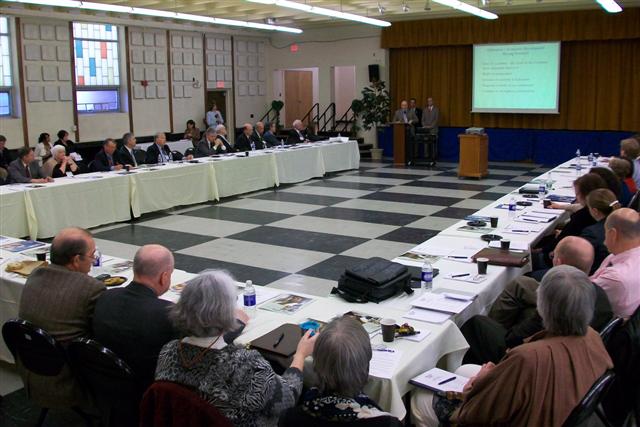
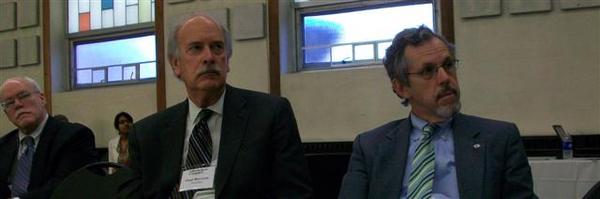
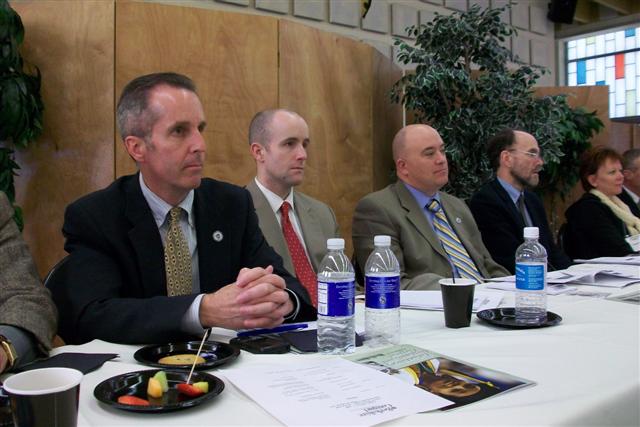
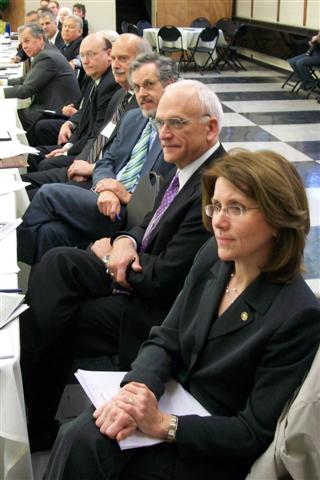 Above, Rep. William 'Smitty' Pignatelli, Sen. Benjamin B. Downing and Rep. Denis E. Guyer attend the annual Berkshire Compact meeting. At right, compact leaders Andrew H. Mick of New England Newspapers and MCLA President Mary Grant. Top photo, BCC President Paul Raverta, left, and guest speaker state Education Secretary Paul Reville. Above, Rep. William 'Smitty' Pignatelli, Sen. Benjamin B. Downing and Rep. Denis E. Guyer attend the annual Berkshire Compact meeting. At right, compact leaders Andrew H. Mick of New England Newspapers and MCLA President Mary Grant. Top photo, BCC President Paul Raverta, left, and guest speaker state Education Secretary Paul Reville. |
His experience is just one of the reasons why he's a member of the Berkshire Compact, a group of county colleges, employers, public schools, work-force training groups, social and community groups and civic leaders whose aim is to give area youngsters the access and inspiration to pursue post-secondary education.
"I would like to see a day in Berkshire County where children aren't making that conscious decision at 12 or 13 years old, thinking that they cannot go to college. That's part of why the work of the compact is so important to me personally," said Guyer, who eventually went on to study at Southern Vermont College in Bennington after spending much of the 1980s in the Air Force. He said the compact has even deeper meaning to him now that he has a child in the public school system.
Guyer and dozens of other civic, business and education leaders — including Secretary of Education Paul Reville — gathered Friday at the Church Street Center at the Massachusetts College of Liberal Arts to mark where the compact has been, where it is now and where it's going.
Berkshire Compact report in PDF format
Mary K. Grant, MCLA president and compact member, iterated the goals of the compact, which are to create access to higher education, raise the aspirations of elementary and secondary school students, recognize how technology is infused in all aspects of modern business, and examine how to address the needs of employer and employee alike.
"You know from the beginning of this effort that the work has been about engaging many partners; it's been about understanding the changing needs in our own back yard; it's been looking at what our population needs to go forward;and it's been developing strategies that have been fluid and have been flexible over time. And we have done that,” said Grant.
She cited several programs that have been under way to help foster a yearning for higher education in young people, such as Third-Grade Visits.
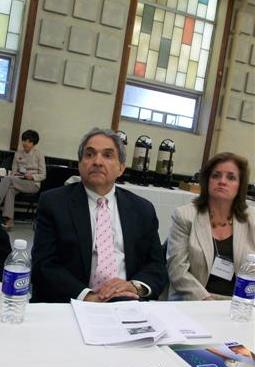 North Adams School Superintendent James E. Montepare
|
Berkshire County Goes to College Day, another open-door event, will take place next month on April 3, 8 and 15. At this event, sixth-graders from across the county get the opportunity to visit MCLA, Berkshire Community College, Bard College at Simon's Rock and Williams College for the expressed purpose of getting a firsthand college experience.
There's also a counseling program in which a college student is on-site in high schools talking to kids about continuing their education.
For those about to enter the work force, the Berkshire Compact has helped facilitate technology and creative internships, such as with the Berkshire Wireless Learning Initiative and B-HIP, the Berkshire Hills Internship Program, "which is pipeline into the creative economy," Grant said.
MCLA and BCC are also offering dual enrollment currently to 250 students, who use both schools to their benefit.
An ongoing effort of the compact — and perhaps is greatest effort — is Berkshire Passport, a program that uses milestones starting in elementary school to help remove obstacles between a student and college. Those milestones include campus visits, SAT preparatory exams, scholarships and, eventually, an endowment for students to help
pay for their college educations.
Andrew H. Mick, chairman of the Berkshire Compact and publisher of The Berkshire Eagle, said a work-force development summit held last year included a Northeastern University study that demonstrated the gap between jobs available in the region and workers with the skills and education to do those jobs. Mick said education is more than just an ongoing effort to promote learning; it's a tool for economic development.
"Taking the work of the compact to the next level requires a shared focus on students, on employers, and in the unassailable notion that education is an economic development tool," said Mick.
Further, he said, "We know these investments pay off," citing B-HIP as an example, as it helped more than a dozen students finds jobs in the Berkshires.
"There's been a lot of progress made, but there's still a lot more work to be done," said Mick.
.jpg) Pittsfield Mayor
James Ruberto |
"The whole project to boost college aspirations is critically important, because the value of education goes up both for individuals and society, [especially] in an area with high graduation rates but low college-going rates. It just makes all kind of sense and is very impressive," said Reville.
He said the compact would serve as a model for the rest of the state, and that he talks it up as much as he can when he travels.
"Particularly in these economic times, I think it's imperative to do so," said Reville.