Higher Education Commissioner Tours MCLA
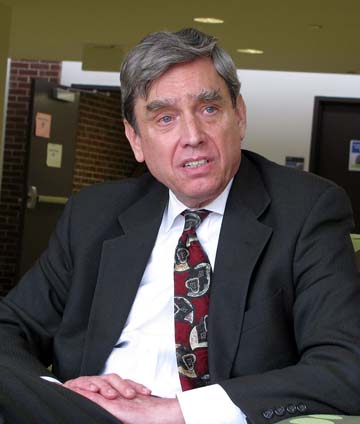 Higher Education Commissioner Richard M. Freeland toured MCLA on Tuesday. Freeland plans to visit every state campus by next fall. |
"This is part of something that's happening all over the country," said Richard M. Freeland, during a brief interview with local media early Tuesday afternoon before meeting with a group of undergraduates selected to represent a cross-section of the student body. "Particularly in older urban centers which have lost their industrial base, where their retail stores have moved away to malls. We find that the colleges are tremendous sources of economic activity."
Westfield and Framingham state colleges, for example, are working closer with their respective communities, he said. Colleges become major employers, students and faculty spend their money in downtowns, and their scholarship breeds innovation.
Freeland, and Assistant Commissioner Nate Mackinnon, spent the morning touring MCLA, including Gallery 51 on Main Street. The college-sponsored art gallery has become a hub for collaborative creative efforts in the city, including the upcoming 2nd annual DownStreet Art that will feature nine storefront galleries this summer.
Having visited North Adams four of five years ago for an exhibit at Massachusetts Museum of Contemporary Art, Freeland said it gave him a sense of "the progress of this whole idea of North Adams as a cultural center, as an arts center."
The development of the science center, a priority for President Mary Grant and local lawmakers, should be a further boost to the community.
"Science is a fundamental part of any college curriculum," said Freeland. "One of our concerns in the state is that sudents lose in interest in science before they ever get to college, so getting high school kids into a modern science center should energize them."
Beyond being economic drivers, colleges make for attractive communities, he continued. "They generate bookshops, and galleries and coffee shops and lots of things people enjoy. What we're seeing here is part of the pattern."
MCLA's role in the community is what sets it apart, indeed, what makes each college or university school different, he said. Freeland said his "single most important responsibility" is to ensure that each public school has the resources it needs while still allowing college presidents the flexibility within their own campuses.
Small schools like MCLA, which hopes to raise its enrollment from 1,700 to about 2,000, will have to find ways to balance the pressure to take more students for economic viability against the quality of their more personalized education.
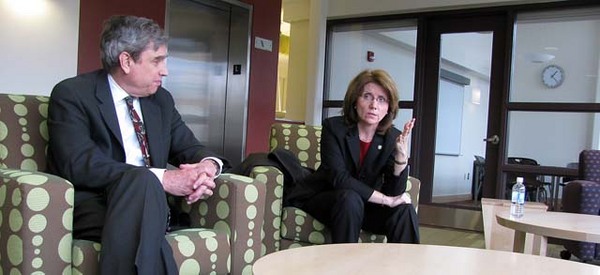
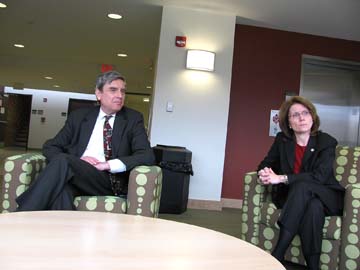 Freeland and MCLA President Mary Grant in the lounge area of the new entrance to the Berkshire Towers dormitories. |
Freeland knows what it takes to lead an institution of higher learning. He spent 10 years at the helm of Northeastern University, during which time the institution jumped from 163 to 98 on U.S. News' list of Best National Universities. Prior to that, he spent a dozen years at the University of Massachusetts in a range of administrative roles, including developing and opening its Boston campus. He also spent several years as a vice chancellor at City University of New York.
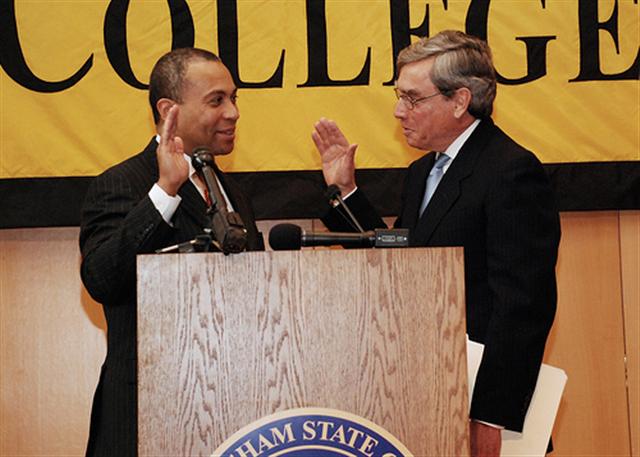
He was sworn in as higher education commissioner in February by Gov. Deval Patrick, replacing acting commissioner Aundrea E. Kelley. The recent reorganization of the Department of Education created three commissioners overseeing their respective Departments of Early Education and Care, Elementary and Secondary Education, and Higher Education, all under a secretary of education, Paul Reville.
 Courtesy governor's office
Freeland was sworn in as commissioner in February by Gov. Deval Patrick. |
Rather than focus on per capita spending on higher education, which is lower in part because nearly half of students attend the state's 200 private colleges, Freeland said recognition has to be paid to the fact that the faculty and presidents at state schools are being paid less than their peers and that students are being asked to pay more and more of the operating costs, from less than 30 percent six years ago to more than 40 percent.
Scholarships that once covered 80 percent of tuition now cover only 14 percent at the same time the global fiscal crisis has more students turning to the relatively less-expensive state schools.
"This is not what public education is about," said Freeland. "Students from exactly the kinds of families we exist to serve are going to be priced out."
It will mean working to promote the state's colleges not only to prospective students but also to the Legislature to ensure funding resources to maintain the system's sustainability. That a political question, he said, that will require a constituency of students, parents and communities to underscore the vital importance of a high-quality college system, academically and economically.
Grant said this is a collaborative effort, that the state college presidents are being included in the commissioner's working groups.
"[It is] so great to have a new commissioner with such experience in higher education," she said. "It's a big landscape and each of us play a different role. I think the presidents are just delighted to have a colleague and leadership that really wants to get out and figure out these attitudes."
Freeland plans to visit every college and university campus this spring and next fall, including Berkshire Community College in Pittsfield. He's already toured a half-dozen and spoken to a number of students.
He's come away impressed with "how much they appreciate their education and how much value they place upon it. ... I think this bodes very well for public higher education in terms of public perception as more and more students are exposed to it."