Williamstown Woman Helps Design African 'Field of Dreams'
Architect and Williamstown resident Sarah Violette recently spent two weeks in Uganda helping to design a children's home. Submitted photos and illustrations
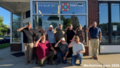
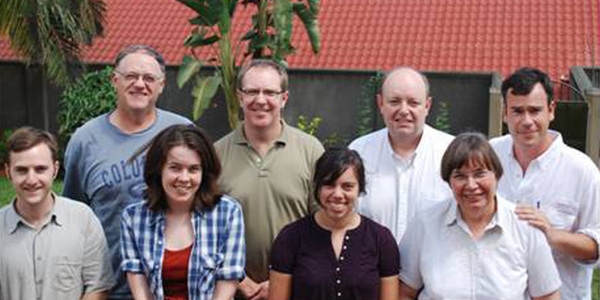
Margaret and I hang out at Show Mercy's Hope Children's Home. Top: the eMi team of, back row from left, Robert from Colorado, Martin and Mike, both from London, and Sam from California; front row from left, David from Bristol, England, me, Megan from Oregon and Marietta from London. |
When I finally disembarked at Entebbe International Airport in what the flight attendant called a "tropical downpour," I was exhausted, disoriented and wet. Fortunately, my "working vacation" — a mission trip to help design a new orphanage for an Oregon-based nonprofit called Show Mercy International — would only improve over the next two weeks.
I first considered taking this kind of trip years ago when I was still in architecture school. I was tired of studying theory and wanted to work on a real construction project far away from my desk. Engineering Ministries International (eMi) offered me that kind of opportunity.
eMi is a "non-profit Christian development organization made up of architects, engineers and design professionals who donate their skills to help children and families around the world step out of poverty and into a world of hope." This includes helping churches and NGOs realize their visions through the design of hospitals, schools, orphanages, bridges and utility supplies. While I never went on a trip during college, after my dad, a structural engineer, traveled with eMi to the Congo in May 2008, I felt that it was finally my time to go.
 The master plan of Field of Dreams includes housing for children and volunteers, as well as offices, kitchens, and multi-purpose spaces. The site offered some challenges. Below, Hope Children's Home is 30 minutes from the Ugandan capital of Kampala.  |
On this site, they plan on housing up to 150 more kids, 8 to 10 long-term volunteers, and 20 to 30 short-term volunteers, as well as constructing community facilities like a medical clinic. In the United States, a project of this size would take months to design. We had less than 14 days.
We arrived at the Field of Dreams a few hours after landing to find that the site we thought was flat and dry — mostly because of misleading Google Earth photographs — was anything but. Almost half of the 25 acres fell on a hillside and the rest of it lay at the foot of the hill in a marsh. While neither of those things was insurmountable, they would definitely impact our design. The steep slope called for site work and retaining walls that we hadn't planned on and the marsh disqualified a large portion of buildable area because of malaria concerns. Jet lag or no jet lag, it sent me and my fellow architects — literally — straight to the drawing board.
Researching local construction techniques and — for myself — working in the metric system were also challenging. Only one of my team's four architects had ever designed a building in Africa before and standard American sizes — like a 3-foot door or an 11-inch tread — were suddenly meaningless. A local contractor took us on a tour of a steel mill and a clay brick factory to try and bring us up to speed, but I found that visiting Hope Children's Home, Show Mercy's existing orphanage, was more helpful.
The kids at Hope Children's Home surrounded our matatu — a minibus taxi — as soon as we pulled up at the front gate. They range in ages from infants to high schoolers, but all are the victims of HIV, war and disease. Until they came to Hope Children's Home, they had no hope for the future and no value of themselves.
But the children who grabbed my hands and arms as soon as I left the bus are not those kinds of children anymore. Kids like Patricia, Margaret, and Grace had joy, purpose, and a whole lot of love.
Patricia sat with me during Sunday school and translated the entire class from Bugandan to English. Margaret put me to shame when we had a hula-hoop contest with an old bike tire. Grace asked if I was from England and then poured over my postcards of New England as I explained the difference between the two. Show Mercy restores the hope of these children by meeting their physical needs and sharing God's love and purpose for their lives. We visited Hope Children's Home in order to understand how Ugandan orphanages are designed, run and maintained, but left with a much deeper understanding of hope, love and purpose.
 The Field of Dreams will house about 150 children in homes like the one pictured here. |
The entire team spent a week staying up late, listening to Joni Mitchell, and drinking Stoney Tangawizi — my new favorite soda — in order to finish the project in time for our final presentation to Show Mercy's director. He cried when he saw it. Show Mercy was founded only five years ago and he was overwhelmed to have it come so far in such a short period of time.
I was overwhelmed to play a small part in such a big project. Africa always seemed like a big problem that was far away, and therefore, something I could do nothing about, but during my time in Uganda I learned that it's not and I can.
Changing the world — Patricia, Margaret and Grace's world, my world, your world — doesn't start 15 hours away. It starts with the talents, skills, and purposes in my own life and ends in places like Uganda. I wonder where it'll end up next.