Public Utilities Hearing Finds No Support for Electric Rate Hike
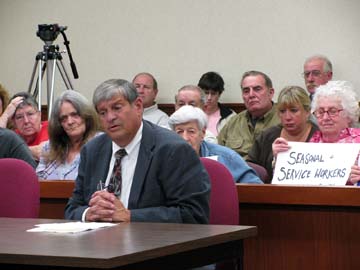 Mayor John Barrett III speaks at Wednesday's hearing on electricity rates at City Hall. |
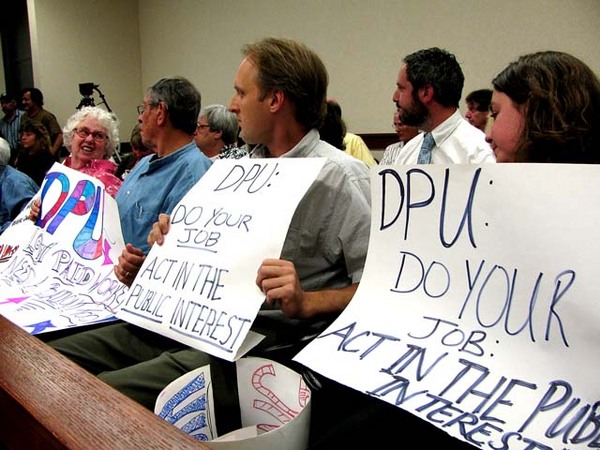
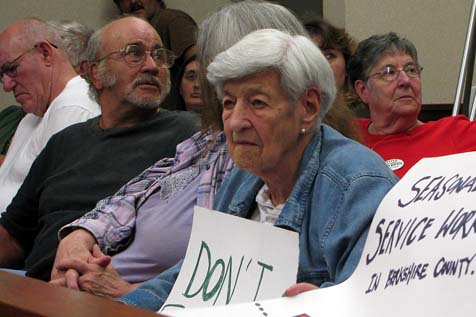
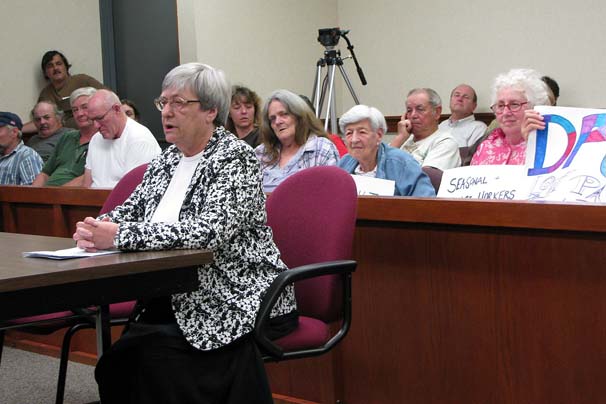
Some three dozen citizens and elected officials attended the public hearing held by the state Department of Public Utilities at City Hall. About dozen spoke, including Mayor John Barrett III, three city councilors and a Sheffield selectman.
National Grid filed for an increase two months ago of some $111 million in distrubution charges beginning Jan. 1, 2010. It is the first request for an increase in 14 years and, if approved, would mean an average 5.5 percent total increase for most residential customers, or about $4.25 a month, according to the company.
But even that amount is too much, said hearing attendees, who complained of poor service and complicated bills and the effect of an increase on the region's poor, elderly and business commmunity.
"I don't think there's anyone in this room other than the gentleman from National Grid ... who wants a rate increase," said North Adams resident Joyce Wrend, who took exception to the assertion that the typical customer used 500 kilowatts. "Everyone of my bills is over 500KW. ... it's just me and husband. I don't have an electric stove or electric heat."
Barrett read one of several letters he'd received from residents detailing their opposition the rate hike. One woman wrote how the machines that kept her husband breathing ran 24 hours a day.
"If they raise it again, my bills are up in the hundreds," he read. "Besides the oil prices and other utilities, I don't know how we can make it. ... There are so many like us out there struggling to make ends meet."
National Grid's representative at the hearing, attorney Steven V. Camerino, said the company has spent some $900 million since 2000 in upgrading and the expanding the system but far more work was needed. At the same time, he said, National Grid had sought savings through cost cutting and efficiencies.
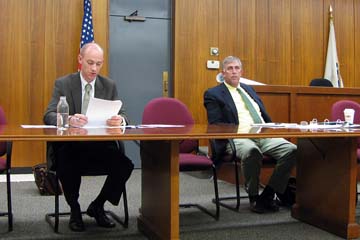
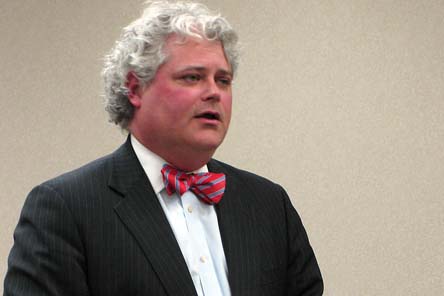 Above, Assistant Attorney General Jed M. Nosal tells the crowd he's on their side; below, attorney Stephen V. Camerino explains why the rate hike is necesary. 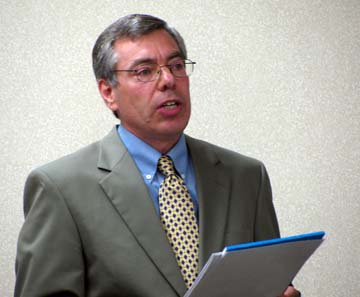 |
This will also be the first case of "decoupling" in Massachusetts, a movement to unlink the use of energy from a utility's revenue to encourage conservation.
The so-called "poles and wires" rate hike is "critical to the company's ability to continue to upgrade and replace aging infrastructure while providing safe and reliable energy," said Camerino.
Barrett was having none of it, claiming the company could talk about what it had done but couldn't speak to its plans for the future.
"They talk about building up reserves, I don't know about their operation, but the reserves in the cities and towns across Massachusetts have been depleted because of cuts," he said. The new charge was nothing more than a tax, he added, and National Grid's further request to increase its "return of equity," or profit, by 11.6 percent only helped shareholders not customers.
It's an increase in profit that the attorney general's office finds an "inordinately high profit under good economic conditions," said Assistant Attorney General Jed M. Nosal, chief of the Office of Ratepayer Advocacy.
Nosal said National Grid's example of a typical ratepayer didn't fully explain the variance in rate hikes that could be seen by both residential and commercial customers. Some may see an actual decrease, others distribution hikes of 12.9 percent to 18 percent. Distributions charges account for up to a third of a customer's bill.
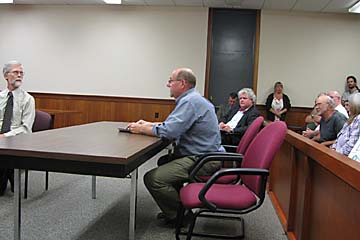 City Councilor Richard Alcombright speaks at the hearing. |
"That tells us there is a population in this community that is on a fixed income or low income," said the North Adams city councilor. "They're struggling now to keep their heads above water."
City Councilor Richard Alcombright spoke of the disproportionately large elderly population and the city's "fragile" creative economy; Councilor Lisa Blackmer of the struggles of small businesses.
And not just small: Sheffield Selectwoman Renee Woods said her town could lose a major employer that's been weighing the benefits of relocating to Ohio because of energy prices. Energy costs were the No. 1 concern in a business survey done last year in the town.
Monsanto spin-off Solutia Inc. of Springfield has seen its energy costs double over the past five years, said company representative Christopher Schaper, and passed on chances to bring in offshoots — and jobs — because of high costs.
Massachusetts has the fourth-highest electric rates in the nation; Ohio ranks 24. The Berkshire Chamber of Commerce and its 1,200 members have been grappling with rising energy costs for several years.
"Bill impacts for commercial and industrial customers will vary and could be as high as 5.7 percent," said Christine Hoyt, chamber director of programs and events. "When coupled with other program filings by National Grid, the business community's cost burden could progressively increase to an additional $16 million in 2010, $150.8 million in 2011 and an overwhelming $212.8 million in 2012."
Camerino said, "Obviously, there is never a good time to seek a rate increase," but the company's proposals would ensure the stable and safe transmission of power while progressing the state's green energy initiatives.
Nosal, however, said the attorney general's office would be working hard to represent ratepayers at the evidentiary hearings in Boston this August.
"Overall, National Grid's proposal is excessive and puts the interests of shareholders over the interests of ratepayers," he said.
 |
 |
 |