Williams' Buy Local Program Boosts Farms, Lowers Costs
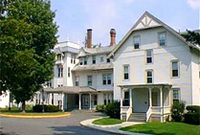 |
| Dodd House, home of the Williams College Dining Services. |
Williams dining services prepares 885,690 meals annually for its approximately 2,000 students, in four dining halls, a faculty house and a number of snack bars. The college also runs more than 425 catered events each academic year. In each of these settings, the college maintains a deep and long-term commitment to local food.
A few years ago, the college purchased only a handful of foods from local producers. Today Williams spends up to 20 cents of every food dollar on local foods — a $400,000 boost to the local economy. One hundred percent of its milk is now supplied by High Lawn Farm, a small dairy in Lee that raises grass-fed, hormone-free Jersey cows. Dining services employees use this milk to make gourmet-quality gelato and ice cream.
In addition, virtually all of the college's summer vegetables, and many of its winter-storage vegetables come from Peace Valley Farm, a family farm located 10 minutes from campus. Other local producers supply pastured meats, a limited supply of organic shiitake mushrooms, organic honey, low-spray apples, melons, blueberries, organic granola, free-range eggs, and several varieties of artisanal cheeses. Across campus, 100 percent of coffee is fair-trade, brewed by Dean's Beans in Orange and local, grass-fed beef hamburgers are served nightly in two of the campus dining halls.
Executive Chef Mark Thompson said Williams' unit chefs plan menus around the harvest time line to incorporate fresh products that can be blast-frozen for use in the colder months. Onsite vacuum sealers and flash freezers make processing local foods simple, and loading docks are specifically designed to accommodate small growers.
"It's become like clockwork," said Thompson. "Each July, Bill Stinson from Peace Valley Farm calls me to say that he's got 400 pounds of ripe tomatoes ready, along with onion and basil."
In a matter of days, Thompson and his staff have processed these ingredients into 50 gallons of tomato sauce, which are blast-chilled, then frozen for use during the school year.
"I also know he'll call me in mid-July with pickling onions and cauliflower, which we'll turn into marinated vegetables for our Harvest Dinner, and that in the fall, we'll be making pesto from his fresh basil. It's just part of the cycle."
Thompson even finds uses for unusual local ingredients. Last year, Stinson offered the college 200 pounds of chive blossoms. Dining services purchased these and used them in a homemade chive-infused vinegar, which were offered at the campus salad bars.
"It takes a little planning to work this way," says Thompson. "But this approach allows us to serve the very best food."
Bob Volpi, director of dining services, agrees.
"It starts with deciding what's important. We want to make sure the food we serve is healthful, fresh, and good. We buy local produce, because that is what's best. We buy High Lawn Farm's milk, because it's the healthiest, best-tasting milk we can get," he said.
Jeanette Kopczynski, assistant director of catering and the faculty house, created a 20-point list of guidelines for catered events; among these guidelines are "use organic, locally grown and produced foods whenever possible."
While critics dismiss sustainable food practices as too expensive, the college is tangible proof that an institution can prioritize sustainability without increasing costs. Last year, when the college purchased the highest volume of local foods than ever before, Williams enjoyed its lowest food cost ever — less than 15 percent below what it was a few years prior.
"It simply does not cost more to do it this way," said Volpi.
For example, prior to making the transition to High Lawn Farm dairy products, dining services staff analyzed the quantity and types of milk consumed at the college. They found that the majority of the milk consumed on campus was fat-free, while whole milk was least-consumed. Meanwhile, High Lawn Farm's other clients preferred the higher-fat products. The college purchased High Lawn Farm's excess skim milk for a lower price; the deal saved the college $10,000 annually on dairy costs.
"It was a perfect match," said Roberto Laurens, farm manager at High Lawn Farm. "They needed the very product that we most needed to sell."
Volpi came to Williams several years ago from Bates College, where he greatly improved the sustainability of the college's dining services. Under Volpi's direction, Bates College won the coveted National Award for Environmental Sustainability from Renew America.
"The benefits of local food are compelling — a healthier local economy, better relationships with the town, and the best, freshest foods available. Plus," said Volpi, "there is another reason to buy locally. It's just the right thing to do."