'Best of Enemies' Clash Over Civil Rights
PITTSFIELD, Mass. — Let there be no doubt that "The Best of Enemies" with Aisha Hinds and John Bedford Lloyd is one of the most important historical plays about America to ever reach the stage. It is also the finest drama I have ever seen at Barrington Stage. It is a modern-day parable of the civil rights movement of the 1970s that expands dry, historical fact into a riveting tale of two polar opposites clashing over how to integrate the schools of Durham, N.C.To capture the sweep and detail of the battle for black rights in the South of 40 years ago is no easy task. Playwright Mark St. Germain contrasts the role that C.P. Ellis had promoting white supremacy with Ann Atwater, a homespun black activist, who is a rare voice in the community, speaking up for simple justice and equal education. The stage treatment for this explosive confrontation was inspired by Osha Gray Davidson's book of the same name, "The Best of Enemies."
 St. Germain has kept his story focused on just a few people, yet these larger-than-life shapers of history are highly charged theatrically. His approach to detailing the civil rights era comes to life in a way that more scholarly approaches would tend to bland out.
Watching "The Best of Enemies" unfold, we relive the agony of the inexpressibly sorry past when far too many things in America's southland were labeled either "white" or "coloreds." In those horrible days, some white men would cross the street rather than to have to pass a black man on the sidewalk. The reverse was true as well.
C.P. Ellis (played by John Bedford Lloyd) was one of them. In the first scene, we find ourselves at a rally of the Ku Klux Klan where Ellis is the Exalted Cyclops. His first words are indeed horrific, insulting beyond anything we hear today. Ellis and his wife Mary (Susan Wands) are doing the best to raise their family on a meager income and like so many racists, C.P. reacts to his poverty by hating those even poorer than himself.
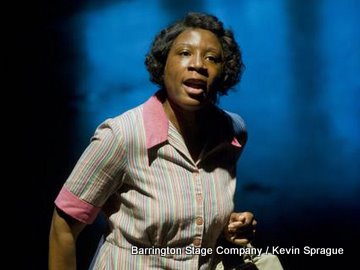
Ann Atwater (Aisha Hinds) is no saint when we meet her either. Despite the Bible she tucks under her arm, she has little love for those white folks around her who daily demean and devalue her very existence. While she clearly sees the hypocrisy in Ellis' (and the KKK's) claims of piety to Jesus, she too harbors murderous thoughts and is tempted to act on them.
The two could not be further apart and their story — while real — indeed unfolds almost like a parable. As such, it is a short play (95 minutes) that illustrates a positive and universal truth, that people are capable of change. For Atwater and Ellis their transformation began to take place when both reluctantly agreed to co-chair a charette to determine how to best integrate the Durham school system. This was accomplished, coerced, finessed by a college-educated community organizer Bill Riddick (Clifton Duncan) in a series of bold, chancy moves.
|
Infusing Mark St. Germain's play with so many verbal and visual artifacts of the past made everyone in the audience a firsthand witness to history.
Julianne Boyd's fresh and innovative presentation with its dramatic sweep of the minute details of an important American moment deserves a life beyond the current production. Like St. Germain's "Freud's Last Session," this is a show that is ready to move on to New York, minimal change required. Barrington Stage has made an important point in American history an absolutely memorable, understandable and riveting evening of theater. No lecture hall recitation of dry facts, dates, and names can even come close to its educational power.
As Atwater, Aisha Hinds returned to the stage after almost a decade away doing film and TV. Her portrayal of the fiery, fierce and wholly human civic leader was stunning in its power and complexity. As a raging bullhorn, she held her own with the equally bombastic Ellis character. She struggles with life, and yet still grows and changes, seeing the world with new understanding. It is reflected in not only her words, but her face and body postures.
 As Ellis, John Bedford had an equal challenge as an actor, to reflect the changes in attitude and opinion that slowly happened in his thinking. Clifton Duncan as Riddick was successful in making his job as a facilitator feel like this wasn't an actor, but someone setting everything up for us. The briefest role was held by Susan Wands as Mary, C.P.'s wife, and she was able to convince us that while stuck in an awful marriage, she was strong enough to try to change her Exalted Cyclops of a husband.
To date this summer, we have had two brilliant musicals, well-done comedies, and now we have the first truly great dramatic epic of the 2011 season, "The Best of Enemies." Who knew history could be so entertaining, that you could transform such troubling times into something so moving, riveting, and powerful.
Once again Mark St. Germain has shown that the true skill of a great playwright is not just the writing, it is recognizing a great story when they see it. The "Best of Enemies" is the best play about the Civil Rights era ever to hit the stage. Kudos to Barrington Stage Company for this gift, part of the Lift Ev'ry Voice Festival in Pittsfield.
Larry Murray is a contributor to iBerkshires.com and offers reviews and arts news from around the region at Berkshire On Stage.
Tags: Barrington Stage, theater,