North County Farming Report Producing Bleak Picture
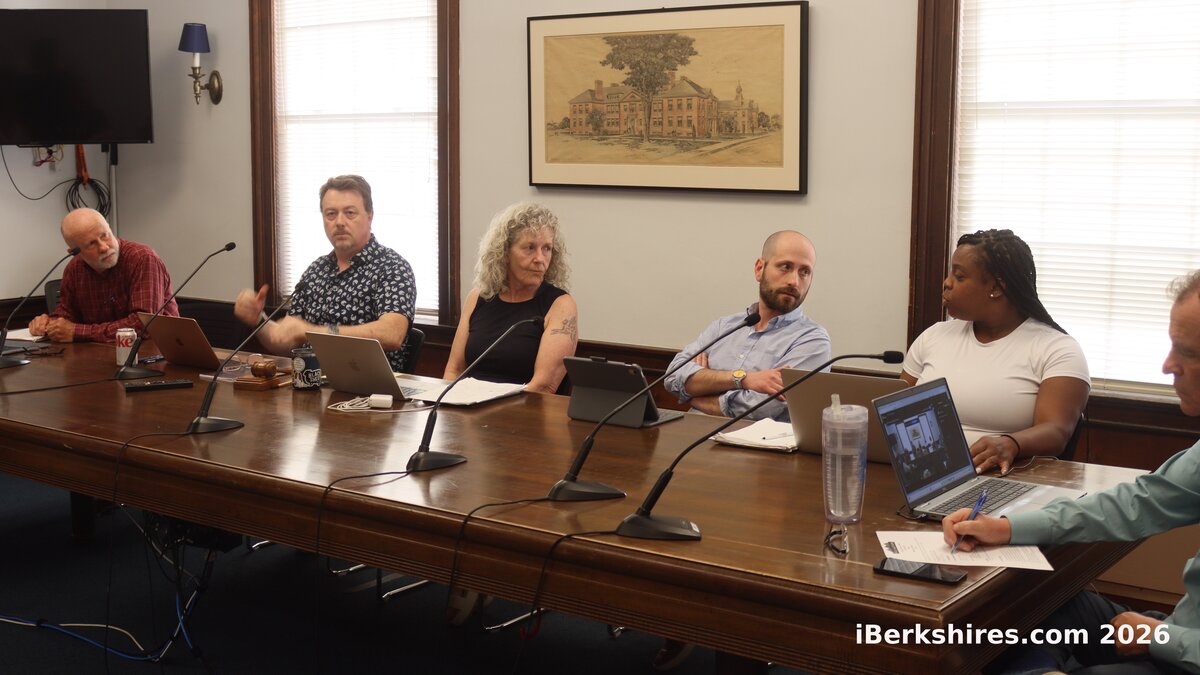
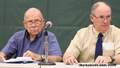
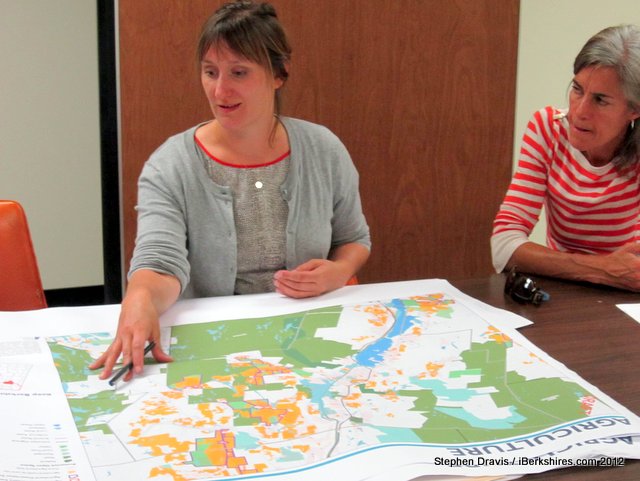 Berkshire Regional Planning Commission project manager Amy Kacala, left, goes over a map of Cheshire farmland as Williams College professor Sarah Gardner looks on at a recent meeting of the Keep Berkshire Farming initiative. |
It may be worse.
"Many of the dairy farms are on the verge," Williams College professor Sarah Gardner recently told the Keep Berkshires Farming initiative.
"We all got a sense of urgency about trying to keep them going. We think it needs immediate action. It needs the attention of someone to figure it all out."
"Figuring it out" is the mission of Keep Berkshires Farming, a volunteer group formed last year under Sustainable Berkshires, a regional planning process funded by a grant from the federal Department of Housing and Urban Development and managed by the Berkshire Regional Planning Commission.
The group is nearing the end of the data collection and survey phase, which included comprehensive interviews of North County farms by Williams students and Gardner, the associate director of the schools' Center for Environmental Studies.
At a meeting attended by a dozen farmers and activists on Thursday, Gardner and two of her students discussed a draft report of their findings.
Gardner and rising seniors David Nolan and Emily Ury painted a bleak picture of a farming population that is aging, increasingly isolated and hampered by payments insufficient to cover the cost of production.
Finding solutions means first defining the problem, explained Melissa Adams, a program coordinator for the state Department of Agricultural Resources who facilitated the meeting at City Hall.
The next step involves bringing farmers together to talk about possible fixes.
"We've been working on this since last fall," Adams said. "Now we're coming together to figure out what it all means.
"We would like to hold a farmers forum in the fall to present what we've found in the surveys and build from there. We're going to look at how we can work together on cooperative actions and strategies."
Fifty years ago, the local landscape was dotted with family farms, and networking meant simply talking to your neighbor. Today, it is not that easy.
"One of our findings is that the farmers here in Berkshire County are so disconnected because there are so few of them and they're so scattered," Gardner said. "A lot of solutions require collaboration."
In the region's eight towns, researchers have identified 60 farms, and they have interviewed farmers at 46 of those operations.
The majority of those farms fell into one of two categories: dairy and livestock.
"Vegetable farming is important, but there's not a lot of it right now," Gardner said.
"There aren't that many people growing vegetables, and the two CSAs (community supported agriculture farms) in North Berkshire that are growing vegetables are very successful. There are only a handful of others growing vegetables in the area, and they're successful at the farmers' markets.
"We did interview vegetable farmers, but they're a small percentage of the total farming population."
Nolan, a Williamstown native, noted that the region's terrain lends itself to growing grass — and raising cattle — as a result.
One problem for farmers raising beef cattle is that they have to bring their animals outside the region for processing.
"We found that [farmers] saw a demand for local meat, but they couldn't tap into it because there is no USDA processing center in the county," Nolan said. "Most go to New York. Some go to Athol. Many proposed a Berkshire cooperative or some Berkshire processing facility.
"It's something that came up over and over again without any prompting from us."
Gardner said her team asked farmers whether the region produced enough cattle to sustain a local slaughterhouse.
"All of them said we would have enough, and many said they would increase their herd size if the facility existed," she said.
Adams, who is based in the Hampshire County town of Williamsburg, said Pioneer Valley cattle farmers also were looking for processing options.
Just like meat producers, dairy farmers are hampered by high transportation costs.
Of nine dairy farms surveyed, eight sell to large processors like Agri-Mark and Dairylea, Ury said. Keeping the milk local could make dairy farming more profitable.
"There is a thought that some sort of local cooperative for local Berkshire milk would save on trucking costs," Ury said.
Like most solutions, that would require money and a group effort.
The former, ultimately, might mean some form of public funding. The latter, organizers hope, will start with the forums that Keep Berkshire Farming plans to hold starting the week of Oct. 22.
"Right now, it's hard for us to envision [collaboration] after meeting the farmers because they're all so independent," Gardner said. "One of our thoughts is we've have to get all the beef farmers together. This would have to be their project, not ours."
Adams agreed.
"It is a balance of not being heavy handed and saying, 'You should do this, this and this,' but you still need to present options," she said.
Tags: agriculture, community supported agriculture, farming,