Williamstown Elementary Looks Inside MCAS Numbers
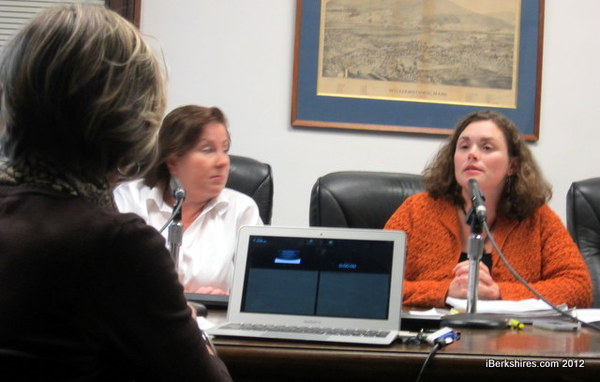
 Principal Joelle Brookner discussed Williamstown Elementary's designation as an MCAS Level 2 school and what the numbers mean. |
But once she looked deeper into the numbers, she realized the classification was nothing to be discouraged about, even though it does give the school a target to shoot for, she told the School Committee at its Wednesday night meeting.
"This is actually not a bad thing at all," Brookner said. "Level 2 is not Level 1, but it's not bad."
The elementary school missed out on the highest of five levels in the commonwealth's new classification system because the 2011-12 tests revealed too wide a gap between pupils' high aggregate scores and the scores of high-needs students.
Brookner gave the panel a detailed explanation of the school's scores, highlighting both its high achievement relative to other schools in the state and the areas where school officials hope to achieve improvement.
Showing improvement is a big part of the new MCAS scoring structure, which gives schools more credit for narrowing proficiency gaps, Brookner said.
One key measurement in the new system is the Student Growth Percentile, which was explained in a 2011 report from the state education department:
"Each student with at least two consecutive years of MCAS scores receives a student growth percentile, which measures how much the student gained from one year to the next relative to other students statewide with similar prior achievement. Student growth percentiles range from 1 to 99, where higher numbers represent higher growth and lower numbers represent lower growth."
The target, Brookner said Wednesday, is 75 on the growth index. The rating for all WES students last year was 87.
The area of concern for the school is in the subgroups of "high needs" and "low income" pupils, which rated 50 and 41, respectively.
When Brookner's presentation touched on the school's historical performance on the MCAS test, committee member Chris Jones noted that, "it seems to be a stable number at the low end of the [performance] scale."
Brookner and Superintendent of Schools Rose Ellis, who joined the discussion, agreed with Jones' concern and said addressing underperforming pupils is a priority for the school.
"We need to offer targeted assistance to those children," Brookner said. "Teachers are regrouping children in different ways. It's not like the old days when a child was in your classroom and you closed the door and they were in there with you all day. ... Based on needs, we are more efficiently able to provide intervention.
"I would hope we'd see results from that."
Ellis pointed out that those targeted interventions could pay off immediately in the Progress and Performance Index score.
"Under the new system, you get credit for growth," she said.
As much as school officials want to achieve that growth, they cautioned against having the same visceral response Brookner had to the overall score.
"WES is in the top 20 percent of elementary schools in the state," Ellis said. "We're in the top four in the county along with Lanesborough Elementary School, Lenox and Mount Greylock.
"There's always room for growth, but I'm satisfied, overall, with our performance."
Performance was a big topic at Wednesday's meeting, at which Ellis outlined the district's new procedure for evaluating educators as part of a joint meeting of the School Committee and the Superintendency Union 71 School Committee. Regina DeLego, the chairman of the Lanesborough School Committee and a member of the SU71 Committee, joined the session at Town Hall.
Ellis described the revised model for evaluation as a yearlong process that relies heavily on individual goals for teachers and administrators. The district is negotiating with the teachers about specifics of the new evaluation process, but administrators already have begun the new process, Ellis said.
"We're hoping to model the process and work out the kinks," she said. "It's very comprehensive. It's going to standardize the way we do evaluations."
In other business on Wednesday, the committee gave Brookner and Ellis the go-ahead to explore with the town the possibility of adding crosswalks and new sidewalks to the school parking lot.
Currently, children whose parents park in the lot end up crossing the driveway and through the pick-up/drop-off lane. It creates a potential safety hazard, Brookner and Ellis told the committee. Their solution is to paint a crosswalk between the grassy "islands" that divide the parking lot and run sidewalks over a portion of those islands to create a natural walking path — possibly protected at the end by a speed bump where cars turn to exit the pick-up/drop-off lane and drive through the new crosswalk.
Brookner also said that with about half of the school's 442 pupils arriving by foot or by car, the school needs to consider down the road paying a staff member to monitor the pick-up/drop-off lane and foot traffic through the parking lot on a daily basis.
Tags: MCAS, school committee,