Bay State on Track to Be Clean-Energy Hub
 Frank Gorke, director of the Division of Energy Efficiency, spoke about the state's energy goals. |
"So when your last name is Fairbank you typically like to see the snow but as you can also see, we like to see the sun and the wind," said Fairbank, to laughter. "At this time of the year, we're not planning on snow."
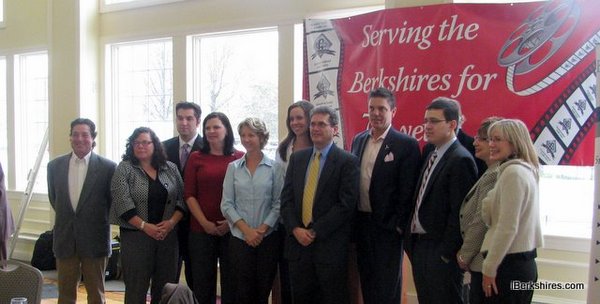
The Fairbank name may be linked to Jiminy Peak Ski Resort, but his EOS Ventures was recognized for its part in the solar-dependent Berkshire Bundle, one of four Good News Business Salutes at the chamber's monthly breakfast meeting. The groundbreaking project was a suitable introduction for a meeting that featured Frank Gorke of the state's Department of Energy Resources.
EOS created the innovative partnership of seven entities inside and outside the Berkshires that together leveraged the necessary credits to invest in photovoltaic systems, with Altaris Renewable providing the systems and Berkshire Bank the financing.
The combined project is expected to save 4.3 million pounds of carbon dioxide in the state over the next 25 years, the equivalent of planting 200,000 trees, said chamber Chairwoman Karen Zink, on introducing Fairbank.
It's projects and innovation like the Berkshire Bundle that are helping Massachusetts make is mark in clean energy technology, said Gorke, director of the Division of Energy Efficiency.
|
DOER has been working with related agencies to improve the state's energy efficiency, a goal of the Patrick administration, in both public and private areas. The state's beginning to see results, he said, with Clean Edge, a research and publishing firm, ranking the Bay State second only to California in green policy.
Gov. Deval Patrick has set a goal of reducing greenhouse-gas emissions from state buildings by 25 percent in 2012 and 80 percent by 2050 through the Leading by Example Program. To help public and private entities become cleaner and greener, some $55 million in American Recovery and Reinvestment Act funds are being used as efficiency investments.
One example is a $15 million competitive "high-performance building grant" that attracted more than 100 applications, including the addition of more solar panels to the Massachusetts Museum of Contemporary Art. Others are grants through the Green Communities Act; $7 million has been put aside for towns attaining the Green Community criteria by May 14.
"If we make energy efficiency our first fuel, it improves our energy independence, reduces emissions, redirects energy dollars into the local economy," said Gorke, adding that consumers could see savings top $6 billion over the next few years through the efficiency programs being implemented by utilities. "And if we get this right, we will see significant economic productivity increases while our energy use ... stays the same or goes down."
It won't be easy, he said. "We know that we're only going to be achieving these goals through the work you all are doing and the choices you make every day."
Also saluted were:
► Berkshire Music School, which has been providing quality musical education to the greater Berkshire community for 70 years. The nonprofit offers scholarships so that it never turns a student away and sponsors a number of musical ensembles for a variety of ages. It currently has 400 students taking weekly classes and ranging in age from 16 months to 86 years.
► Literacy Volunteers of Berkshire County is celebrating its 30th anniversary of tutoring adult students, with the strong belief that education can change lives. The group gives free one-on-one sessions at the Berkshire Athenaeum, helping adults learn to speak better English and read and to develop their communication skills. The volunteers' work has helped others succeed in their careers and personal lives, making them better citizens.
► Greylock Federal Credit Union, the breakfast's sponsor, is marking its 75th anniversary. It originated as the General Electric Employees Credit Union in 1935 with 272 member/owners; it now has 68,000 members and $1.25 billion in assets. It has 12 branches and a new headquarters on West Street but remains committed to its first office on Kellogg Street, which will soon be undergoing a complete remodeling. The credit union's commitment to its members led to its ranking as the top performing credit union in the nation for customer value.