Regional Leaders Mull Nuclear Options, Collaborate on Efficiency
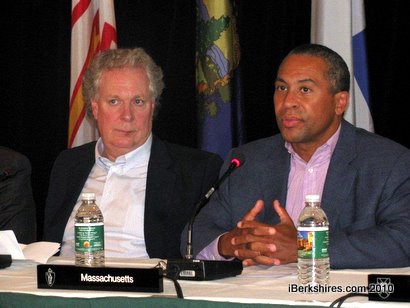 Gov. Deval Patrick hosted his second meeting of leaders in as many days with the 34th Conference of New England Governors and Eastern Canadian Premiers. Quebec Premier Jean Charest is at left. |
Gov. Deval Patrick hosted his peers at Cranwell Resort on Monday to discuss and debate transportation, climate change and energy technologies in the region at the 34th Conference of New England Governors and Eastern Canadian Premiers. The topic of energy was both timely and pressing to all of the leaders in attendance.
"It's been a full and productive day," Patrick said at the day's concluding media conference. "Everyone has contributed to making useful and important conversation."
One important conversation, according to the governor, has resulted in a unanimous agreement among all of the leaders present that by 2020 each state and province will have 20 percent improved energy efficiency in buildings through stricter codes.
"Given the determination of fellow leaders we are capable of making that accomplishment on time," said Patrick, who left the National Governors Association meeting in Boston on Sunday for the regional meeting, which continues into Tuesday.
While energy efficiency proved to be the common goal at the conference, how to improve that through technology was not so clear cut.
When asked to address the resistance of many state governments to renewable sources such as hydroelectric power, Patrick said, "it was not the logic of using hydroelectric power" that has slowed down talks but rather the "flow of credit and dollars" that needs to be sorted out.
Jean Charest, premier of Quebec, said he was confident that the United States and Canada would have no trouble reaching an agreement, both financial and logistical.
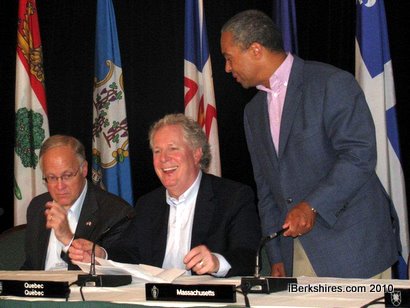 Patrick shares a laugh with Charest and Vermont Gov. James Douglas at a press briefing at Cranwell Resort. |
The province of Quebec owns and operates Hydro-Quebec, Canada's largest utility, which produces and distributes hydroelectric power for Quebec and exports its surplus to Vermont.
According to Charest, an integrated energy market would enhance the already amicable relationship between the U.S. and Canada, both of which have recognized that the common goal is energy efficiency and independence.
In addition to pursuing talks on uses of and for hydroelectricity, the governors and premiers spoke at length about the use of nuclear energy.
"Nuclear energy is part of the energy future," said Rhode Island Gov. Donald Carcieri. "Clearly the U.S. was a leader in nuclear power early on, Europe has taken the lead. We need to be moving more aggressively with a definitive nuclear strategy."
New Brunswick Premier Shawn Graham cited the current (and very expensive) refurbishing of the Point Lepreau Nuclear Generating Station as a means by which a definitive nuclear power strategy could be accomplished.
"It would largely target a New England market," he said.
President Obama supports the move back toward nuclear power, announcing in February an $8.3 billion loan guarantee for a facility in Georgia and tripling the amount of guaranteed funds available for such projects.
While Patrick was decidedly reticent on the subject of nuclear power, he did refer to Vermont's use of nuclear energy (according to the U.S. Energy Information Administration, nuclear power accounts for about 75 percent of electricity generated within the state; however, the 38-year-old Vermont Yankee nuclear power has come under fire over safety concerns) as a model move toward energy independence.
"We haven't landed in the same place as Vermont has," said Patrick. "Everyone here expresses support for the waivers that have already been negotiated. We are all aware that time is running."