image description
MassWildlife Director Wayne MacCallum fields questions and concerns at Thursday's public meeting in Lenox on wildlife habitats.

MassWildlife Looking to Revamp Habitat Management

Nichole DupontiBerkshires Staff
Print Story | Email Story

Two centuries ago, most the heavily wooded areas we see today were open fields and shrub lands.
LENOX, Mass. — Walking through a quiet canopy of old-growth pine, something this area of the state is known for, you’d never know that nearly 200 years ago more than 80 percent of the state was open fields.

The 1830s marked the height of agriculture in Massachusetts, as well as the rapid decline of species that utilized forestlands. Thankfully, according to Tom O’Shea, assistant director of wildlife for the state Division of Fisheries and Wildlife, the farm boom didn’t last and the forests came back. Maybe too much forest.


“There are fewer areas of young forest,” O’Shea said on Thursday evening at Town Hall,  the first of three public meetings the Fisheries and Wildlife Board has scheduled across the state for input into wildlife habitat and management policies.  “Less than 5 percent of our lands are grassland and shrub land habitats. There has been a significant decrease in native species, especially birds, in these types of habitats.”

In 2006, MassWildlife along with at least 10 special-interest groups devoted to maintaining native plant and animal species (such as the cottontail rabbit)  conducted a study to indentify habitats and species with the greatest conservation needs.

“We need more grassland, shrub land and young forest,” O’ Shea said. “Ideally, we would like 28 percent of our lands to be these habitats. It’s going to be a long way to get there. It takes nuance in management to get it right for the species. We’re going to see continued wildlife decline on state lands until we get it right.”

Ironically, the very conservation efforts that have been in place since the 1990s may be partly responsible for the decline in those grasslands, shrub lands, young forests and their relative species.

“The Smoky the Bear campaign worked very well, almost too well,” said MassWildlife Director Wayne F. MacCallum. “Many of the natural disturbances that these habitats rely on have been altered.”


Tom O’Shea, assistant director of wildlife, says we may have gone too far in conserving forests.

Natural disturbances include fire, water, beaver development and wind. In each case, human intervention (often in an attempt at conservation) has interfered with the natural process. Some 3,000 dams have been erected across the state, fire suppression has been successful, and forest cutting has been very selective, perhaps too selective, according to O’Shea.

“Bird species are very sensitive to changes in structure,” he said. “They do better with larger patch sizes of land; 30 to 40 acres would be perfect. Actually, anything greater than three acres is really good.”

But how do you convince the public that clear cutting is good and fire is helpful, Bill Peters of Northborough wanted to know.

“It’s hard to watch clear cutting and say ‘my god, that’s good for wildlife,’” he said. “The salamanders and woodpeckers need these old-growth forests to survive.”

Robert McCarthy,  Williamstown's tree warden and a sportsman, was concerned that the clear cutting was not enough and that bureaucracy and lack of coordination among multiple wildlife agencies is getting in the way of successful, sustainable management.

“Not enough is being done,” he said. “The woodlands are like a garden; if you don’t tend it, it turns to garbage. We need to keep the ticks out. I’m not talking about bugs, I’m talking about politics. Keep it out of our lands and leave wildlife management to the experts.”


If you would like to contribute information on this article, contact us at info@iberkshires.com.

A Boutique Hotel is Bringing Guests a Luxury Stay in Lenox

By Breanna SteeleiBerkshires Staff

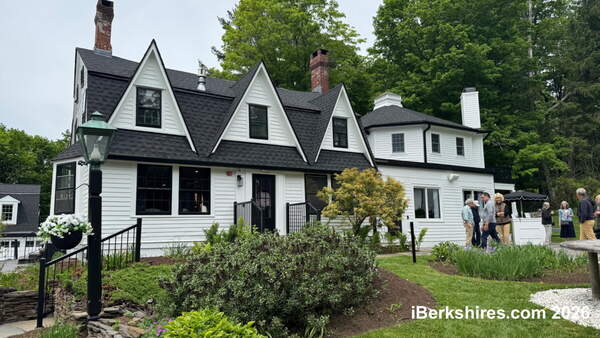
LENOX, Mass. — A new Inn is bringing a boutique-style stay for visitors and locals to enjoy.

Owners, Sullivan Capital LLC, purchased the property, located on 135 Main Street, in 2024. After a year or renovations, Garden Gables Inn is open for business. 

"Garden Gables started off as one of the many Berkshire cottages, 1790 was the date on that, and it's always operated as an inn," said Hospitality Manager Yvonne Walton. "It's just a great gathering place and relaxation spot for people to come and get the feel of Lenox, and just slow down and enjoy the nature and the surrounding area...get culture and art and see some great concerts. I think it'll be a wonderful place, definitely does more of the upper-scale hospitality." 

Owners Niko Giallouis and Eric Sullivan bought the property from the former owner. Sullivan had his eye on Lenox since attending a wedding almost 10 years ago.

"I came to a wedding in Lenox, probably six or seven years ago. Personally, just kind of fell in love with the area, and I guess that's kind of how it got on my radar. So you know from that perspective, as we got into the hotel business out towards an area, it was a place I was kind of monitoring and waiting for the right property to show up."

After purchasing the two underwent a full renovation, a project that cost around $1.5 million. The building, first built in 1780, required some TLC. Sullivan's wife, Jessica, who owns Jessica Sullivan Design, designed the inn.

Sullivan said they installed a new roof, repainted everything, renovated the bathrooms, installed new floors, a new HVAC system, and new plumbing.

"We really touched everything from the outside...I mean, all the aesthetics and layouts changed a bit," he said. "As I said, put about a million and a half into it. All new furniture, fixtures, everything. The design's completely different. It wasn't a full gut, but it was a heavy, heavy renovation."

The two like to collaborate with local businesses, and they make a point to direct visitors to local restaurants, businesses, and attractions.

"If guests are asking for recommendations, our customer service team, our guest services team, will relay that kind of information. Even if we can call and make a reservation for somebody, happy to do it," he said. "We aren't doing breakfast, but what we do is we have partnerships with a lot of the breakfast places downtown. We actually purchase a gift certificates for each person each day, so that they can use that to go downtown."

Sullivan hopes that guests don't see their inn as just a place to sleep and dump their bags, but make it an experience for anyone who stays.

"We really focus on kind of the experience side of things, so again, we want to give you the best experience you can have here...and we want that not just to be the place you put your bag and go do things. It's important to think of everything," he said.

Sullivan said partnerships are important to their business and are a way to connect with locals.

"The local partnerships, I can't stress that enough, because no matter how much and how great the room is, people are still going to want to go do other things," he said. "So, I think it just benefits everybody if we're all working together and so forth, and supporting the community, being neighborly too, because we are surrounded by residential homes...But we really try to put a lot of blood, sweat, and tears, a lot of love into the building, all the details, really care about the senses," Sullivan said.

The Inn's check-in and reservations are completely online. When guests arrive, all they have to do is check in online and receive their code that they will use to enter their room. Sullivan hopes this helps create less stress for guests and gets them to their room as fast as possible, especially after a long trip.

View Full Story

More Lenox Stories